This post was originally published on this site
In her recent op-ed for the Orthodox Observer, “The Holy Land is beyond AI,” Christina Moniodis closes with the observation that sacred sites “endure,” because people are “seeking a lived encounter.” It’s an astute one, and many have remarked similarly about the notable, if modest, increase in young people searching for connection in faith communities. I also share the author’s concerns about artificial intelligence and the way religious practices negotiate with its expanding presence. Indeed, in a public forum like the OO, the piece prepares the ground for an overdue re-examination of the relationship between the sacred and the secular, the precision of language in the public life of the Church, and how our theology can guide the way Orthodox Christians move in the world.
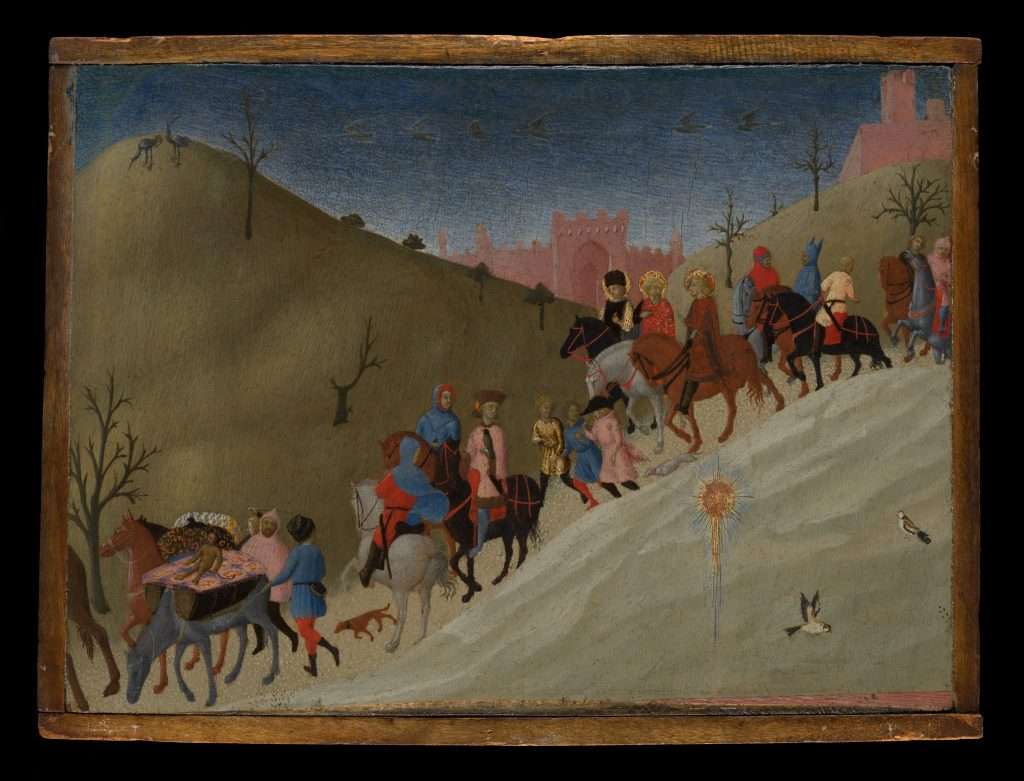
It’s not always clear what we mean when we refer to the Holy Land. Are its boundaries geographical, historical, or cosmological? Moniodis suggests they are marked not only by the biblical history—primarily Christ’s birth, life, passion, and resurrection—but also by “what continues to happen there,” that is, miracles and other spiritual experiences. At the same time, she writes, instability in the Middle East “has placed” the Holy Land “in the crosshairs of conflict.” I am struck, however, by how easily these sacred sites can be displaced, even rhetorically, from their material location and historical life within the broader region.
Though many millenia old, the performance of religious pilgrimage, for example, is intimately tied up with the commercialization of religious sites. After the Six-Day War in 1967, Israeli tourism outreach to U.S., mostly evangelical, Christians increased, though this group already had a vested interest in “Holy Land tours” by the early twentieth century. The occupation of the West Bank soon took on immense political and financial value for both Israelis and evangelicals.[1]
Yes, religious tourism is exactly that, and in the Holy Land, it complements the Israeli state’s destruction of Palestinian communities and the residential and commercial resettlement of their land. The writer Hari Kunzro likewise describes his visit to “The City of David,” or East Jerusalem, whose chic “archaeological branding” defined the boundaries of this sacred site— and provided cover for the displacement of residents in the Palestinian village of Silwan.[2] This is to say nothing of the way Israeli military and AI surveillance technology is tested on Palestinians within the borders of this “sacred geography” before being exported for use by governments around the world. The biblical past and the miracles which may continue to happen on holy sites occur within history, alongside and entwined with other human activity.
In such a landscape, what in or about the Holy Land calls for protection? The traditional Orthodox attunement to the role of architecture, music, and art in the cultivation of the spiritual life makes that very tangible historicity of the Holy Land an integral part of religious experience for local worshippers and pilgrims alike. Certainly, the threat to material structures is ongoing, and in 2023, the Greek Orthodox Patriarch of Jerusalem issued a statement condemning the bombing of the Saint Porphyrios Church in Gaza. Oftentimes, however, calls to protect the holy sites gesture toward something else, perhaps a kind of ineffable experience which may be facilitated by those material remains of the past, but which cannot be “theorized,” as the piece puts it, or rationalized by the latest technical innovations. These are experiences, it would seem, which belong exclusively to this place called the Holy Land and deliver us closer to a world “beyond” this one.
This brings me to my concern about framing the Holy Land as a “frontier to what lies beyond an AI-centered world.” As I have hoped to demonstrate, there is no separation between the sacred and the profane, no supremely sacred space on earth that takes us entirely out of this reality. In fact, I wonder if we do not idolize access to “our sacred inheritance” and miss the point entirely, so much so that we direct our attention precisely to the site of mass crimes against humanity, ethnic cleansing, environmental destruction, and, finally, some of the most advanced projects for the development of AI enhanced weaponry—and call instead for the protection of sacred buildings we claim to be a haven for the legally protected religious tourist seeking escape from an increasingly impersonal world.
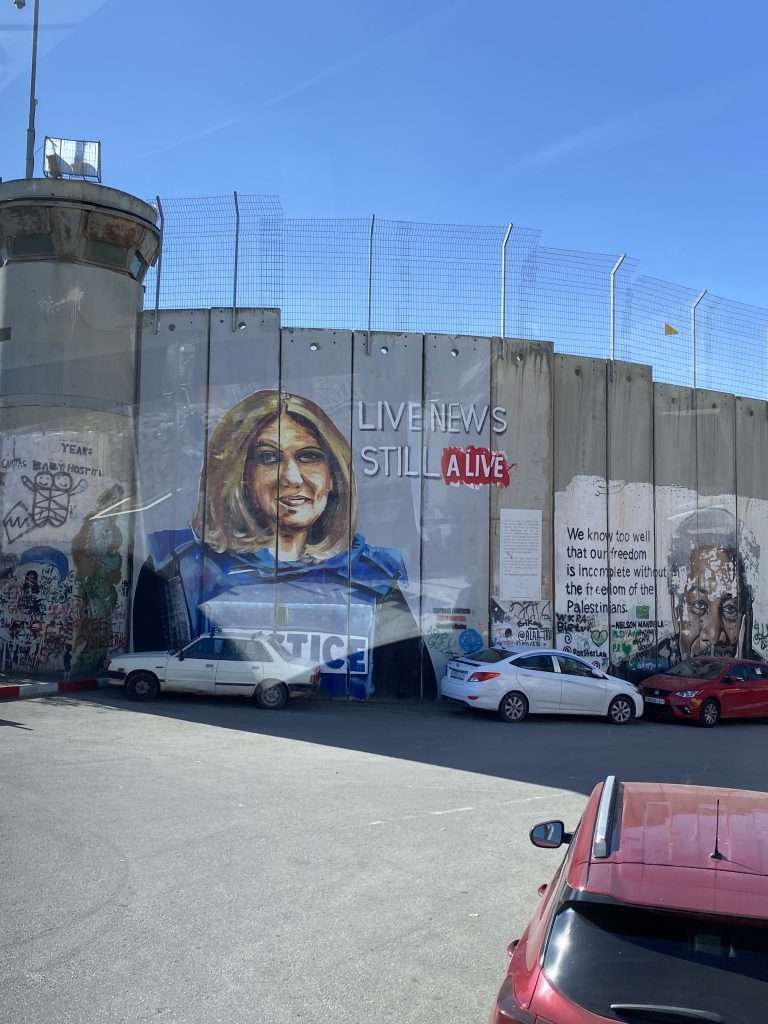
My aim isn’t to launch a litany of “whataboutisms” or take a comparative approach to the diversity of daily struggles we each face. I believe the threat of AI is already here: here in the United States and in the Holy Land, though in ways deadlier for Palestinians, as for countless other targets of state violence, than we as a Church are willing to admit. Nor is my aim to champion the profane over the sacred. There is something special about the Holy Land; I had the blessing of experiencing this myself in 2022 while on assignment for the Greek Orthodox Archdiocese of America. Yet co-mingled with this blessing was the pervasive nausea of passing through checkpoints in the West Bank with the speed of an American religious tourist, and not the deathly slowness of a Palestinian trying to make a living or access medical care on the other side of the wall.
If each of these preceding sentiments still appears at odds with the other, then my intention is to emphasize the inextricability of the sacred and the profane. I press this question: since we cannot escape it, what happens when we lean into this ambiguity? Might there be some continuity between a Divine Liturgy held outdoors for a homeless population in Connecticut and a Holy Friday procession, following three years of devastating war, in the occupied Palestinian Territories? Might not these both example exactly the lived encounters so many seek as the many arms of Silicon Valley stretch all around us?
St. Maximus the Confessor has written about this oneness in the Orthodox cosmology. He understands presumed opposites—like the nave and the sanctuary; the sensible and the intelligible; earth and heaven—as sharing a unified existence: “The universe demonstrates that the whole of each enters into the whole of the other, and both are the same whole.”[3] Maximus draws usefully from Ezekiel’s image of the universe as a “wheel within a wheel,” and this collapse of one realm, or level of reality, into the other (and vice versa) is the key to understanding how the individual person approximates God within the context of the liturgy.[4] And while this movement is searching, progressive, but generally endless, it is not fruitless. Maximus addresses this paradox with some of his own: the harmonious “silence of the inner sanctuaries” of the voice of the divinity, which is nonetheless conjured by the worshiper’s hymns of “many syllables and notes;” the coexistence of the Scripture’s letter, which “passes away,” and the Scripture’s spirit, which “never ceases to exist in that which is hidden in the letter;” the “unseen movement” of the soul itself; the “poor man” as God.[5]
The dichotomy of sacred and profane is an intuitive sort of shorthand for making sense of a life that is always in tension with itself. But even if only rhetorical, and all-too-common, it is a misleading characterization of Orthodox cosmology. At best, it lends itself to vague platitudes about the value of faith in the contemporary world. At worst, it restricts our relational and imaginative capacities and distorts the political consequences of our actions—whether we have set out to “do politics,” or not.
—
1 Melani McAlister, “I Walked Today Where Jesus Walked: Christians and the Future of Israel,” in The Kingdom of God Has No Borders: A Global History of American Evangelicals (Oxford University Press, 2018).
2 Ibid.
3 Ibid.
4 Harry Kunzro, “High Places,” in Kingdom of Olive and Ash: Writers Confront the Occupation, ed. Ayelet Waldman and Michael Chabon (Harper Perennial, 2017).
5 Maximus the Confessor, On the Ecclesiastical Mystagogy, ed. and trans. by Jonathan J. Armstrong, (Yonkers, NY: St Vladimir’s Seminary Press, 2019), 56. (Emphasis mine.)
6 Ibid. 57, 55.
The post Opinion | Response to ‘The Holy Land is beyond AI’ appeared first on Orthodox Observer.