This post was originally published on this site
The great classical scholar Adamantios Korais might well be thought of as the Greek Thomas Jefferson. Like Thomas Jefferson—the author of the Declaration of Independence, the most influential of the founders of the American republic, and the country’s third president—Adamantios Korais—the architect of the intellectual foundations of the Greek struggle for independence, sometimes referred to as the “Teacher of the Nation”—was a revolutionary who believed that nations were entitled to independence and self-rule, just as individuals were entitled to liberty and inalienable rights. Like Jefferson, Korais worked to establish the social and political ideals of the Enlightenment in his emerging nation. Both of these men were the veritable authors of their respective nation’s respective revolutions. It is a testament to their remarkably similar, vital roles in the lives of their respective nations that circumstances would bring these two men together to form a connection which would have lasting significance for both America and Greece.
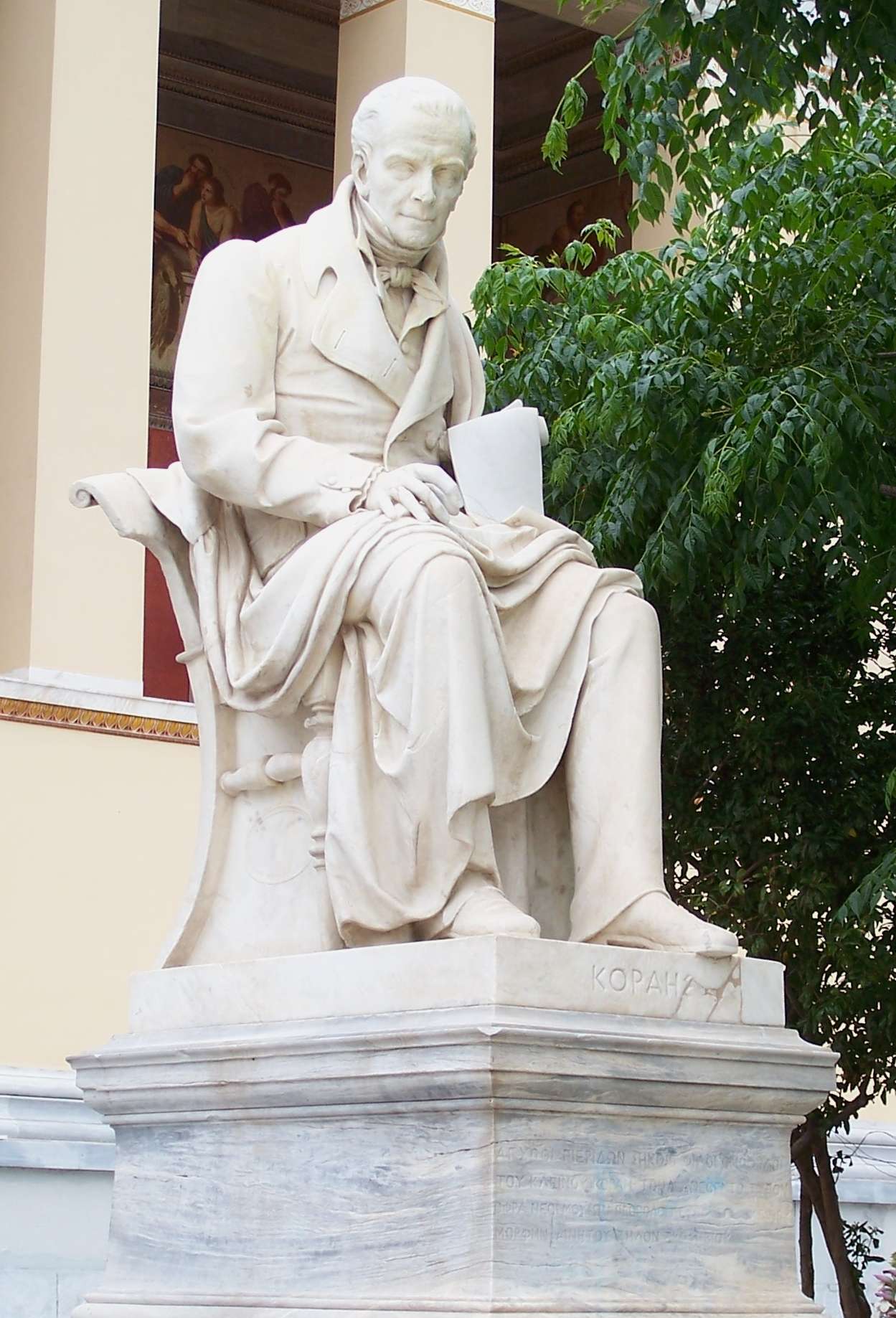
Korais was born in Asia Minor’s great historic Greek port city of Smyrna in 1748, five years after Jefferson was born in Virginia. Adamantios was born to Ioannis Korais, a Chiot by origin and leading Smyrniot entrepreneur, and Thomaida Rysia, a native Smyrniot and daughter of Adamantios Rysios, a wealthy businessman and devotee of Greek letters. At a very early age, Adamantios showed signs of genius and an insatiable love of learning which were encouraged by his parents. Although Ioannis Korais, like most Greeks living under Ottoman rule, had been deprived of an education, he was an avid admirer of learning and eagerly provided Adamantios with the resources for formal schooling and private teachers. The most influential of these teachers was a Dutch pastor, Bernhard Keun, who taught Adamantios Latin and Dutch, while Adamantios also began his eventual mastery of English, French, Hebrew, and Italian. Adamantios also benefited significantly from the legacy of his maternal grandfather, whose rare, personal library became a treasure trove for Korais’ intellectual curiosity.
As a young man, Korais worked alongside his father in their family’s silk business, but he soon found commercial life unsatisfying, intruding as it did on his true love—study. Nonetheless, in 1772, at the age of 24, Adamantios was sent by his father to establish a branch of the family business in Amsterdam, the then preeminent center of international commerce and trade. The next six years Korais spent in Amsterdam changed his life forever.
When he was not engaged in trade, Korais immersed himself in the vibrant intellectual and cultural life of Amsterdam, deepening his studies of languages and philosophy. Korais’ experience of freedom and education in Holland, which stood in stark contrast to the tyranny and ignorance which his countrymen endured under Ottoman rule, bred in him a deep conviction that the Greek people must free themselves from Turkish oppression. Korais also concluded that before the Greeks could liberate themselves from Turkish rule and establish an independent national state, they would have to emancipate themselves through education and moral regeneration. In other words, they would have to eliminate from their cultural life the corrupting Ottoman influences that had penetrated and subverted the Greeks’ lay and especially religious leadership, institutions, and attitudes. Korais saw education, expressed through a revival of the Greeks’ classical heritage, as the means by which a moral, enlightened Greek people should achieve their freedom and return to the fulfillment of their greatness as a nation. In Korais’ view, a moral rejuvenation, predicated upon intellectual reawakening, would have to precede the inevitable political revolution against Turkish tyranny. Only in this way would the Greek people, degraded as they were after centuries of Ottoman occupation, become adequately prepared and equipped to succeed in their goal of creating not only an independent Greek state, but a happy, just, and moral Greek society.
Korais’ ideas and subsequent work were next influenced by his move to France. After repatriating from Amsterdam to Smyrna for four years, Korais, who could no longer tolerate the humiliation of life under Turkish rule, returned to Europe in 1782 and trained as a physician for six years at France’s most prestigious school of medicine, the University of Montpelier. Driven by his boundless intellect, while Korais pursued his medical training, he also resumed his study of languages and philosophy, began publishing scholarly works, and was soon recognized as one of Europe’s leading authorities of classical studies.
In 1788, upon completion of his medical training, Korais settled in Paris. Within a year of his arrival, the French Revolution began, and, instead of a career in medicine, Korais was swept up in the radical political changes which shook France, becoming a man of letters and the preeminent literary harbinger of Greek revolution. Seeing firsthand how the spread of education in France gave birth to the love of liberty, Korais resolved to work to the best of his abilities as a writer and scholar for the education of his fellow Greeks.
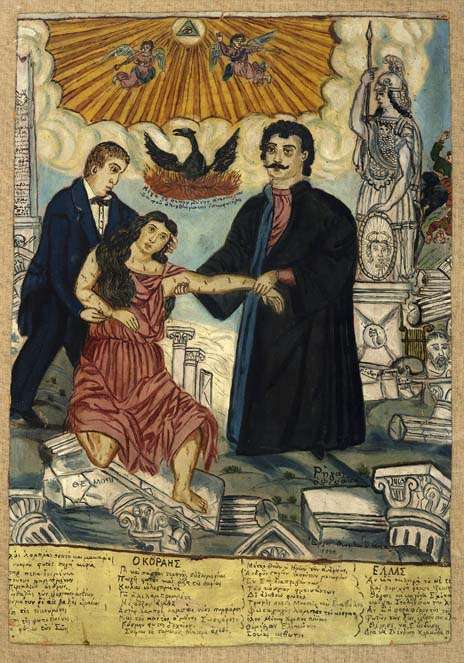
Korais undertook to remake his countrymen, to awaken them to the significance of their heritage, to elevate their cultural and historical knowledge, to prepare them for freedom and self-rule. With the financial support of wealthy diaspora Greeks, the French revolutionary government, and later Napoleon, Korais edited, among other important works, the celebrated “Hellenic Library,” a highly influential series of the classics in Modern Greek translation, published between 1805 and 1827 in sixteen primary volumes and thirteen secondary volumes. After the completion of this colossal project, he published the first Modern Greek dictionary. Korais was one of Europe’s first intellectuals to recognize the crucial connection between a literary language and nationhood. This awareness led Korais to place language at the center of his efforts for Greek enlightenment. Consequently, he was a strong proponent of a standardized written language, “katharevousa,” cleansed of foreign elements, as close to Classical Greek as possible, and balanced between elegance and precision to overcome the parochial divisions and deficiencies of vernacular Greek. Although Korais’ advocacy of “katharevousa” would produce its share of problems, his linguistic innovations would have an enormous and constructive influence on Modern Greek language.
Korais’ efforts were not limited to influencing only his countrymen. He made use of his scholarly connections and the respect that he enjoyed as an accomplished classicist to promote the Greek cause among Western Philhellenes. This fact may explain why Adamantios Korais and Thomas Jefferson met in Paris while the former—Korais—already by that time a renowned classical scholar, was studying medicine in Montpelier, and the latter—Jefferson—was serving as the United States ambassador to France, a post he held from 1784 to 1789.
Jefferson and Korais met in 1785. Little is known about this private encounter or a subsequent meeting and shared dinner, other than the fact that both men attributed their acquaintance to a mutual friend, John Paradise (Ioannis Paradisis). A Greek expatriate entrepreneur with residences in London and Paris, John Paradise, whose wife, Lucy Ludwell Paradise was an American from Jefferson’s native Virginia, enjoyed a close friendship with Thomas Jefferson. This friendship, evidenced in a substantial correspondence of some eighty letters, both delighted and enlightened Jefferson, who learned pronunciation of Modern Greek from Paradise.
Jefferson’s interest in Greek, Classical and Modern, was a life-long fascination. Jefferson’s childhood education imbued him with a deep reverence for Greek language and civilization. Peter Jefferson, Thomas’ father, helped shape his son’s interest in classical studies and Philhellenism. At his father’s encouragement, Thomas, at the age of nine, began studying Greek and Latin. As a Classics student at the College of William and Mary, Jefferson was known to carry his beloved Greek grammar everywhere he went. Jefferson’s admiration of Greek thought and democratic ideas increased as their brilliance and value became more and more evident to him in the years leading to the outbreak of the American Revolution and the Declaration of Independence. Indeed, he viewed Greek philosophy, literature, and history as the foremost sources of moral and political guidance, as matchless practical preparation for good government and civic life.
Although it is impossible to divine with any certainty the content of their conversations in Paris, it is reasonable to posit, given Jefferson’s and Korais’ mutual admiration and common interests, that these two students of Classical Greece, gentlemen of the Enlightenment, and democratic revolutionaries, must have discussed their political and philosophical thoughts about the Greek world. What is clear is that nearly forty years after their first meeting, Jefferson and Korais engaged in a brief, yet weighty, exchange of letters about Greece’s political future.
In the summer of 1823, two years after the start of the Greek Revolution, Korais wrote his first letter, penned in French, which would be followed by two more letters and gifts of books, to Jefferson. Now in his seventies, Korais was too old to join the revolutionaries fighting for independence from the Turks, but he continued to work tirelessly from Paris to raise international awareness of, and support for, the Greek cause. After the provisional revolutionary Greek government turned to Korais for advice, he wrote to Jefferson for his counsel on how best to organize a future Greek state. Korais had great admiration for the establishment of the American republic, which he saw as the closest modern realization of the ancient Greeks’ ideal of democracy, and he regarded his old acquaintance Jefferson as the chief author of the American political miracle. Korais, in his letter, also appealed to Jefferson to lend his public stature and influence for the Greek cause by publicly expressing his political support for the Greek Revolution and urging American intervention on behalf of the Greeks.
Jefferson responded to Korais in the fall of 1823. In a letter written in English and dated October 31, Jefferson propounded that although the world owed Greece an eternal debt of gratitude, and despite Americans’ great sympathy for the Greeks’ struggle, the United States government could not interfere in European affairs. Expressing both support for the Greek cause of liberty and restraint against direct involvement in the Greek revolt, Jefferson wrote the following:
“No people sympathize more feelingly than ours with the sufferings of your countrymen, none offer more sincere and ardent prayers to heaven for their success, and nothing indeed but the fundamental principles of our government never to entangle us with Europe could restrain our generous youth from taking some part in this holy cause. Possessing ourselves the combined blessings of liberty and order, we wish the same to other countries and to none more than yours, which, the first of civilized nations, presented examples of what man should be.”
In the same letter, Jefferson discussed in considerable length the central principles of the American constitution and the organization and function of the federal and state systems, emphasizing the importance of the separation and balance of powers across government.
Albeit earnest, there was considerable irony in Jefferson’s sage exhortations. After all, Jefferson’s basic premises of government were essentially modern adaptations of ancient Greek principles that Korais knew well and had, in fact, elaborated on in his introduction to Aristotle’s “Ethics,” one of the volumes in the “Hellenic Library” series, a copy of which was sent to Monticello with Korais’ first letter. It should not surprise us that Jefferson, immersed throughout his life in classical studies was deeply influenced by Greek thought, which he looked to for practical political guidance and statecraft. Despite the conventional view that Jefferson was influenced primarily by Enlightenment thinkers such as Diderot, Rousseau, and Voltaire, his writings do not contain a single quotation from these French writers. Instead, his writings emphasize and draw extensively from Greek philosophers. Jefferson’s seemingly original, seismic concept of the pursuit of happiness, for instance, which in the Declaration of Independence he identified as a fundamental, unalienable human right, is merely a reflection of Epicurean philosophy tempered by Aristotle’s earlier writings, not a modern American innovation, but an ancient Greek idea.
Nevertheless, Jefferson’s commentaries on American constitutional democracy had a profound influence on Korais’ thinking, affirming by practical example his already well-formed political ideals. Jefferson’s specific observations on rule of law, representational government, restraint of state power, fundamental rights, individual liberty, and other lessons from American democracy were clearly evident in Korais’ subsequent writings. Korais’ commanding presence as the Greek Revolution’s preeminent intellectual ensured that his ideas would not be ignored as Greece’s emerging new order took shape. Indeed, through Korais’ influence many of the principles of American democracy were enunciated in the Greek Constitution of 1827, a document of magisterial scope and conceptual brilliance.
In 1976, concurrent with the bicentennial of the American Declaration of Independence and the approaching 150th anniversary of the Greek Constitution of 1827, Professor Andrew S. Horton of George Mason University observed the following about Jefferson, Korais, and the American and Greek Constitutions:
“Had Jefferson lived another year he would have seen the realization of his desire to be of help to the Greek constitutional committees. Korais’ influence on many of the members of these committees was quite strong. That he often urged the delegates to study Jefferson’s ideas and the American constitutions was not empty praise for a distant acquaintance. The direct triumph of many of Jefferson’s (and therefore America’s) principles was the Greek Constitution of 1827.
This most liberal…constitution affirms the right of democratic sovereignty and the creation of a legislature independent of the executive but elected by the people. The Bill of Rights, closely modelled on the American document, guaranteed all of the familiar rights suggested by Jefferson as well as the illegality of slavery and nobility.”
Albeit exemplary, the 1827 Constitution was never fully implemented before it was suspended by President Ioannis Capodistrias. Because of the breakdown of Greek society into violent factionalism and chaos in the midst of the Revolution, Capodistrias was forced to suspend the Constitution—events which seemed to confirm Korais’ fears that a political revolution would not secure the Greeks’ aspirations if it were not preceded by a cultural and moral revival sufficient to produce mature political leadership and a far-sighted citizenry. Moreover, the European Great Powers, who presided over the formalization of Greece’s independence in 1832, were hostile to democracy, imposed a foreign monarchy on newly independent Greece, and in so doing crushed any possibility of restoring the 1827 Constitution.
Unlike his friend Jefferson, Korais lived long enough to see the liberation of a small part of the Greek world from the Turks, and he also lived long enough to see the enormous difficulties that the newly independent state faced, not the least of which was an absolutist monarchy unrestrained by a national constitution. Nonetheless, the importance of the 1827 document was not erased. The political principles and philosophical concepts advanced by both Jefferson and Korais, manifested in the 1827 Constitution, would continue to resonate with, if not always be practiced by, Korais’ countrymen long after his death in 1833.
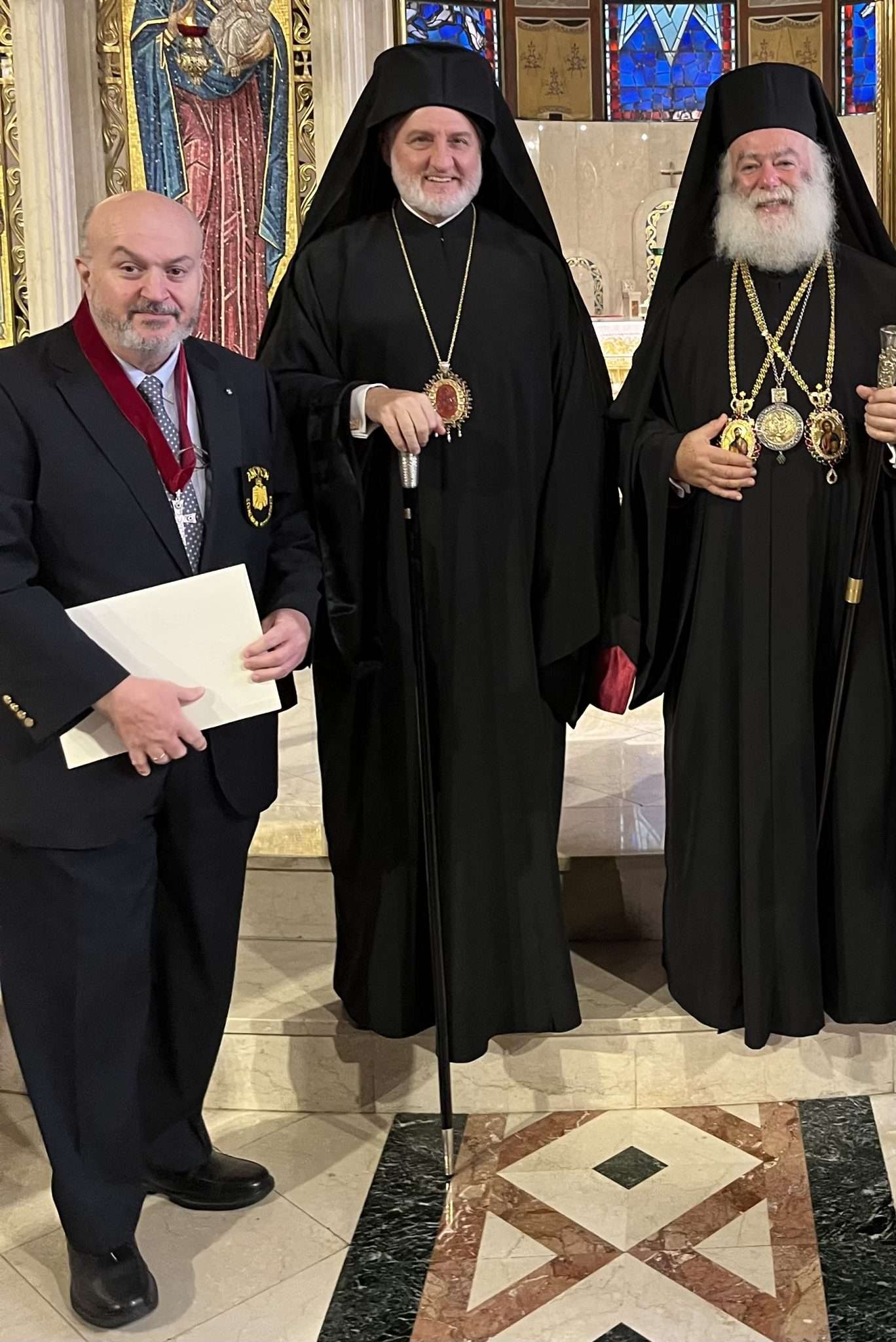
Dr. Alexandros K. Kyrou is an Archon of the Ecumenical Patriarchate and Professor of History at Salem State University, in Salem, Massachusetts, where he teaches on the Balkans, Byzantium, and the Ottoman Empire. He has authored multiple book chapters, journal articles, and review essays that focus on famine relief in Axis-occupied Greece, Greek America and Balkan Diasporas, Orthodox Christianity and the origins of international humanitarianism, war and peace in Byzantium, and US foreign policy in Southeastern Europe.
The post The revolutionary fathers of two nations: Adamantios Korais and Thomas Jefferson appeared first on Orthodox Observer.