This post was originally published on this site
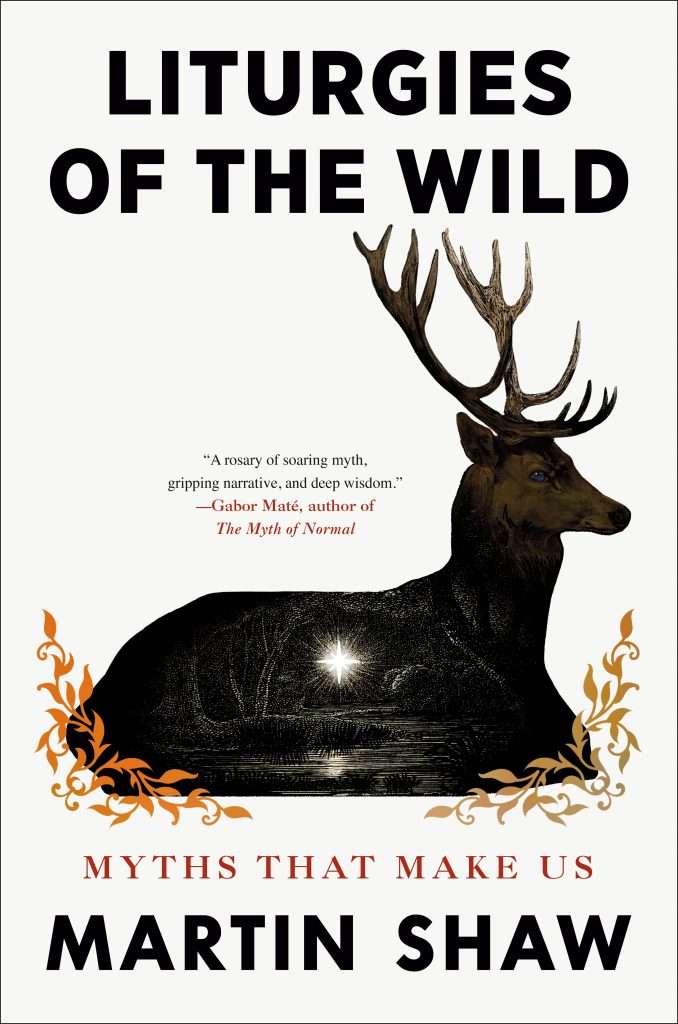
Liturgies of the Wild: Myths That Make Us (Sentinel, 2026) is a superbly breezy yet broad-ranging book by popular mythographer and Orthodox Christian thinker, Martin Shaw. Promising to furnish readers with “stories and ideas to assist the experience of really being a human,” it succeeds in offering a vision of myth as lived wisdom rather than abstraction.
Shaw has spent decades writing, teaching, and leading wilderness vigils. He recently converted to Eastern Orthodox Christianity after a 101-day stint in a Dartmoor forest, bringing his longstanding engagement with myth into renewed theological focus. His expertise in the realm of myth and aptitude in the art of storytelling draw upon an unconventional life as much shaped by direct encounter with the landscape and his time as a punk rock musician as by scholarship and literature.
Liturgies of the Wild consists of thirteen thematic forays into the basic rhythms and realities of human life. Chapter titles run the gamut from “On Envy” and “On Evil” to “On Passion” and “On Praise Making.” Shaw is at his best when he illuminates spiritual questions through images drawn from folklore, scripture, and lived experience.
Much to his credit, Shaw avoids the excesses of vague or romantic spiritualization. He employs myth not so much to direct the modern reader’s attention toward the spectacular but rather the specific, ordinary, everyday meaning(s) which await personal disclosure through a clear-sighted encounter with the past.
The Orthodox Observer had the opportunity to ask Shaw a few questions about his new book, his journey to Orthodox Christianity, and the integral role myth plays in lending structure to the everyday activities, joys, and sorrows of life.
—
Tell us about your conversion to Eastern Orthodoxy, and its contribution to Liturgies of the Wild.
Although it may not seem immediately obvious, the influence of Orthodoxy is everywhere in the book. The emphasis on mystery, discipline and wonder is infused in my experience of the church. During my time as catechumen it was like coming home, so familiar yet fresh was the adventure of entering Orthodoxy.
Who is this book for, and what kinds of insight do you hope readers come away with? Do you expect (or hope?) that Orthodox readers may encounter the work differently than readers of other/no tradition?
The book is for anybody seeking a deeper life. It’s for anyone with interested in the process of becoming more human, and quite what myth has to do with that process.
I would be excited if Orthodox readers round there was to the book. It is in no way a substitute for our faith – not at all – but an invitation to enjoy and learn from myth in the way that Tolkien and C.S. Lewis did. It also hopes to beckon people closer to Orthodox tradition.
How do you feel your training as a mythographer impacts how you encounter biblical texts and/or the Christian tradition in general?
Whilst I’m not a theologian, I have thirty years’ experience of reading and interpreting stories – at a doctorate level for the last fifteen. It’s important to state that I take the gospel accounts literally. I believe these things actually happened. At the same time that doesn’t discount the enormous symbolic and metaphorical implications of Christs life and message. The poetics of it. I would have a storytellers instinct for describing those tales as vividly as I can. However, I would have no interest in putting a ‘spin’ on them to appeal to modern polemics. I would be quiet and try to bear witness to what the Holy Spirit is communicating.
In your book, you describe your first experience of the Divine Liturgy as one at which “absolutely everything changes” (18). What moment or aspect of the liturgy do you find most moving? Has this answer changed after your reception into the Orthodox Church?
In the west I experienced a very extroverted brand of Christianity. The services seemed led by sermons not Liturgy. In Orthodoxy so much scripture is provided in singing, image and a great infusion of beauty. But not beauty for it’s own sake but to honor the meeting of heaven and earth that the Liturgy is. In Orthodoxy I find access to my deep interior, to my soul. As a younger man I could only locate that in forests and by the ocean, to locate it in church is a source of tremendous, unexpected joy.
Initiation implies the presence of a community, an organic web of rites and relationships (ex. a priest baptizes an infant, represented by a godparent, in the presence of the church). How else does the Orthodox faith “initiate” us into new forms of community and communion, both seen and unseen?
Part of the initiation is physical – the prostrations, the fasting, the praying. Orthodoxy is right there in the body. Also the initiation into the body of the church. You aren’t alone but surrounded by your fellow worshippers and a great cloud of saints. You are no longer alone but gathered in. And all of this contributes to the greatest initiation of all, to slowly fall into the mind of Christ.
Who are some of your favorite saints, and why? How does one “become a saint” (225)?
I’d have a great love for the Celtic saint St Petroc. Both mystical and practical, he founded many communities in my homeland of Devon. It was said he travelled with a wolf and once froze a king who was intending to slaughter a doe who took refuge with Petroc. The king repented and became a Christian. I love the balance of pragmaticism and mystery. I would aim in that direction, though often fail.
Immediately after Jesus was baptized in the River Jordan by John the Baptist, we are told that “He was led up by the Spirit into the wilderness to be tempted by the devil” (Matthew 4:1). Having read your book, the profoundly “mythic” character of this early episode in Jesus’ life and ministry is hard to ignore. Where else in Scripture do you see this mythic pattern of “severance, threshold, and return” occur, and how might we discover it in our own spiritual journeys?
I see it all the time: the story of Elijah and the ravens, Job in his duress, Joseph in prison in Egypt, Naomi walking back from the Moabites. There are many Biblical stories like that. Liturgies encourages us to take the roughage of our own stories equally seriously.
When speaking of your 101-day vigil in the Dartmoor forest, during which you were led to Christ, you reference being given a “much bigger dream” with which to return (164). How would you characterize this dream? How is Christianity shaping your new vision?
I would see this dream as partially to encourage a generation of Christian storytellers, to tell the stories orally round fires and at coffee mornings, not always chapter and verse in church. See how they illuminate their meaning in the telling themselves. Every Divine Liturgy deepens my journey. Every time I open the Bible it seems to be speaking directly to me. Often uncomfortably, but sometimes with immeasurable tenderness. God is the greatest storyteller of all, and we seek to imitate him, so we should tell more stories! Onwards.
The post From forest vigils to the Divine Liturgy: Martin Shaw on myth and Christianity appeared first on Orthodox Observer.