
This post was originally published on this site
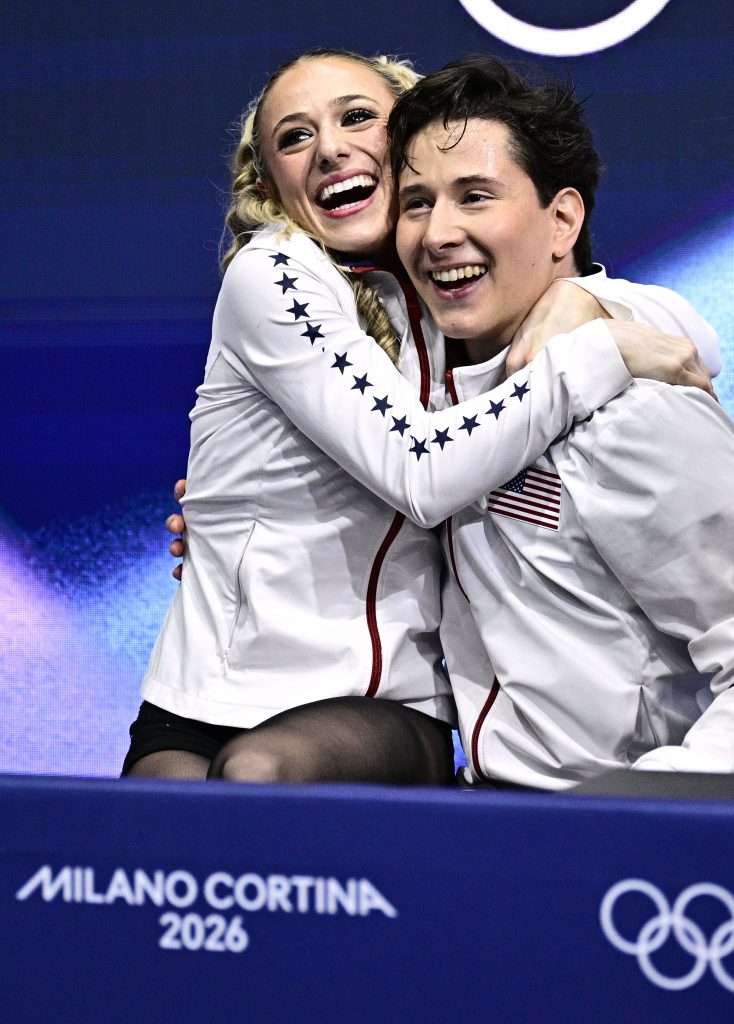
Though Emilea Zingas and Vadym Kolesnik grew up worlds apart in their respective hometowns of Grosse Pointe Farms, Michigan and Kharkiv, Ukraine, the two were nevertheless raised in the same Eastern Orthodox Christian faith. Now Olympic ice dance partners, they find their shared faith gives them what Vadym calls a “special bond.”
Vadym describes his Ukrainian Orthodox family as “very religious,” treating each Sunday’s Divine Liturgy as a special event. When he moved to the U.S. at age 15, he struggled with the loss of this community–but in Emilea, he found not only an athletic match, but a companion in faith.
“When I finally met Emi, I found my perfect partner,” Vadym says.
Emilea’s father is from Cyprus, and instilled the Greek Orthodox faith in his children from the time they were young. When she and Vadym met, they found their Orthodox faith created a shared sense of identity that helped them connect quickly.
“I didn’t know much about Ukrainian culture at all before I met Vadym, but actually the traditions are quite similar,” Emilea says. “Our cultures are pretty similar, and obviously the faith is identical.”
Now, the two attend Orthodox services together, and find support in their parish. “Our entire community really backs him up, backs me up, and they support us equally,” Emilea says.
“It’s just been so special for me to share this with my skating partner, because there’s not a lot of religious people in sports and in skating,” Vadym says.
Over just four seasons competing together, Emilea and Vadym have experienced a rapid rise through the ranks, most recently placing 5th at the 2026 Winter Olympics in Milano Cortina and winning bronze at the 2026 World Figure Skating Championships.
Such a sharp trajectory hasn’t been without its challenges, however. Emilea competed as a singles skater before transitioning to ice dance with Vadym, and experienced a period of severe self-doubt regarding her ability to hold her own as a partner.
“I care about Vadym so much, and I want him to have success just as much as I have success,” Emilea says. “I had to step away for a second and think about why I’m doing this and why I’m dedicating my life to skating … We do this because we love it and not because we have to or we’re forced to. It’s a choice.”
Equally crucial, Emilea says, was remembering figure skating is not her be-all, end-all. “There are definitely bigger things in life than figure skating,” she says. “It’s just a sport, it’s just a competition.”
Her partner shares the sentiment. “Skating is important, but there are more important things in your life–like family,” Vadym says. “That’s what always comes first.”
For Vadym, this perspective is shaped by immigration, war, and the ache of separation. He immigrated to the U.S. alone as a teenager, and though his mother now resides with him in Michigan, the rest of his family remains in Ukraine–a distance Russia’s invasion has made all the more painful.
Kharkiv, Vadym’s hometown, has been a major target since the beginning of the war; Vadym’s brother enlisted in the Ukrainian army, and the family has suffered injuries and the loss of both homes and businesses. But throughout this challenge, Vadym has found sustenance in his faith.
“They suffered–they lost houses, they’ve been injured under the bombs–but they didn’t lose their lives and they didn’t lose their limbs. They’re still alive,” Vadym says. “And I think this is hugely because I’m praying almost every day for my family’s safety.”
This faith, he adds, follows him into competition. “I always go pray for my competitors, pray for me. My mom does it too—she puts a candle every time I compete.”
Emilea, too, finds something sacred in the sport.
“One of the reasons that I love skating is because it feels quite otherworldly when I skate,” Emilea says. “It’s almost like I have a relationship with God through skating because I feel like I’m on a different plane when I’m on the ice.”
Both Emilea and Vadym bring the fullness of their respective identities to the world stage, representing themselves simultaneously as American, Cypriot, and Ukrainian; as athletes, students, and Christians. For them, these identities do not compete, but rather compound.
“I was a normal American teenager,” Emilea says. “But then we speak Greek at home, we cook Greek food all the time.” Vadym likewise carries his origins with him wherever he goes. “I think that my heritage, coming from Ukraine, brings something special into our American career,” he says. “This is an American dream coming true. But also, I think the different mentality that I had coming from Ukraine helped me a lot in succeeding in the U.S.”
This multifaceted cultural identity turns out to be something they share with their teammates.
“The U.S. Figure Skating Olympic team was primarily composed of children of immigrants or second-generation Americans,” Emilea says. “I think that’s really special to see, because that’s what America is made up of. In all honesty, everybody came from somewhere for the most part. We just embrace that a little bit more heavily than other people.”
For Emilea, her Cypriot heritage gave her the framework needed for this acceptance. “The way I was brought up, the way I was raised, and all of the things we celebrate as Orthodox people and as Cypriot people … focus a lot on the collective and are more about your family rather than yourself,” she says.
When she and her family met Vadym, this value system made his story feel immediately familiar. “Vadym’s experience going through U.S. immigration, coming here, learning the language—it’s actually very similar to what members of my family did,” Emilea says. “We connected on that, and he connected with my family on that, and I think it just created a special bond.”
This shared experience—of navigating different identities, of carrying multiple cultures at once—is at the core of their partnership, and reflects the story they wish to tell through their career.
“To represent the coming together of two different cultures–it can be something beautiful,” Emilea says. “You don’t have to be one or the other. You can be all things, and you can still achieve your dreams.”
With the 2030 Olympics already in Emilea and Vadym’s sights, these dreams are just beginning. When asked what kind of people they hope to be when they reach the next Olympic stage, the two share priorities that extend beyond the ice.
“Hopefully by then I’ve graduated college,” Emilea says with a laugh. “It’s taking me way longer than I thought it would. It’s really hard to stay in school when we travel so much.” Beyond that milestone, she hopes for financial independence, stability, and above all, a preservation of the joy that’s defined the early years of she and Vadym’s partnership.
“I really hope we still love skating and we still take every single day with enjoyment, because that’s how we are now,” Emilea says. “I think if we can carry that light and that fun that we have … I think we can only grow and go up from here.”
For Vadym, the goal is more communal. “I just hope I’m going to set a good example for younger kids getting into figure skating–just show them the right way and what’s good,” he says.”
This sense of responsibility to the next generation also shapes the messages Emilea and Vadym offer to young skaters.
“I think skating is a really special sport, and I think more people should try it,” Emilea says. “Figure skating, and ice dance specifically, is a great combination of artistry and athleticism … And there’s not very many sports where you can share your goals and dreams and success with just one other person and create this special kind of bond.”
She also speaks directly to any young athlete weathering self-doubt. “Take a step back, gain some perspective, think deeply about why you love what you do,” Emilea says. “If you still love it, go from a place of enjoyment rather than being forced to do something. Always choose what you’re passionate about and do what you truly want to do.”
“I always felt that if God was giving you a talent, you should continue with it, develop it, and enjoy your time on this earth,” Vadym echoes.
Vadym’s words speak to the faith that’s been with him and Emilea since the beginning of their careers–present in Sunday liturgies and pre-competition candles, in the otherworldly feeling Emilea chases each time she steps on the ice, and in the prayers Vadym offers for war-torn Kharkiv.
“God’s been with me in my best and worst times,” Vadym says. For the two young skaters, this presence may be the most significant partner of all.
The post Orthodox figure skaters find faith on and off the ice appeared first on Orthodox Observer.