This post was originally published on this site
The Russian invasion of Ukraine has exposed a profound crisis in Orthodox Christian theology: the relationship between the Church, the state, and the moral responsibilities of Christian leadership in times of war. Although Orthodox history includes different models of cooperation between ecclesiastical and political authorities, the Church’s relationship with the state cannot be reduced to unconditional support for political power. The war in Ukraine raises a particularly urgent question: what happens when religious language and ecclesiastical authority are used to legitimize a state’s military ambitions?
The position adopted by the Moscow Patriarchate under Patriarch Kirill makes this question especially significant. Its response to the war must be considered alongside its rejection of Ukrainian ecclesiastical independence and its broader understanding of Russian civilization, historical identity, and the Church’s relationship with the state.
Ukrainian Autocephaly and the Crisis of Ecclesiastical Unity
In January 2019, the Ecumenical Patriarchate of Constantinople granted a Tomos of autocephaly to the Orthodox Church of Ukraine (OCU), establishing its status as an independent, self-governing local Orthodox Church.¹ The decision followed a long-standing dispute over ecclesiastical jurisdiction in Ukraine. The Moscow Patriarchate rejected Constantinople’s actions, maintaining that Ukraine belonged to its canonical territory. In October 2018, before the Tomos was issued, the Russian Orthodox Church announced its decision to break Eucharistic communion with the Ecumenical Patriarchate.²
The canonical dispute is complex, and the competing ecclesiological arguments should not be confused with a direct explanation of the subsequent invasion. Nevertheless, the rejection of Ukrainian autocephaly has become part of a wider struggle over Ukraine’s historical and cultural identity. From the perspective of the Ecumenical Patriarchate, the Ukrainian question concerns not only jurisdiction but also the right of a local Church to exercise ecclesiastical self-government. In the Moscow Patriarchate’s interpretation, by contrast, the assertion of Ukrainian ecclesiastical independence challenges its understanding of the historical unity of the Orthodox world associated with Russia.
This conflict becomes especially consequential when ecclesiastical jurisdiction is linked to geopolitical claims. The Church’s spiritual and canonical boundaries risk becoming instruments for asserting the political unity of territories whose populations have their own national identities and aspirations.
Religious Language and the Legitimation of War
The relationship between the Moscow Patriarchate and the Russian state has become increasingly visible in the religious language used to interpret the war. In public discourse, Patriarch Kirill has situated the conflict within a broader narrative concerning Russia’s historical mission, moral identity, and spiritual confrontation with the contemporary West. Such language does more than express political preferences: it can place political conflict within a framework of religious meaning, making opposition to state policy appear to be opposition to a sacred historical community.
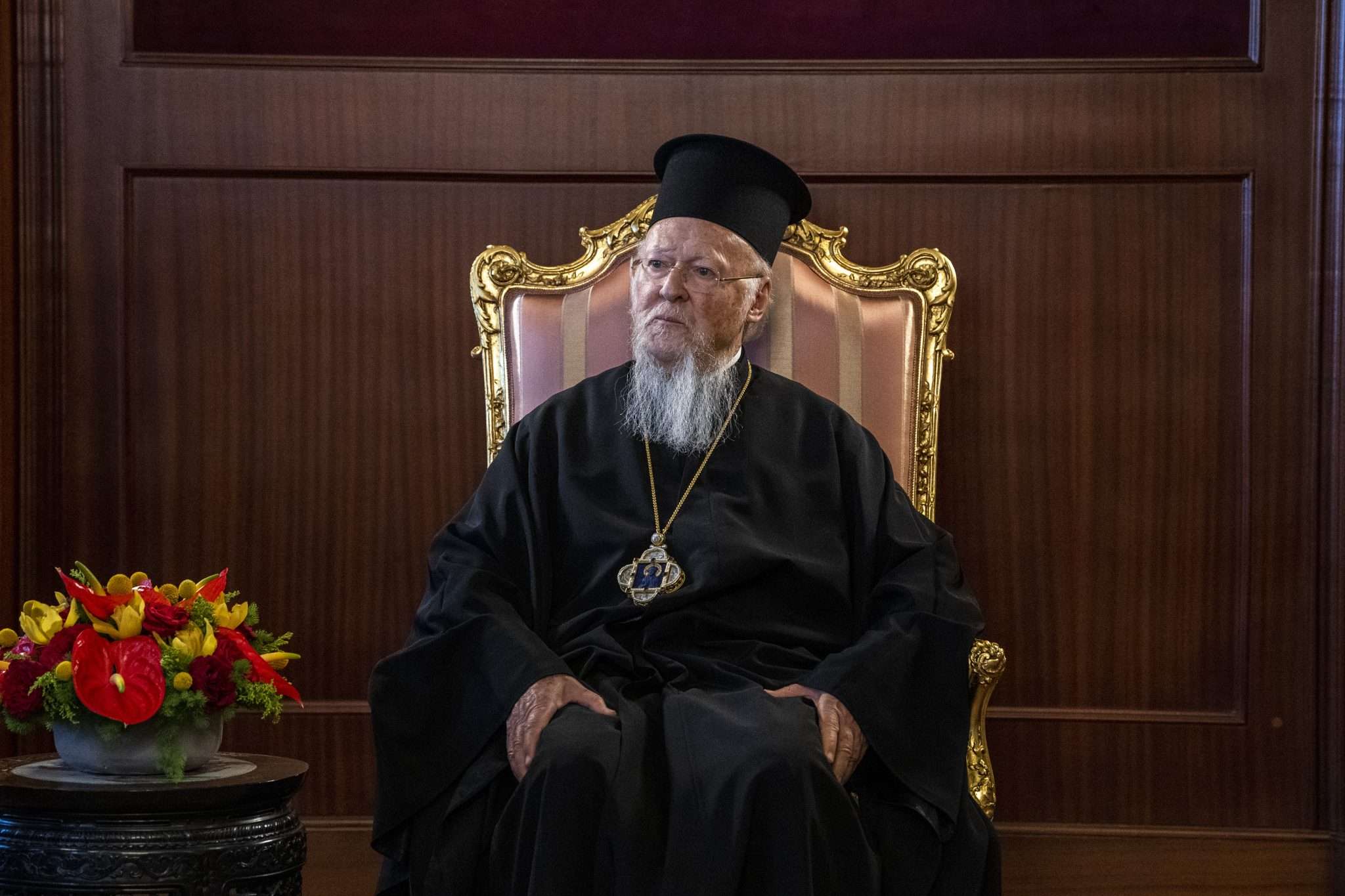
In a March 2023 address on the response of Churches and religious communities to war and conflict, Ecumenical Patriarch Bartholomew explicitly criticized the instrumentalization of religion for geopolitical purposes. He identified the ideology of Russkiy Mir (“Russian World”) as a principal instrument for the “spiritual” legitimation of the invasion of Ukraine.³ His criticism identifies a fundamental theological problem: the transformation of a particular national and geopolitical project into an allegedly sacred mission.
Academic research supports a careful version of this argument. Vebjørn L. Horsfjord’s study of Patriarch Kirill’s sermons and speeches during the first year of the full-scale war finds that explicit expressions of support for the war were relatively rare, while the historical narratives employed in his discourse helped construct a worldview in which the conflict could be understood as necessary or legitimate.⁴ A separate study by Marcin Składanowski, Andrzej Szabaciuk, and Agnieszka Łukasik-Turecka examines the role of Patriarch Kirill’s discourse in Russian propaganda and disinformation, arguing that the Moscow Patriarchate became an important part of the broader system through which the Russian state presented and justified its aggression.⁵
These findings suggest that ecclesiastical legitimation does not depend exclusively on direct endorsements of military action. It may also operate through historical narratives, moral binaries, selective interpretations of identity, and claims that a nation is engaged in a civilizational or spiritual struggle.
The Ecclesial Feedback Loop of War Propaganda
To understand the relationship between ecclesiastical discourse and political power in this case, I propose the concept of an “ecclesial feedback loop of war propaganda.” This concept describes a mutually reinforcing relationship among three processes.
First, the rejection of Ukrainian autocephaly weakens the ecclesiastical recognition of a distinct Ukrainian religious identity within the framework defended by Moscow. Second, the ideology of Russkiy Mir and related appeals to Holy Rus situate Russian statehood within a larger historical and spiritual community, potentially blurring the distinction between Russian national interests and the universal mission of Orthodoxy. Third, religious interpretations of the war can provide moral and spiritual legitimacy to the state’s actions, presenting the conflict as part of a struggle over civilizational values rather than simply an act of military aggression.
The relationship is a feedback loop because each element can reinforce the others. The denial of Ukrainian ecclesiastical independence supports a narrative of historical unity; that narrative can be mobilized to frame Russian political claims as guardianship of a shared spiritual inheritance; and religious legitimation of the war, in turn, can reinforce the rejection of Ukrainian independence as a threat to that inheritance.
This analytical framework does not mean that the canonical dispute alone caused the invasion, nor does it imply that all Russian Orthodox clergy or faithful endorse the war. It identifies instead a mechanism through which ecclesiastical claims and political narratives can mutually reinforce one another. The Church’s institutional authority becomes especially vulnerable when its language of unity is used to diminish the agency of another people or to justify violence against them.
Recovering the Prophetic Freedom of the Church
The crisis in Ukraine invites a broader reconsideration of the Orthodox understanding of symphonia, the ideal of cooperation between Church and state. Historically, the concept has been interpreted in different ways, and it should not be reduced to a simple formula of ecclesiastical submission to political authority. The Church may cooperate with civil authorities for the common good, but such cooperation cannot eliminate its responsibility to speak critically when state power violates human dignity, justice, and peace.
Orthodox ecclesiology, with its emphasis on communion and the Church’s universal character, offers resources for resisting the identification of the Church with any single national or geopolitical project. The Church’s mission transcends state borders. Its unity cannot legitimately be invoked to erase the ecclesiastical agency of other peoples, and its spiritual authority cannot be made conditional upon loyalty to a government.
The war in Ukraine therefore presents Orthodoxy with a test of theological integrity. The challenge is not simply to resolve a jurisdictional dispute or to restore institutional relations. It is to recover the distinction between the Gospel and political ideology, between Christian solidarity and national domination, and between pastoral leadership and the sacralization of state ambitions. Where religious authority becomes a vehicle for war propaganda, the Church risks compromising the very universal mission it is called to serve.
Notes
- Ecumenical Patriarchate, “Patriarchal and Synodal Tomos for the Bestowal of the Ecclesiastical Status of Autocephaly to the Orthodox Church in Ukraine,” January 6, 2019, https://ec-patr.org/en/06/01/15/32/patriarchal-and-synodal-tomos-for-the-bestowal-of-the-ecclesiastical-status-of-autocephaly-to-the-orthodox-church-in-ukraine/.
- Holy Synod of the Russian Orthodox Church, “Statement by the Holy Synod of the Russian Orthodox Church concerning the encroachment of the Patriarchate of Constantinople on the canonical territory of the Russian Church,” October 15, 2018, https://old.mospat.ru/en/2018/10/15/news165263/.
- Ecumenical Patriarch Bartholomew, “Address by His All-Holiness Ecumenical Patriarch Bartholomew at the Seminar ‘Reaction of Churches and Religious Communities to War and Conflict’ (Lithuania, March 22, 2023),” March 22, 2023, https://ec-patr.org/22/03/17/49/address-by-his-all-holiness-ecumenical-patriarch-bartholomew-at-the-seminar-reaction-of-churches-and-religious-communities-to-war-and-conflict-lit/.
- Vebjørn L. Horsfjord, “Patriarch and Patriot: History in Patriarch Kirill’s Sermons in the First Year of the Full-Scale War in Ukraine,” Religion, State & Society52, no. 4 (2024): 367–82, https://doi.org/10.1080/09637494.2024.2353417.
- Marcin Składanowski, Andrzej Szabaciuk, and Agnieszka Łukasik-Turecka, “Church of War: Propaganda and Disinformation in Patriarch Kirill’s Discourse on Russia’s Aggression,” Cogent Arts & Humanities12, no. 1 (2025), article 2515329, https://doi.org/10.1080/23311983.2025.2515329.
- John Meyendorff, Byzantine Theology: Historical Trends and Doctrinal Themes, 2nd ed. (New York: Fordham University Press, 1983)
- John D. Zizioulas, Being as Communion: Studies in Personhood and the Church (Crestwood, NY: St. Vladimir’s Seminary Press, 1985).
The post Opinion | Faith or propaganda? Reflections on the political and ecclesiastical authority appeared first on Orthodox Observer.