This post was originally published on this site
Continuing his Apostolic Visit to the U.S. in Washington, D.C., this evening His All-Holiness Ecumenical Patriarch Bartholomew attended a dinner hosted in his honor by the Honorable Michael J. Rigas, Deputy Secretary of State for Management and Resources.
His All-Holiness issued a pointed warning about the dangers of nationalism in religion, urging instead a renewed global commitment to dialogue, coexistence, and the dignity of every human being.
“As followers of the Lord Jesus Christ, we are called to pursue the kingdom of God, not any kingdom of man, no matter how inviting,” the Ecumenical Patriarch told an audience of ambassadors, diplomats, clergy, and U.S. officials. His remarks positioned the Ecumenical Patriarchate as a transnational, spiritual institution standing above political boundaries and national rivalries.
His All-Holiness acknowledged that many Orthodox churches are structured around national identities, shaped by culture and history. But he was emphatic that the role of the church is not to reinforce nationalism. “Religion was used to consolidate peoples around specific governments, giving coherence to earthly empires, kingdoms and nation-states,” he said. “But has not the human family arrived at a point when such rigid forms of conformity no longer serve the interest of the people?”

His All-Holiness reflected on the persistent entanglements between church and state, warning that while these ties once gave cohesion to empires and nations, they now risk constraining the universal mission of faith.
He tied this warning to the very setting of his remarks, the State Department, saying that diplomacy requires the capacity “to place oneself in another’s condition, to be empathetic and not only sympathetic.” True religion, he argued, should do no less.
“The Orthodox Church does not embrace ethnophilism as a policy, even when some of our sister churches have done so, out of political and even financial expediency,” the Ecumenical Patriarch said. “As Orthodox Christians with a continuous history and memory … we understand the complexity of the relationship between the city of God and the city of man.”
Ecumenical Patriarch Bartholomew emphasized that the task of religious leaders today is to open space for mutual respect, interfaith dialogue, and reconciliation. “The significant contribution of the great religious traditions should be to create fields of mutual respect and understanding,” he said. “All the religions of the world teach the value of every human person. We have been confronted by the need to practice acceptance over rejection.”
Marking the 1700th anniversary of Nicaea, His All-Holiness recalled the creed’s affirmation that Christ is “of the same essence” with the Father, adding that this truth applies to all humanity, whose dignity is equally shared.
His All-Holiness closed by speaking directly to Deputy Secretary of State Rigas, who hosted the event. Noting Rigas’s Greek Orthodox upbringing and his father’s graduation from Holy Cross Greek Orthodox Seminary, His All-Holiness underscored their shared heritage. “You share our awareness that the human family is bound together in a deeper relationship than we might have imagined,” he said. “And in this spirit, we have the key to unlock a happy and fulfilling life for every human being.”
He ended with a blessing: “May God bless you richly, and may God bless America.”
The Ecumenical Patriarch’s remarks followed an extended introduction from Rigas, who praised the Patriarch as both a spiritual leader and a partner in advancing religious freedom. Rigas framed religious liberty as a defining American principle, stretching back to the Pilgrims’ arrival in 1620 and enshrined in the First Amendment. Quoting Jefferson’s Virginia Statute for Religious Freedom, he called it “our first liberty.”
To honor His All-Holiness’s visit, Rigas recounted two stories from Orthodox history. The first was the conversion of Prince Vladimir of Kievan Rus in 988 after emissaries reported the transcendent beauty of Constantinople’s Hagia Sophia. The second highlighted Philip Ludwell III, a colonial Virginian and friend of Benjamin Franklin and George Washington, who in 1738 became the first American convert to Orthodoxy and quietly translated church texts into English.
Rigas then turned to contemporary challenges, noting religious communities facing persecution, displacement, and restrictions on worship across the globe. “Religious liberty is not a privilege, but a universal right,” he said, pledging that the U.S. would remain “steadfast” in confronting threats through diplomacy and international partnerships.

“As the good book says, blessed are the peacemakers,” Rigas concluded, addressing the Ecumenical Patriarch directly. “I look forward to the opportunity to work with you to advance the cause of religious freedom and the cause of peace in the world.”
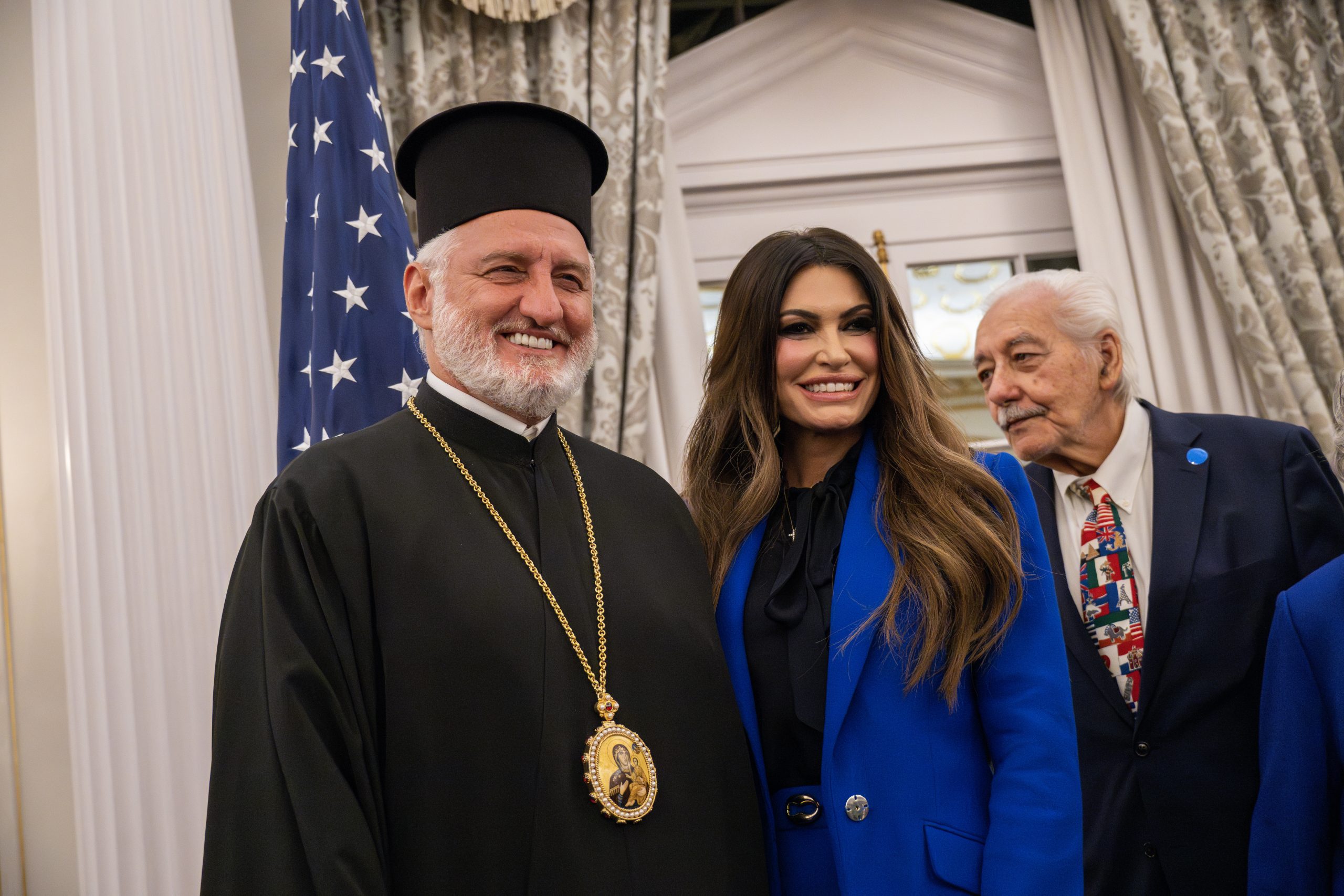
Also attending the U.S. Department of State dinner were Archbishop Elpidophoros and other members of the Patriarchal party; U.S. Metropolitans; Kimberly Guilfoyle, nominee for U.S. Ambassador to Greece; Ambassador of Greece to the U.S. Ekaterini Nassika; Dr. Anthony J. Limberakis, Grand Aktouarios and National Commander of the Archons of the Ecumenical Patriarchate; and additional Greek Orthodox clergy, community leaders, and faithful from the U.S. and abroad.
Photos by Orthodox Observer/Brittainy Newman
The post Ecumenical Patriarch cautions on nationalism, calls for inter-faith dialogue appeared first on Orthodox Observer.