This post was originally published on this site
Saint Nicholas Greek Orthodox Church and National Shrine at the World Trade Center in New York City is a perfect example of an Orthodox ecclesiastical structure, drawing upon Byzantine architectural and iconographic traditions, yet adapted for a particular and specific American context of historic significance.
The rebuilt church at Ground Zero stands as witness to the spirit of rebirth, hope and faith after the devastating attacks on September 11th, 2001. The Shrine’s celebrated architect, Santiago Calatrava, created a modern architectural aesthetic in harmony with the surrounding rebuilt environment of the World Trade Center. Nonetheless, the edifice bears the basic, familiar design of an Orthodox church—that is, an edifice surmounted by a prominent dome. Calatrava himself states that he drew inspiration from mosaic images and architectural elements from the church of Hagia Sophia in Constantinople.
The sacred images of the iconographic program which adorn the interior of the National Shrine were painted by Fr. Loukas, a well-known iconographer and monk of Mount Athos’s Xenophontos Monastery. The Saint Nicholas Shrine is the only church in the United States whose entire iconography is painted by an Athonite monk. Fr. Loukas’ work draws upon the sacred Byzantine visual tradition. A number of the holy images, however, have been adapted to honor the Shrine’s site-specific context and function as both a memorial shrine and a resurrected parish church.[1]
The Image of the Virgin and Child in the Summit of the Apse (Fig. 1):
In Orthodox churches with a centralized, domed architectural plan, an image of the Mother of God or Theotokos is usually placed in the summit of the sanctuary apse. As early as the eighth century, the summit, or conch of the apse, was understood to symbolize the cave of Bethlehem, where Christ was born. Below stands the altar table on which Christ’s Body, the Heavenly Bread, is present in the Eucharist. It is most appropriate that the image of the Theotokos is accorded a prominent place in the sanctuary as she contained in her womb the very Word of God, participating in His Incarnation and thus, the salvation of all.
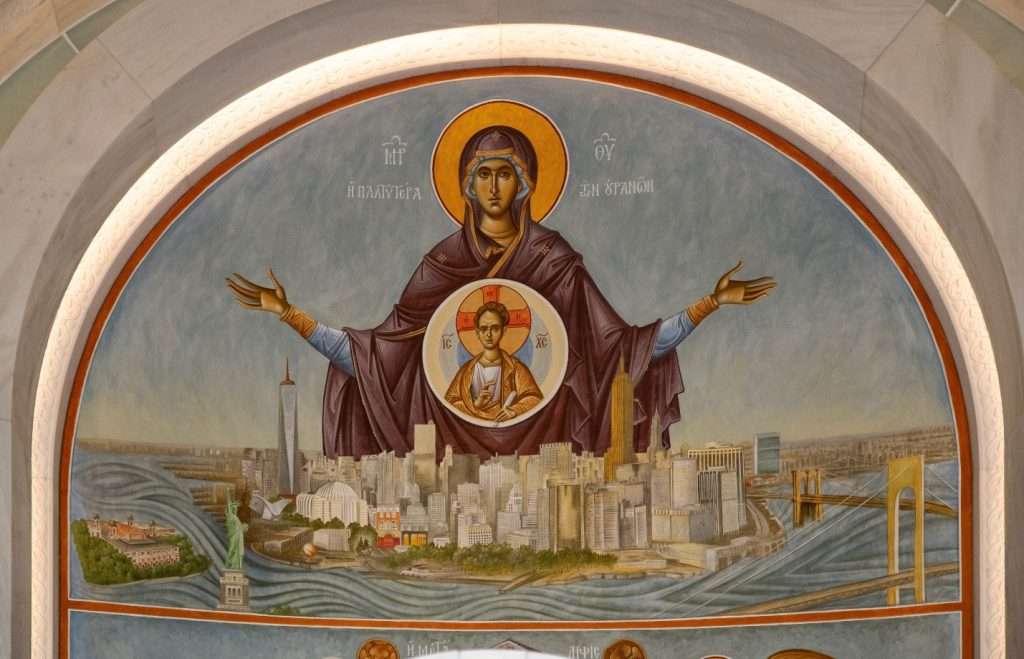
In the Shrine’s example, one finds the image of the Theotokos, half-length, with her arms raised in intercessory prayer, with a medallion of the bust of the Christ Child before her.The Virgin’s maphorion, or veil, is spread out as a protective covering over New York City, alluding to the Virgin Mary’s role as a protectress of cities, particularly in the case of Constantinople where, in the church of the Virgin in Blachernai, the relic of the Virgin’s maphorion was kept, and according to tradition, was carried in procession around the walls of the city during enemy attacks. Here, the image of the Panagia is depicted spreading her protective mantle to safeguard the city of New York which had been so devastated on September 11th. A similar example can be found in the apse of the Church of Saint Andrew in Patras, Greece, which was painted by Yannis Karoussos, a pupil of the renowned twentieth-century iconographer Fotis Kontoglou.
The Image of the Anastasis-Resurrection (Fig. 2):
Among the scenes depicting events from the life of Christ, that of the Anastasis–the Resurrection of Christ–has been adapted to reflect the significant events of the September 11th attacks, but also to offer hope for salvation and eternal life. It appears in the lunette of the south wall of the nave. The central portion of this scene recalls that of the famed fourteenth-century icon in the funerary chapel of the Chora Church in Constantinople.
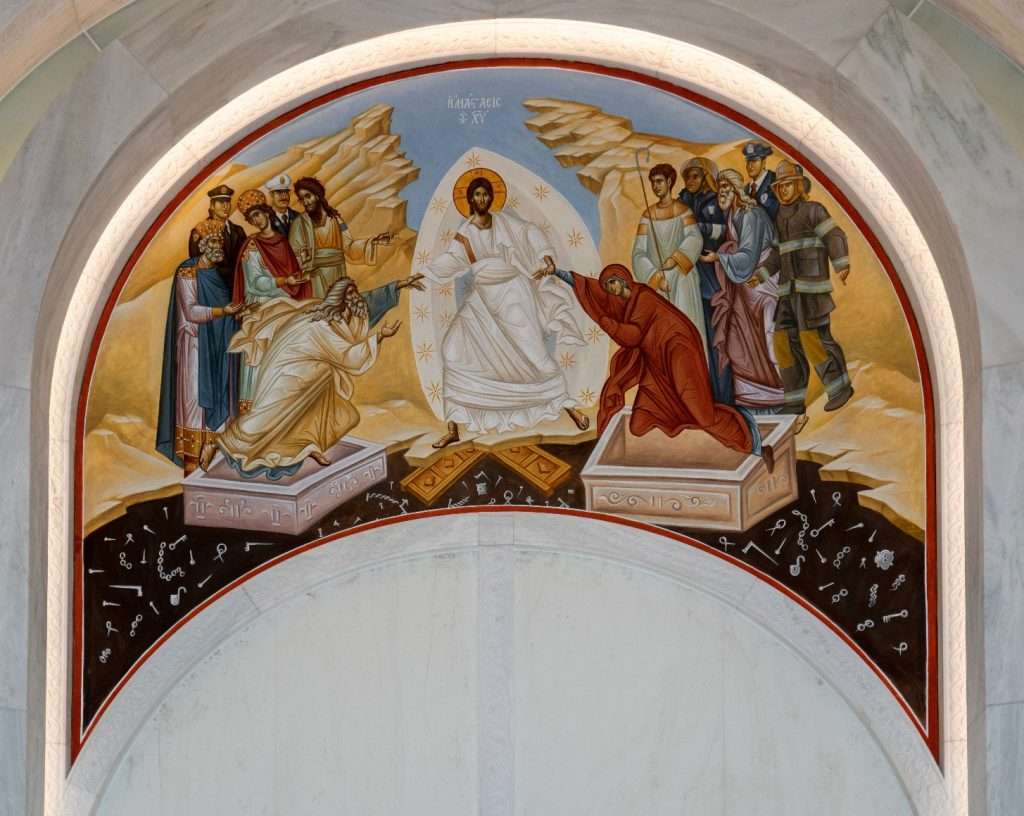
In addition to the customary figures found in an Anastasis image, some contemporary ones are found in the image at the National Shrine. They represent the heroic first responders who sacrificed their lives to save others on September 11th. There are numerous precedents in Byzantine iconography for incorporating depictions of contemporary figures within sacred images. The inclusion of figures representing the first responders links the site-specific events September 11th to the ongoing hope for salvation and participation in the Resurrection of Christ and the blessing of eternal life with Him.
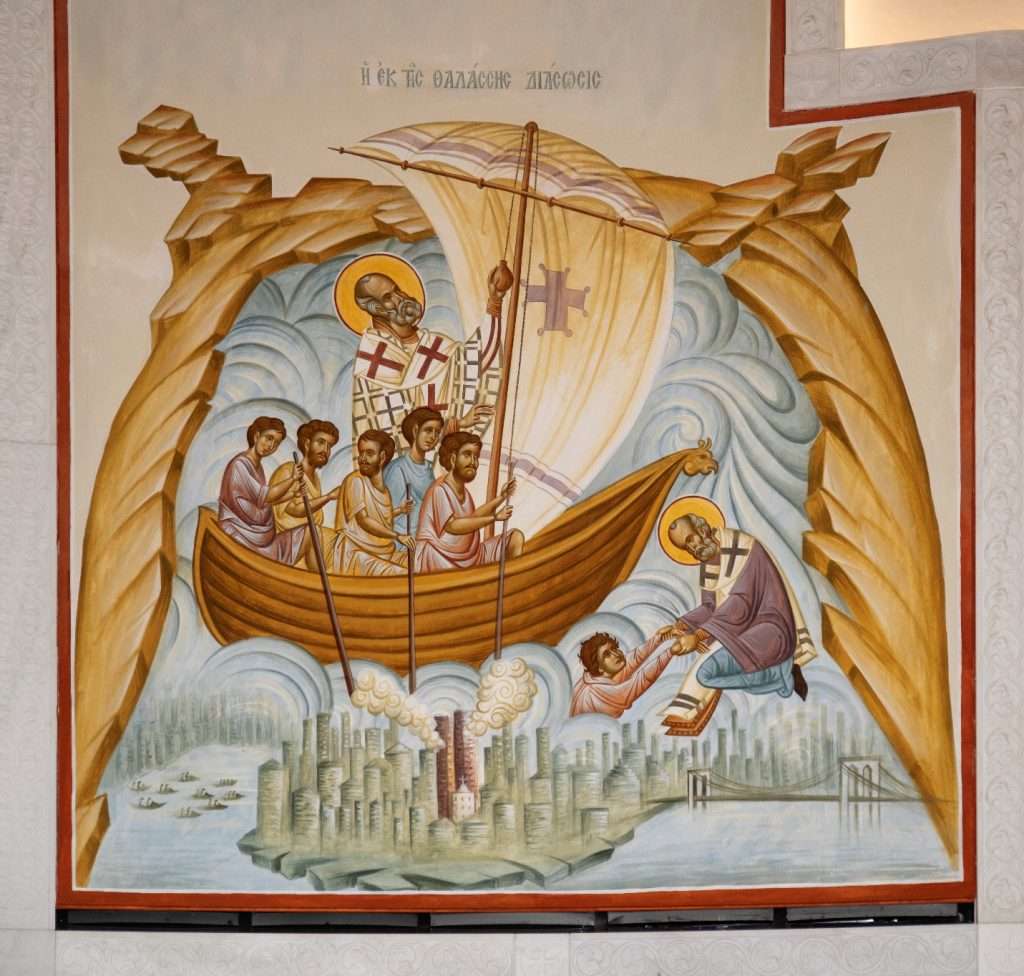
The Sea Rescue (Fig. 3):
In the lowest level of the iconographic program is found a set of images depicting the life of Saint Nicholas of Myra. St. Nicholas was not only the patron of original church destroyed on September, but also holds great significance in the history of New York City in general and in the devotional life of Orthodox Christians in particular. From the latter part of the 18th century onward, St. Nicholas was widely venerated among the various Christian communities in New York and by 1810, he was officially regarded as the patron saint of the New York Historical Society.
Within the Orthodox tradition, however, St. Nicholas is revered as one of the most popular saints in light of his intercessory powers, especially remembered for rescuing people from various dangers and being a great intercessor at tribunals for those who were wrongly accused.Consequently, St. Nicholas is regarded as the most powerful intercessor for the dead at the Last Judgement. For this reason, scholars have shown that various depictions from the life of St. Nicholas were painted as coherent cycles in historic churches across the Byzantine Orthodox commonwealth, most often placed in spaces where intercessory prayers for the dead were conducted. Considering the historical associations of St. Nicholas with the city of New York and the great loss of life that occurred on September 11th, it was essential that the iconographic program for the National Shrine included a Life Cycle of Saint Nicholas.
One of the scenes from the painted Life Cycle is that of the Sea Rescue. This scene is located on the lower right section of the north wall of the nave and depicts the traditional story of St. Nicholas rescuing a ship in a storm at sea. Again, the traditional iconography has been adapted to the site-specific events of September 11th. Below the boat and the figure of St. Nicholas rescuing a man from drowning is found the Manhattan cityscape on the day of the September 11th attacks: the burning Twin Towers billowing forth smoke, the white structure of the original Saint Nicholas church on Cedar Street, and the flotilla of rescue boats crossing the Hudson River from New Jersey to heroically evacuate 500,000 people from Ground Zero.
Saint Nicholas Greek Orthodox Church and National Shrine at the World Trade Center, whose architecture and iconography draw upon Byzantine Orthodox traditions, clearly demonstrates how centuries-old sacred aesthetics and visual practices can be appropriately adapted to memorialize significant events within the historical American context.
This article is published as part of the America at 250: Orthodoxy in a New Homeland media initiative co-organized by the Orthodox Observer and the Department of Inter-Orthodox, Ecumenical, and Interfaith Relations of the Greek Orthodox Archdiocese of America to honor the contributions and experience of Orthodox Christianity in America and celebrate 250th anniversary of America’s founding.
[1] For a full analysis of the iconographic program of the Shrine of Saint Nicholas, see Bishop Joachim (Cotsonis) of Amissos, Saint Nicholas National Shrine at the World Trade Center: The Iconographic Program (Scala Arts Publishers, Inc.: London/New York, 2026).
The post A Byzantine vision of an American sacred space: St. Nicholas Church and National Shrine appeared first on Orthodox Observer.