This post was originally published on this site
In communist Albania, atheism was enshrined in the constitution. Owning a copy of the Gospel was enough to land a person in prison for a decade–if they were lucky. Churches had been destroyed, clergy executed, and the entire nation’s spirituality driven underground. It was in this world that His Beatitude Archbishop Joani of Tirana, Durrës and All Albania first encountered Christianity through a borrowed book.
“It was not a conversion,” Archbishop Joani says. “It was a revelation.”
Archbishop Joani’s ancestors were Christian before an Ottoman-Albanian ruler converted southern villages to Bektashism–a syncretism between Orthodox Christianity and Sufi Islam. By the time he was born as Fatmir Pelushi, however, there was no religion whatsoever in his household. His first contact with the sacred came in his fourth year of high school, when a friend of his brother gave him a French book. Neither knew, but the book was the Gospel of John.
“When I read the Gospel, I felt the same joy of childhood,” Archbishop Joani remembers. The youngest of eight children, he recalls feelings of protection and warmth that faded as he grew up. His first prayer was simply, “Thank you, God, for bringing back the joy of childhood.”
He was baptized on June 24, 1979, taking the name of St. John the Baptist. There were just three people present with him–a priest, a godfather, and a young boy keeping watch outside.
The priest who baptized him, Fr. Kosma Qirjo, risked everything in doing so; another priest in the northern city of Shkodër had already been executed merely for performing a baptism.
“It was much easier to find dynamite than a Gospel,” Archbishop Joani says.
During the Albanian Orthodox Church’s years of restoration, then-Metropolitan Joani honored Fr. Kosma’s years of ministry under peril by ordaining him to the episcopacy. His son, the boy who kept guard at the baptism, is now a priest as well.
This personal history shapes how Archbishop Joani approaches his ministry. When he speaks of the need for visible unity among the Orthodox churches, he speaks from the experience of a people who once had no church at all, and who know that it means when one is resurrected.
“Visible unity is a witness,” Archbishop Joani says. “It gives hope to our people and to other people who don’t have dialogue now.”
“It’s very important that people see something. We can keep the unity in our hearts, but it’s not enough–true unity has to be expressed.”
On Sunday, Archbishop Joani celebrated the Sunday of Orthodoxy alongside clergy and hierarchs from ten different jurisdictions. This occasion, he says, is evidence of the importance of visible unity.
“We gave a message and I saw the reaction of the people,” Archbishop Joani says. “They were all happy; it gives hope to them.” In this, he says, hierarchs have a responsibility not only for themselves, but for their people.
> Previously: Pan-Orthodox liturgy commences visit of Archbishop Joani of Albania
In Albania, the unity Archbishop Joani describes is practiced not only among Christians, but between differing religious traditions. The country’s Christian and Muslim communities have developed what he calls “a dialogue of life,” shaped by shared schools, neighborhoods, and dinner tables.
“The people live together,” Archbishop Joani says. “It’s possible to live in peace if we respect and love each other.”
Albania’s interfaith councils rotate their presidency annually among religious leaders. “After we finish meeting, we have a common dinner,” Archbishop Joani explains. “If they’re in a church, we’ll do it; if we’re in a mosque, they’ll do it.”
“This gives stability to the country and to the people,” he says. “It’s a friendship, and you cannot fight with friends.”
He tells a story about an elderly woman who told him she had always felt fearful when passing the local mufti (Islamic legal scholars). But after seeing Archbishop Joani’s peaceful, easy interactions with them, something shifted. “She said, ‘now that I see them with you, it seems different to me,’” Archbishop Joani recounts.
“When they see us together, this is transmitted to the people,” Archbishop Joani says.
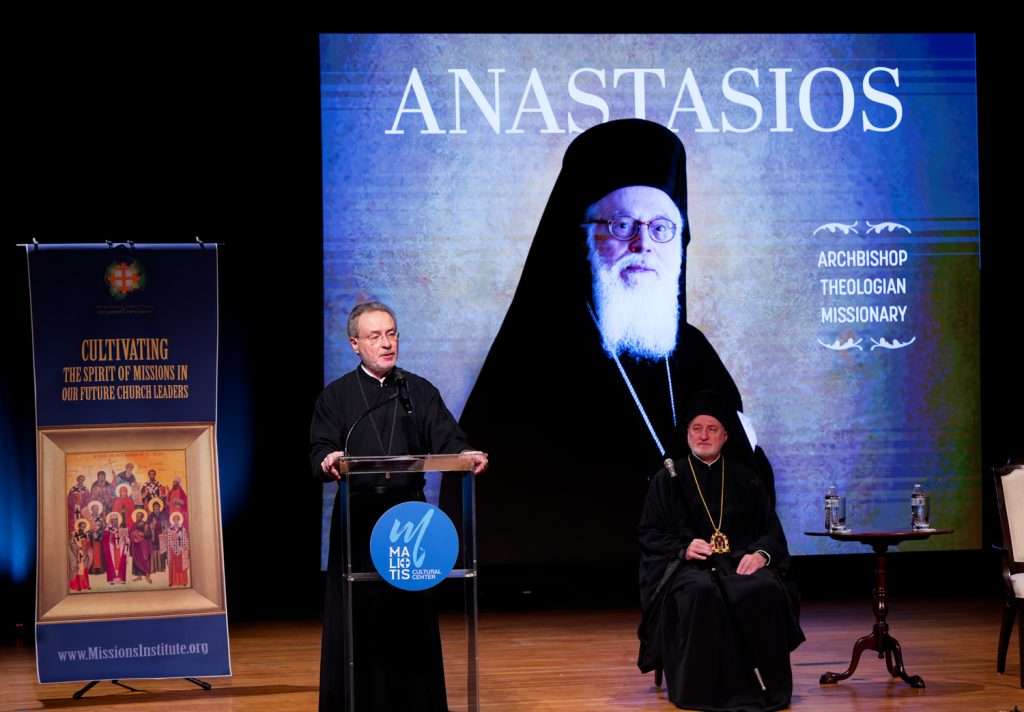
Asked how the Church should respond when faith is weaponized, Archbishop Joani is unequivocal.
“The manipulation of religion is a sin,” Archbishop Joani says. “Archbishop [Anastasios] has always said that the question is not which side one takes. What matters is how injustice is condemned.”
This conviction has shaped how the Albanian Orthodox Church has addressed the war in Ukraine. “From the first days of the aggression of Russia against Ukraine, our church had a declaration,” Archbishop Joani says. “Every Sunday, in every liturgy, there was a prayer condemning the aggression and a prayer to God for peace.”
“I believe that the Church in Albania has followed the example of St. John Chrysostom,” Archbishop Joani says. “When St. John Chrysostom was accused of attacking the Empress and the Emperor because of his calls for justice, he answered with these words: ‘I never spoke against people. I spoke against injustice.’”
> Previously: Archbishop Joani of Albania reflects on predecessor’s legacy
Archbishop Joani emphasizes Christianity teaches universal and unconditional love. “It’s impossible to love one and hate the others,” he says. “If you have love, you love everybody, or it’s not true love.”
He illustrates this with a story of a Romanian priest imprisoned for 20 years before being released due to Western pressure. When he traveled to France, journalist pressed him: why did the communists hate Christians? The priest corrected them, saying they didn’t hate Christians, they hated everyone.
“If it’s hatred, hatred will spread,” Archbishop Joani says. “First you hate this other religion; after, you’ll hate people of your own religion.”
He stresses the common humanity shared among all peoples. “St. Gregory of Nyssa said to say human beings in plural is a heresy,” Archbishop Joani says. “It’s only one human being, but millions of persons, just as the Holy Trinity is only one divine being, but three persons.”
He turns to the theology of the icon to explain why inter-Orthodox and interfaith dialogue is a spiritual imperative, more than simply a practical necessity.
“Dialogue with others is very important because it’s a kind of revelation,” he says. “When you start to see another being, you see the icon of God. If we really see this icon, we love them.”
This vision of faith could only belong to someone who once read the Gospel in secret, who was baptized in basement with a boy keeping watch outside. Archbishop Joani received the faith as something hidden. Now, he says it must be seen–in a dinner shared between interfaith friends, in an old woman no longer afraid of her neighbors, in faithful meeting at a shared chalice.
The post Exclusive | Archbishop Joani of Albania on his secret baptism and visible faith appeared first on Orthodox Observer.