This post was originally published on this site
The initiatives and influence, along with the recognition and reverberation of the ecological ministry of His All-Holiness Ecumenical Patriarch Bartholomew is often measured by his theological and ecclesiastical vision along with his social and global outreach. What many are perhaps unaware of are the significant and momentous milestones throughout His All-Holiness’s unprecedented environmental ministry that transpired on the soil of this blessed country over the last 30 years. In this brief article, I will highlight just three events that defined both the environmental achievements of the Ecumenical Patriarch and the environmental awareness of the Greek Orthodox Archdiocese of America.
Santa Barbara (1997)
On November 8, 1997, addressing a prestigious gathering of theologian, scientists, and policy makers on the occasion of his first official visit to the United States as Ecumenical Patriarch, His All-Holiness declared that “if human beings were to treat one another’s personal property the way that they treat their environment, we would view that behavior as anti-social.” It was the same year that Time magazine would name him among “the 100 most influential people in the world.”
At this symposium in Santa Barbara, the Ecumenical Patriarch presented a radical and daring vision that revised the Christian perspective of sin by proposing that the abuse of natural creation was nothing less than sin itself. It was the first time any religious leader had ever identified any act of harm to the environment as sinful. His audience included Bruce Babbitt, then United States Secretary of the Interior, representing President Bill Clinton at the symposium; Jean-Michel Cousteau, the preeminent oceanographic explorer; Carl Pope, Executive Director of the Sierra Club; and Paul Nosie Jr., of the San Carlos Apache tribe in Arizona.
Ecumenical Patriarch Bartholomew’s undiluted criticism of ecological destruction remains monumental to this day:
To commit a crime against the natural world is a sin. For human beings to cause species to become extinct and destroy the biological diversity of God’s creation; for human beings to degrade the integrity of the earth by causing climate change, stripping the earth of its natural forests, or destroying its wetlands; for human beings to injure other human beings with disease or contaminate the earth’s waters, its land, its air, and its life, with poisonous substances . . . these are sins.
Mississippi River (2009)
Over the 35 years of his tenure, the Ecumenical Patriarch has organized five Summer Seminars (1994–1998), nine Seaborne Symposia (1995–2018), and six Halki Summits (2012 to date), all focused on bringing people from diverse backgrounds together to call for principled environmental stewardship and care for creation.
The eighth symposium was held in October 2009 on the banks of the Mississippi River in New Orleans and titled “Restoring Balance—The Great Mississippi River.” As one of the world’s greatest rivers, with the third largest drainage basin on the planet, the Mississippi is a vast ecosystem that has fallen completely under human domination with a chain of cities along its length discharging domestic and industrial waste into the river for nearly two centuries. Yet, as His All-Holiness declared at the opening of the symposium, the fate of the Mississippi waters should be primarily perceived as an ethical crisis:
Let us remember that our responsibility grows alongside our privileges; we are more accountable the higher we stand on the scale of leadership. Our successes or failures, personal and collective, determine the lives of billions. Our decisions, personal and collective, determine the future of the planet.
The exploitation of the great river produced catastrophic human and natural consequences, as the whole world observed in the aftermath of Hurricane Katrina.
In his message to the Ecumenical Patriarch and the delegates, former Vice President Al Gore observed:
Your All-Holiness, I would like to welcome you to the United States and, in particular to the South. From the days when I first addressed you as the Green Patriarch, our paths have crossed many times but we have both kept our course, struggling for a better future for our planet with the hope that our efforts will not fail . . . Your All Holiness, your perseverance in this struggle is demonstrated yet again by this waterborne symposium. As Martin Luther King said, “Let’s not become silent about things that matter.”
In the White House, as His All-Holiness later revealed, climate change “was one of the foremost issues” raised by the Ecumenical Patriarch in his conversation with President Obama just prior to the Mississippi symposium.
Templeton Prize (2025)
Finally, just last year, on September 24, 2025, at a special ceremony in New York City, the John Templeton Foundation awarded the 2025 Templeton Prize to His All-Holiness “for his pioneering efforts to bridge scientific and spiritual understandings of humanity’s relationship with the natural world, bringing together people of different faiths to heed a call for stewardship of creation . . . as well as for articulating a compelling moral and theological vision of humanity’s responsibility to care for the earth and to uphold harmony, unity, and mutual love within and across religious communities.”
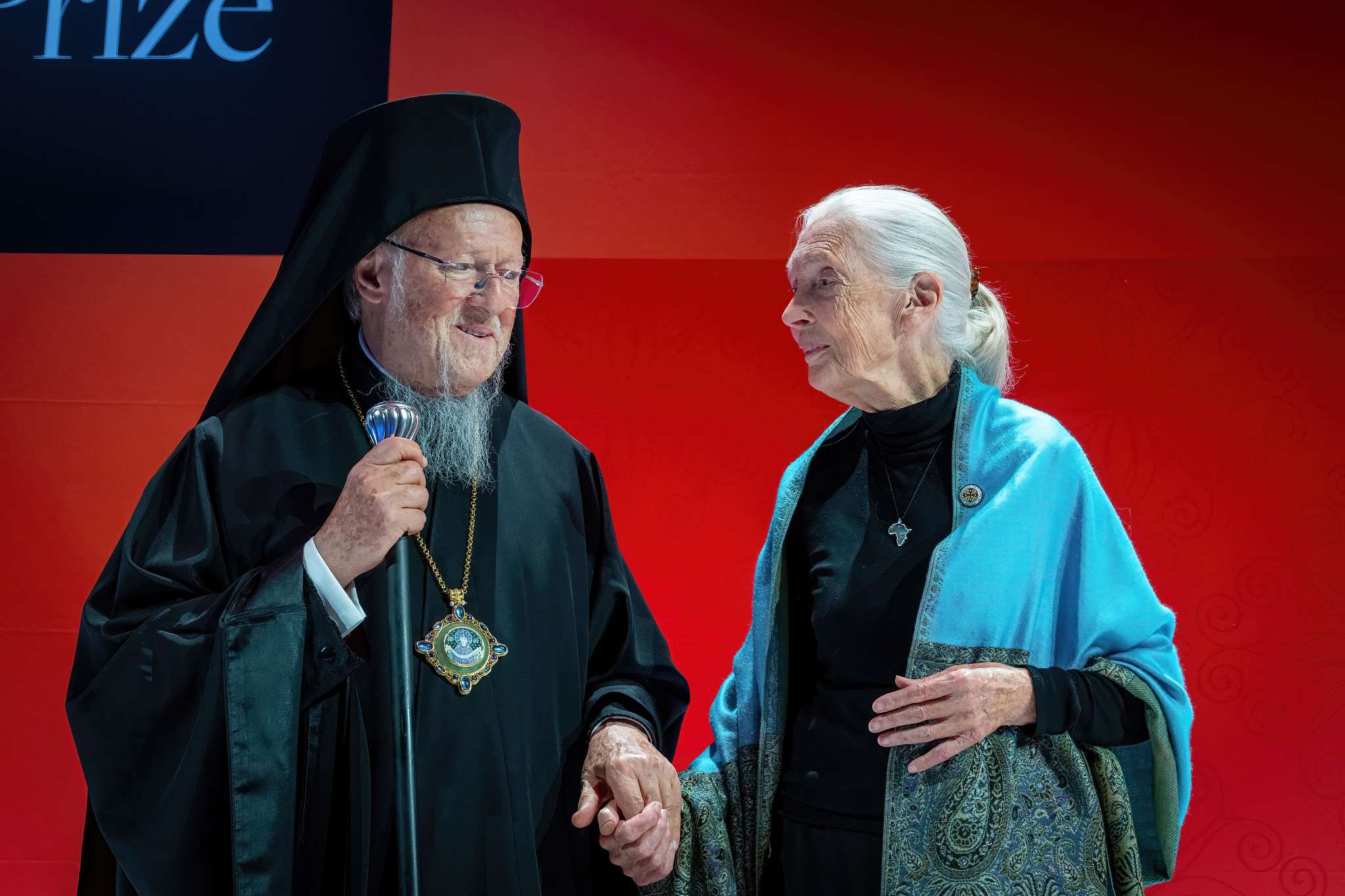
It was a fitting recognition of a commitment and conviction established and developed over decades, first initiated under Ecumenical Patriarch Demetrios (1914–1991), articulated by such thinkers as Metropolitan John Zizioulas of Pergamon (1931–2023), and tirelessly promoted by Ecumenical Patriarch Bartholomew throughout his ongoing tenure as the longest-serving Ecumenical Patriarch in history.
Conclusion
There is no doubt that the recent history of the United States and the Greek Orthodox Archdiocese of America is conspicuously and unmistakably marked by the exceptional presence and ecological impact of His All-Holiness Ecumenical Patriarch Bartholomew.
People across the world and in the United States have certainly acknowledged the importance and impact of His All-Holiness on issues related to raising awareness to protect the sacred gift of creation. As such, it is up to all Orthodox Christians and people of good will to find ways, particularly in the United States, to adopt the Ecumenical Patriarch’s vision of ecological stewardship in their lives and communities to participate in caring for creation to the glory of God.
The post How the Ecumenical Patriarch brought creation care to America appeared first on Orthodox Observer.