This post was originally published on this site
When Pope John Paul II first convened religious leaders to pray for peace in Assisi in 1986, the world “was divided into opposing blocs and lived under the great fear of a possible nuclear war,” His All-Holiness Ecumenical Patriarch Bartholomew recalled on Tuesday. At that time, he said, the meeting was “considered bold and even reckless in the eyes of international politics.”
Forty years later, at a prayer service in the Basilica of St. Francis, Ecumenical Patriarch Bartholomew offered a stark account of the distance between the former Pope’s aspirations for such a gathering and its tangible outcomes. “We continued to meet, but we failed to make a meaningful impact,” His All-Holiness said in his meditation on the Book of Revelation at the meeting. “We did not do enough to prevent the emergence of new nationalisms [that] diminish[ed] the value of the human person.”
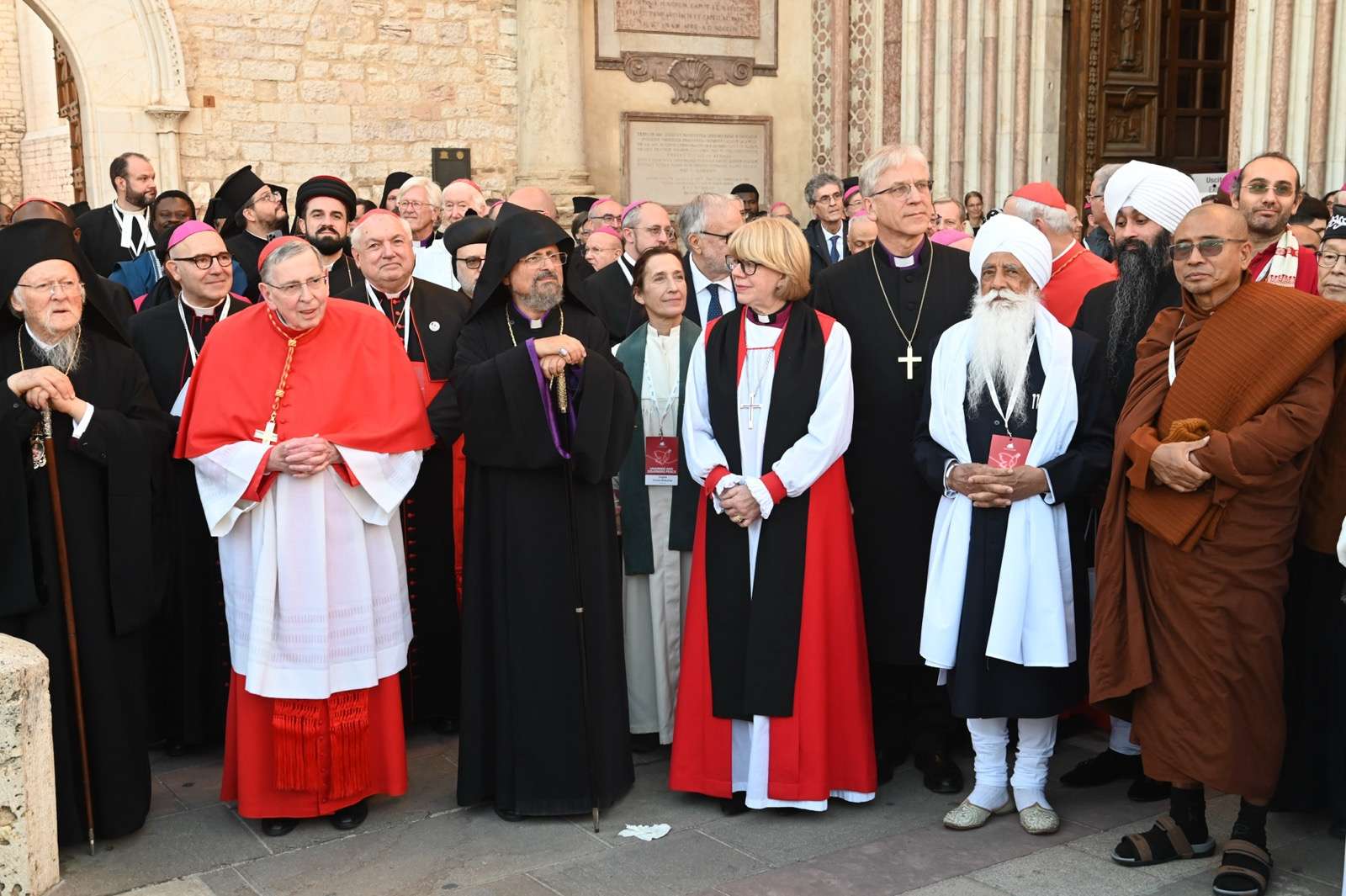
Ecumenical Patriarch Bartholomew was the guest of honor at this year’s International Meeting for Peace, organized by the Community of Sant’Egidio, which drew 384 representatives of numerous faith communities from 53 countries. The meeting’s theme, “Unarmed and Disarming Peace,” drew upon the first words that His Holiness Pope Leo XIV spoke from the balcony of St. Peter’s Basilica on the night of his election to the papacy in May 2025. There, the Pope described “an unarmed peace and a disarming peace, humble and persevering.”
Pope Leo would join this year’s meeting only from afar, as doctors advised against the trip to Assisi following his Oct. 13 surgery which removed the lower lobe of his right lung in order to treat what was later confirmed to be an early-stage adenocarcinoma, or lung cancer. The Vatican said the operation was successful, with no complications. Speaking by video to the closing ceremony, Pope Leo said that while he was unable to join the meeting at the tomb of St. Francis, he nonetheless conveyed his support to all assembled to call for an end to the “troubling revival of war as an instrument of international politics.”
> Previously: Archbishop Elpidophoros prays for the health of Pope Leo
Approximately 130 armed conflicts were active at the start of 2026, more than double the number 15 years earlier. According to the International Committee of the Red Cross, wars are lasting longer and growing more complex. Often, the parties to these conflicts are “challenging international humanitarian law or simply ignoring it.”
Pope Leo, too, looked back to 1986 in his remarks. In the years following the fall of the Berlin Wall, “many believed that globalization would ensure lasting peace” and “an almost blind faith was placed in the ability of the markets to generate prosperity, democracy and stability,” the Pope said. Instead, it seemed to bring about a new era of nationalist and fundamentalist backlash.
“We must rebuild peace everywhere,” Pope Leo said, “not prepare for more wars.” The Pope added in his address, “There is no such thing as a holy war: only peace is holy.”
The first Assisi gathering, on Oct. 27, 1986, drew about 160 religious representatives from a dozen faiths, TIME reported, among them Archbishop Methodios of Thyateira and Great Britain; Robert Runcie, Archbishop of Canterbury; the İznikİznik; and Mother Teresa. “There is no peace without a passionate love for peace,” Pope John Paul II told the assemblym then. Five years later, Ecumenical Patriarch Bartholomew was elected to the Ecumenical Throne and would journey to Assisi to celebrate the anniversaries of the gathering with Pope Benedict XVI in 2011 and Pope Francis in 2016, respectively.
This year’s Assisi meeting coincided with the 800th anniversary of the repose of St. Francis in October 1226. Pope Gregory IX laid the cornerstone of the basilica over his tomb on July 17, 1228, only a day after he canonized Francis as a saint of the Roman Catholic Church.
At this year’s meeting, Cardinal Kurt Koch, the Vatican’s Prefect for Promoting Christian Unity, led an ecumenical prayer service in the Basilica of St. Francis. His All-Holiness Ecumenical Patriarch Bartholomew and Cardinal Matteo Zuppi, the Archbishop of Bologna, offered meditations, and Sarah Mullally, Archbishop of Canterbury, prayed for countries suffering from war, violence, and terrorism. Above and behind them, the apse of Francis’s tomb was filled with the Last Judgment: the dead rising from graves, an archangel beneath the Cross, and the condemned dragged down at the right.
> Previously: Archbishop Elpidophoros condemns Al-Karak terror attack
Earlier on Tuesday, in a hall named after the Italian proto-Renaissance painter Cimabue, Ecumenical Patriarch Bartholomew addressed a forum titled “The Ecumenical Patriarchate: From the East to the Global World.”
“The Church that proclaims the Resurrection must at the same time proclaim peace,” His All-Holiness said. The Church, he said, has a duty to be present “where new walls of separation arise.” Skin color, ethnic origin, language, religion, sex or social condition, he said, “cannot add or take away anything from human dignity.”
Of Christian unity, he said, “We long for that day as the watchman in the night longs for the morning.” Eleven months earlier, His All-Holiness and Pope Leo had prayed together with other Christian leaders in Nicaea (modern-day İznik, Türkiye), to mark 1,700 years since the first Ecumenical Council.
Andrea Riccardi, the historian who founded Sant’Egidio, said Ecumenical Patriarch Bartholomew “has planted seeds that will likely bear fruit even after we are gone.” Cardinal Jean-Marc Aveline, the Archbishop of Marseille, said the Ecumenical Patriarchate, under Ecumenical Patriarch Athenagoras and then Ecumenical Patriarch Bartholomew, “has demonstrated that it is possible to bear witness in a way that transcends borders.”
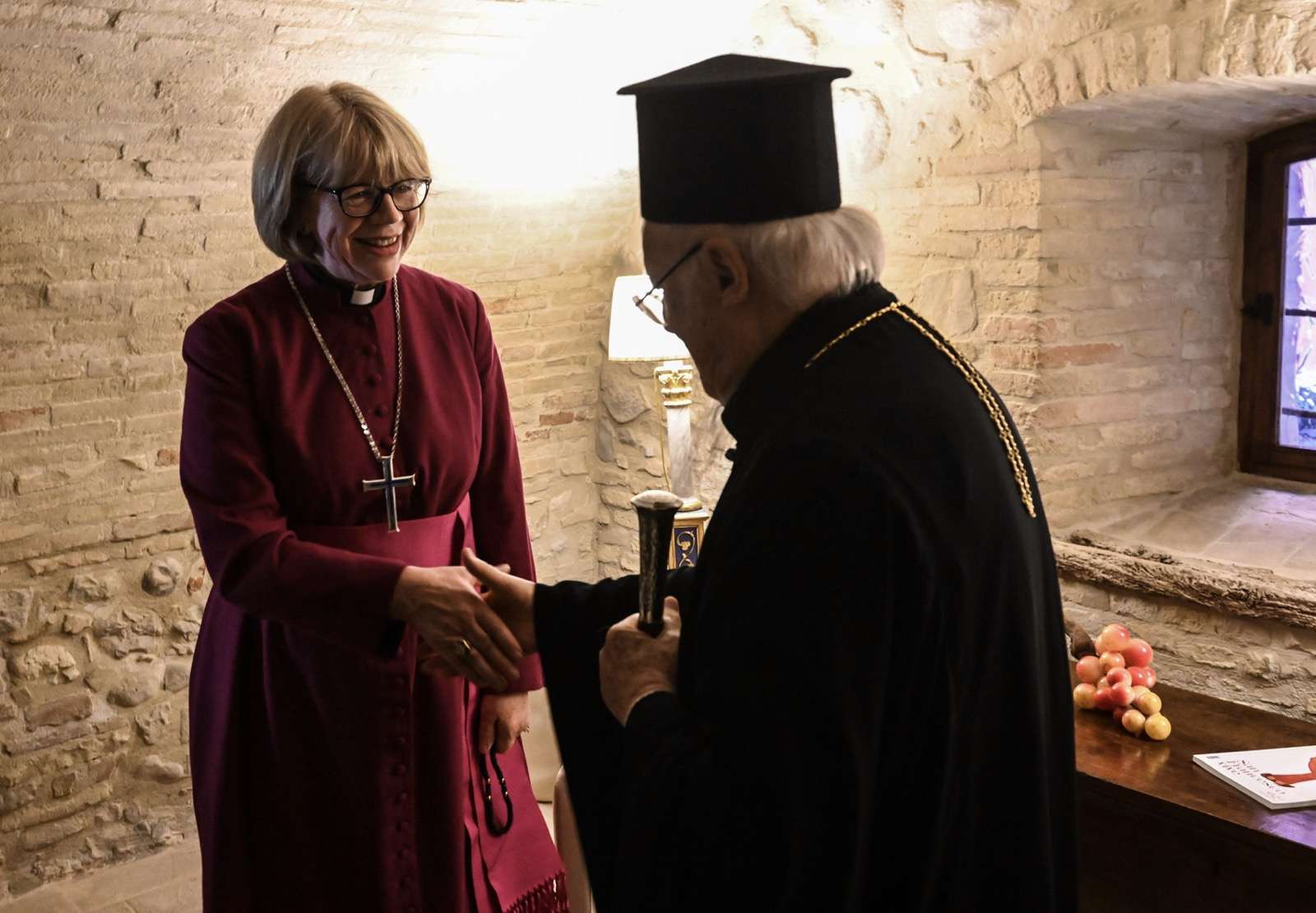
During this trip, Ecumenical Patriarch Bartholomew met with Sarah Mullally, the Archbishop of Canterbury, whose predecessor Robert Runcie had come to Assisi in 1986. She congratulated him on the 35th anniversary of his enthronement, and His All-Holiness gifted her a komboskini—a prayer rope—from Mount Athos.
His All-Holiness participated in the Assisi meeting as part of an official, weeklong visit to Italy. On Oct. 23, the Pontifical University of St. Thomas Aquinas in Rome presented him with gave him an honorary doctorate. The next day, His All-Holinesshe met Pope Leo at the Vatican and wished him a full recovery. On Wednesday, His All-Holiness laid flowers at the tomb of Pope Francis in the Basilica of Santa Maria Maggiore.
In Assisi, His All-Holiness had closed his meditation with a charge to those gathered: “Let us become artisans of a peace that makes no noise, yet changes history.”
The post Assisi peace meeting echoes its Cold War origins appeared first on Orthodox Observer.