This post was originally published on this site
PHILADELPHIA — The Governing Board of the National Council of Churches has called on President Donald Trump and Defense Secretary Pete Hegseth to stop the firing-squad execution of Nidal Hasan, the former Army psychiatrist who killed 13 people and wounded 32 at Fort Hood in 2009, and to abandon the Pentagon’s plan to livestream it. President Trump called off the livestream this week, but the execution remains scheduled for Dec. 3. The council has opposed capital punishment since 1968, when its General Board voted unanimously for abolition and warned that “institutionalized disregard for the sanctity of human life contributes to the brutalization of society.”
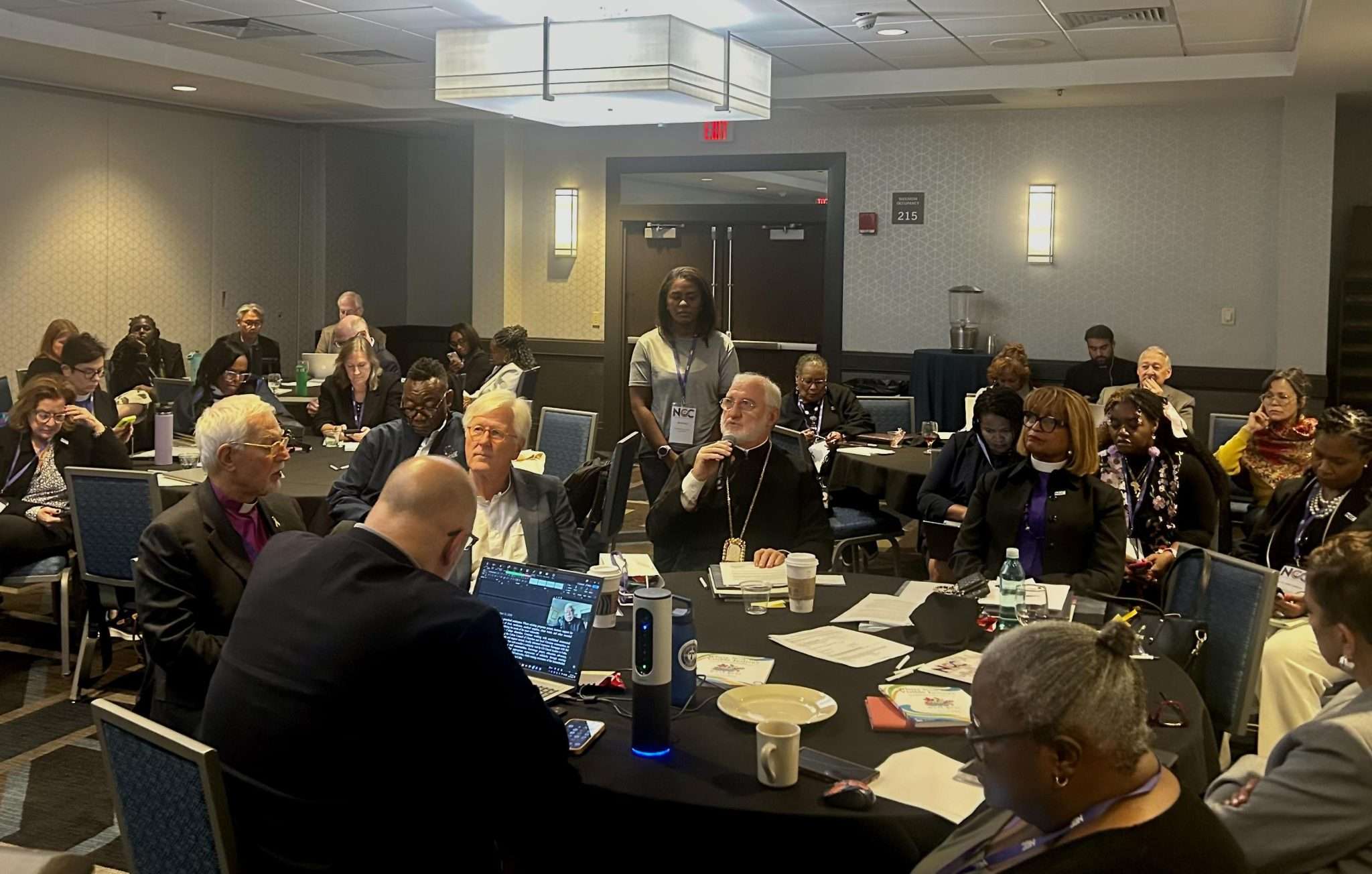
The statement, submitted by Archbishop Elpidophoros of America as chair of the council’s Governing Board, was adopted Monday as the board met in Philadelphia. It was one of four statements the council announced Friday, Oct. 16, as its weeklong gathering there came to a close. It turned first to the victims: “Our first thoughts are with the families of the thirteen men and women killed there in November 2009, and with the thirty-two who were wounded, many of whom carry those wounds to this day. Nothing can excuse what was done to them.”
The statement takes as its epigraph a line from the Gospel of Luke: “Be merciful, just as your Father is merciful.” Every person, it said, “even one who has assaulted the image of God in others, still bears that image.” It invoked Saint John Chrysostom, the fourth-century archbishop of Constantinople: “If you slay God’s image, how can you then revoke the deed?” And it recalled that Christ set aside the old law of an eye for an eye.
The board adopted a second statement submitted by the Archbishop, on the humanitarian situation in Cuba. It called for a collective, ecumenical response grounded in Christian solidarity and in concern for the well-being of the Cuban people. Pointing to the suffering and economic hardship on the island, it urged member communions to deepen humanitarian aid, strengthen church partnerships, engage in advocacy and stand in prayerful solidarity with Cuban churches and communities.
With midterm elections less than three weeks away, the board approved a third statement, urging people of faith to vote and to protect the voting rights of others. It condemns political violence, voter intimidation, election disinformation and efforts to suppress or overturn lawful votes, and calls on Christians to defend the right of every eligible person to vote and have that vote counted. It encourages congregations to take up prayer, civic education, voter assistance and nonpartisan work that promotes peaceful participation in the democratic process.
The board also reaffirmed its commitment to religious freedom for all, the theme of the council’s annual Christian Unity Gathering, which opened at the same hotel the next morning.
The gathering comes as the nation marks the 250th anniversary of its founding. Opening it on Tuesday in the city that is home to the Liberty Bell, the Archbishop argued that the liberty in question runs in two directions. “There are clear measures that can determine whether our commitment to religious freedom is sincere,” he said. “First of all, the principle elucidated in the First Amendment is as much freedom from religion as it is freedom of religion.” Belief and its practice, he said, “are prerogatives of individual conscience, and never that of the State’s mandate.”
He directly opposed the idea that the United States should be a Christian nation: “There are many of our fellow citizens, and indeed some members of our Council who may feel that the United States is meant to be a Christian nation,” the Archbishop said. “But we know that this is explicitly forbidden by our founding documents and, more importantly, our founding principles.” The council itself, he argued, answers any church that claims to be the only legitimate one of the United States of America. “Our Council, by its very composition, demonstrates the bigotry and folly of such a position,” he said, because its members, while all confessing Christ, “hold to that Holy Name in often very different ways.” A nation now home to far more faiths than were present at its founding, he said, depends on the principle that “no one group can assert itself over the interests of another.” “There can be dialogue, even many forms of persuasion, but never compulsion,” he said.
When that dialogue is sincere, the Archbishop said, it opens a space Orthodox Christians would call “perichoresis,” or “inter-dwelling,” the word the church uses for the mutual indwelling of the persons of the Holy Trinity. “Simply put, we abide in love,” he said. He closed by urging Christians to show their freedom by keeping Christ’s commandment to love one another, “Fully. Wholly. Without reservation. And without condition.” He then welcomed the gathering’s next speaker, Bishop Heinrich Bedford-Strohm, moderator of the World Council of Churches Central Committee.
At the board meeting the day before, the Archbishop set the council’s work against its own history. The council marked its 75th anniversary last year in Boston, and he told board members that “an anniversary is never simply an occasion to look backward. It is also an invitation to ask where the Holy Spirit is calling us next.” He cited Ecumenical Patriarch Bartholomew, the spiritual leader of the world’s Orthodox Christians, who has said that “human rights belong to the essence of religion, which inherently espouses and promotes religious freedom and tolerance.” The defense of religious freedom, the Archbishop said, “is inseparable from our witness to the dignity of every human being.”
In its appeal for Hasan’s life, the council argued that “the victims of Fort Hood deserve a justice that binds up wounds and carries the solemnity that death demands, and they are not honored when a killing is offered to the public as entertainment.” “We pray for the families who still mourn the fallen of Fort Hood, and we pray also for the condemned man, that even now he may turn toward repentance,” the statement said.
It closed with a prayer echoing the prophet Ezekiel: “May the Lord, who desires not the death of sinners but that they should turn and live, grant those who govern us the wisdom to choose mercy over spectacle.”
The post National Council of Churches opposes execution, defends freedom of and from religion appeared first on Orthodox Observer.