This post was originally published on this site
by Fr. Stefan Morariu*
In the times we live in, Orthodox Christian parishes are increasingly being sought out by people who express a profound need for spirituality. Policies and ideologies, which no longer adequately address the human person’s needs, are being replaced at an increasing rate by members of society from the most diverse fields and social strata with the teachings of Holy Scripture and the prayers and services of the Church.
The Church’s response must live up to these expectations. The Gospel message, the liturgical message, and the musical message should be expressed in this new context in a way that is as explicit and easily accessible as possible. Otherwise, new candidates for membership in any Orthodox Church risk remaining in a state of personal ambiguity mixed with a zealous ideological fervor – this time of an Orthodox nature – reminiscent of the deviant policies of secularized laicism, from which they wish to disassociate themselves.
Bilingual worship, supported by bilingual printed liturgical texts, a relaxed, oratorical style – unconstrained by excessive theological language yet catechetical at the same time – coupled with social activities carefully tailored to the community’s needs, are just a few best practices through which this emerging category of Orthodox believers has the chance to become more easily compatible with the body of the Church.
It is very important to understand the musical message in a church where everything is expressed almost exclusively through music. Both newcomers and “native” Orthodox believers who have become stagnant can discover together how every faithful soul who participates in worship through sung prayer is a rare – or even unique – flower that beautifies the church’s liturgical garden.
Chanting and musical participation in church services are a necessity, not a privilege reserved solely for a certain category of professionals.
Of course, the clergy and cantors with special theological training retain their role as teachers and musical leaders in the church, being responsible for preserving the authenticity of the liturgical-musical heritage – which, besides, has canonical value – as well as for transmitting it through courses organized for this purpose. The intention must remain to involve the entire congregation in the liturgical order of the service, ensuring that no one is left out, without prayer or singing.
To facilitate the understanding of the musical and liturgical process within church services, a simplified guide that briefly and clearly presents psaltic music and the worship role of the individual in the church is most welcome for any minister or singer eager to encourage the community to participate as actively as possible in worship.
It was against this backdrop of need that the initiative to organize a Summer School of Byzantine Music emerged, supported by a written course, with the intention of serving as a theoretical reference guide for interested members of the community in the future.
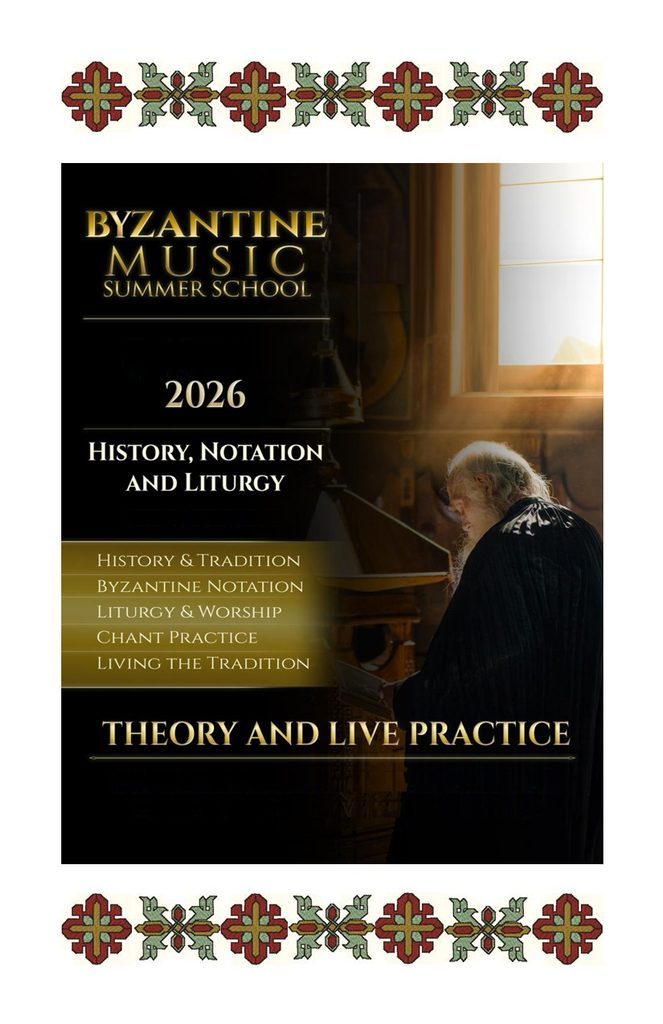
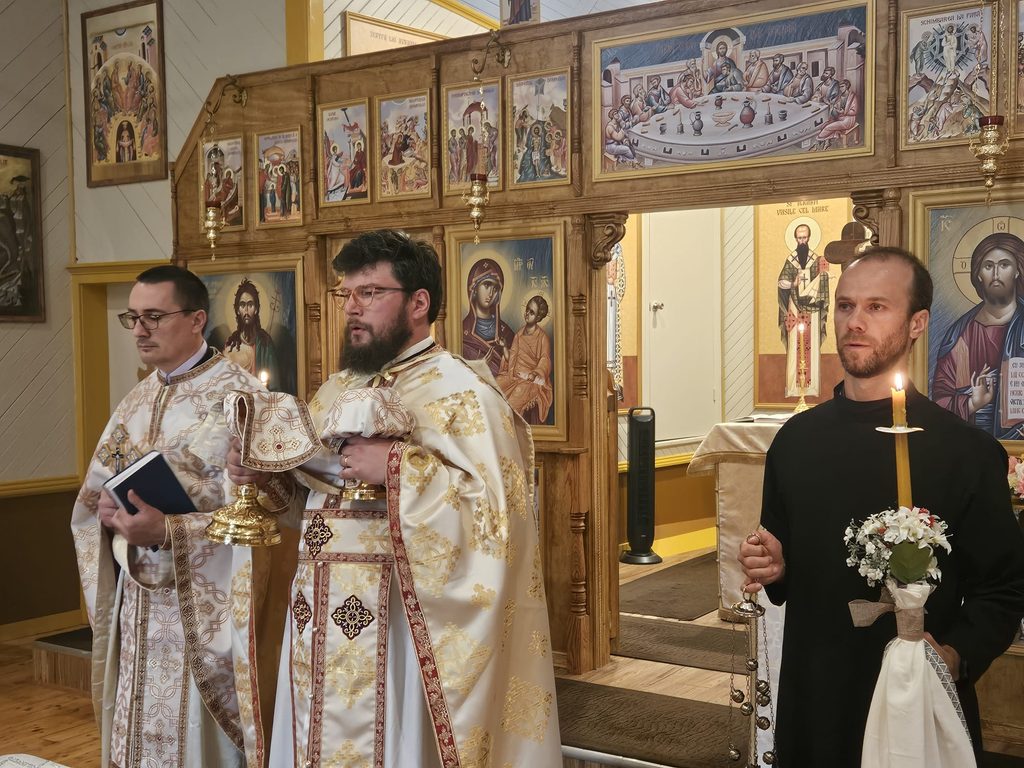
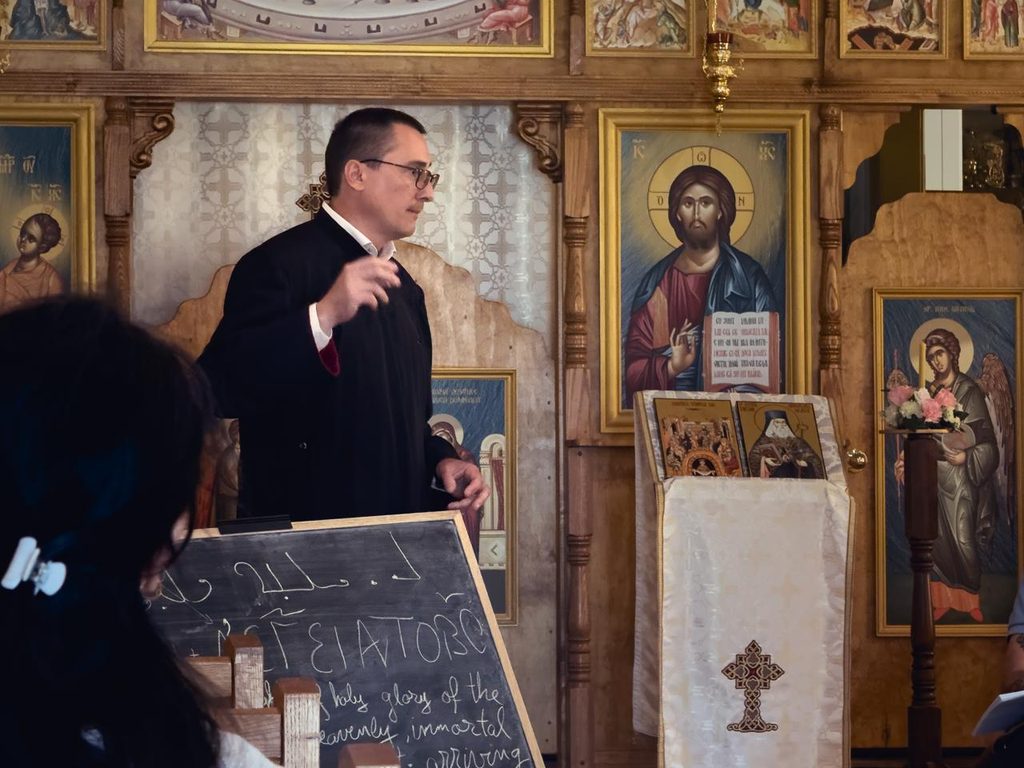
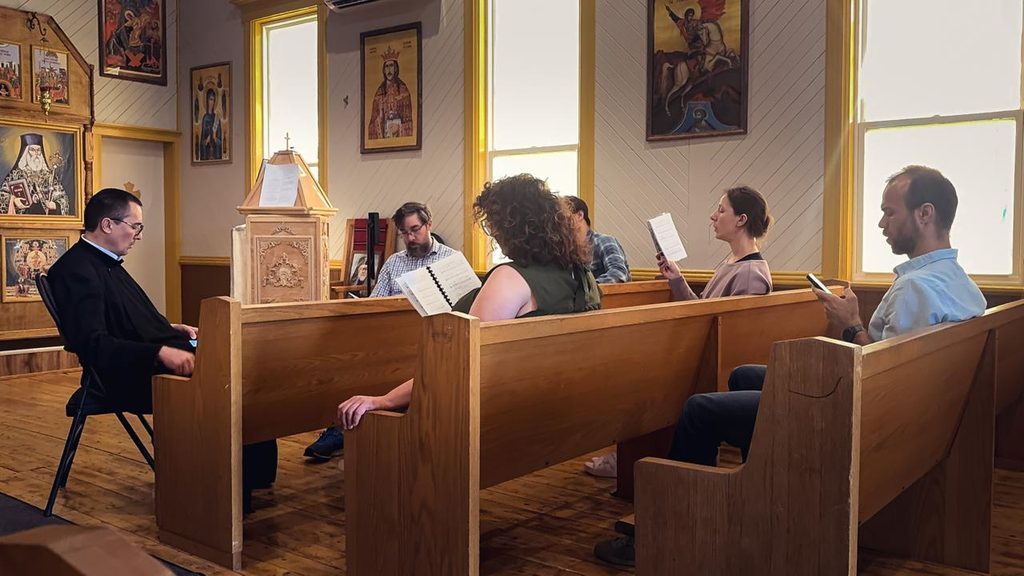
With the blessing of His Eminence Archbishop Nathaniel and His Grace Bishop Andrei, the first session of this Byzantine Music Summer School took place from June 8 to 13, 2026, at St. Varlaam Orthodox Parish in Moncton, New Brunswick, with the support and participation of the parish priest, Father Lucian Vasile, and his wife, Mrs. Mikhai Vasile.
The daily classes, held both in the morning and in the evening, were attended almost constantly by eleven participants – a promising core group for the future initiation and education of other parish members.
The theoretical content of the guide was combined into an engaging lecture with practical examples drawn from music and liturgical books, offering those present the chance to practice on their own and to understand the musical harmony between the cantor, the congregation in the church, and the clergy serving at the holy altar.
As one of the participants put it, “I didn’t really know what I didn’t actually know!” the theoretical-practical course served primarily as a liturgical guide and as a means of discovering the role of the worshiper in the celebration of the liturgical service.
The course is structured into five modules, covered gradually over five days of sessions, with the aim of practicing liturgical hymns and services specific to both the beginning and the end of the liturgical day: the Akathist, the Paraklesis, Vespers, Matins, and the Divine Liturgy.
The History and Tradition module presents the evolution of church music from the Jewish Temple and Synagogue to the early Christian communities and the incipient musical expression in the form of psalmody in the earliest church entities.
The Byzantine Notation module familiarizes students with the basic concepts of psaltic music by comparing it to Western theory and notation, to facilitate understanding.
Liturgy and Worship is the module that integrates the sung prayers of parishioners into the church’s organized liturgical framework, paying close attention to harmonization and synchronization with the cantor and the clergy serving in the holy altar.
In the Chant Practice module, students explore liturgical books and their functions, as well as the basic rules for the sung or recited interpretation of liturgical texts.
Living the Tradition is the way in which all members of the Church – clergy, cantors, and the faithful – take up, enrich, and perpetuate the liturgical tradition, preserving its authenticity while also creating new spiritual dimensions in the tradition of the Holy Fathers, the Church Canons, and the teachings of Christ. The faithful are the living body of the Church and of Christ.
Of course, without claiming to complete this course even as a beginner psalt musician, interested and active participation provides a deeper understanding of the psaltic music sung in church, insight into the best way to engage with the sacred texts of Holy Scripture and liturgical books, as well as the discovery of other spiritual paths within the church’s liturgical practice.
Identifying oneself as a musical person within the church opens up many opportunities to draw closer to others and to Christ. Through church singing, the mind is soothed, the heart is softened, and the soul gains the power of healing, love, and forgiveness, transfiguring the body – even if only for a brief moment – as a sign of eternity and the resurrection to come.
In the hope that the initiative to offer a course in liturgical music will be followed by other parishes of our episcopate, we pray to the Good Lord to receive and hear the prayerful voices of all the clergy and faithful of the Church.
* PhD in Theology with specialization in vocal study of the Church Chant and the aesthetics of Ministry; Parish Priest at Saint John the Evangelist Romanian Orthodox Church, Toronto, Ontario.
The post Byzantine Music Summer School appeared first on The Romanian Orthodox Episcopate of America.