This post was originally published on this site
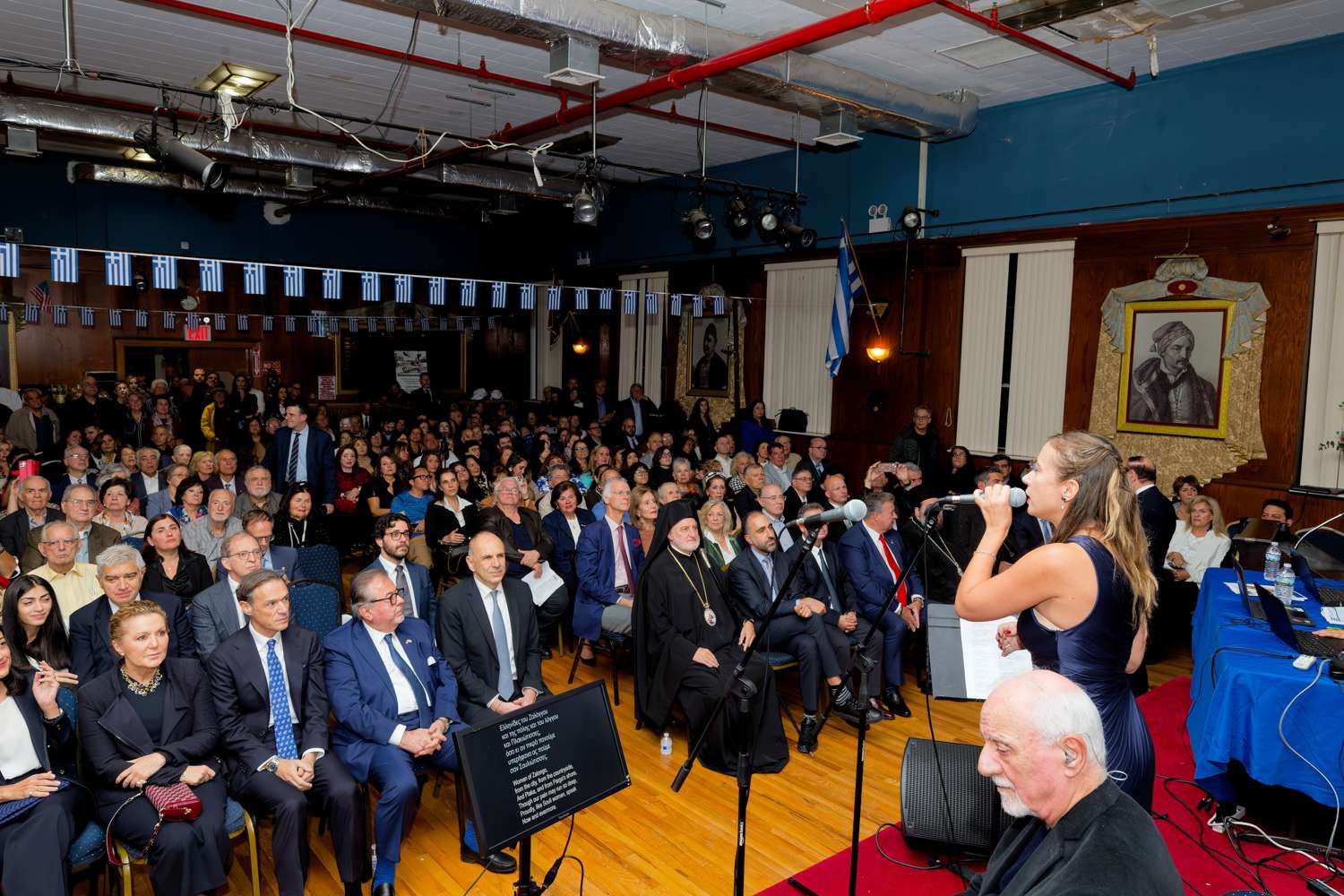
The Stathakion Center in Astoria, headquarters of the Federation of Hellenic Societies of Greater New York, proved far too small to accommodate both the crowd and the enthusiasm of the Greek community members who gathered to celebrate the national anniversary of October 28. This year’s event had a special significance: it was the first in many years to be held by a reunited Federation, which had recently overcome its divisions and elected the distinguished Greek American Christos Vournias as a unifying president.
The Federation’s unity was immediately welcomed by both the Church and the Greek state, with His Eminence Archbishop Elpidophoros of America and the Minister of Foreign Affairs of the Hellenic Republic, George Gerapetritis, honoring yesterday’s event with their presence. To help bring about a resolution, the Archbishop had previously made unity within the Federation a condition for his participation in its events, while Mr. Gerapetritis is the first Greek Foreign Minister to visit the Stathakion Center in more than two decades.
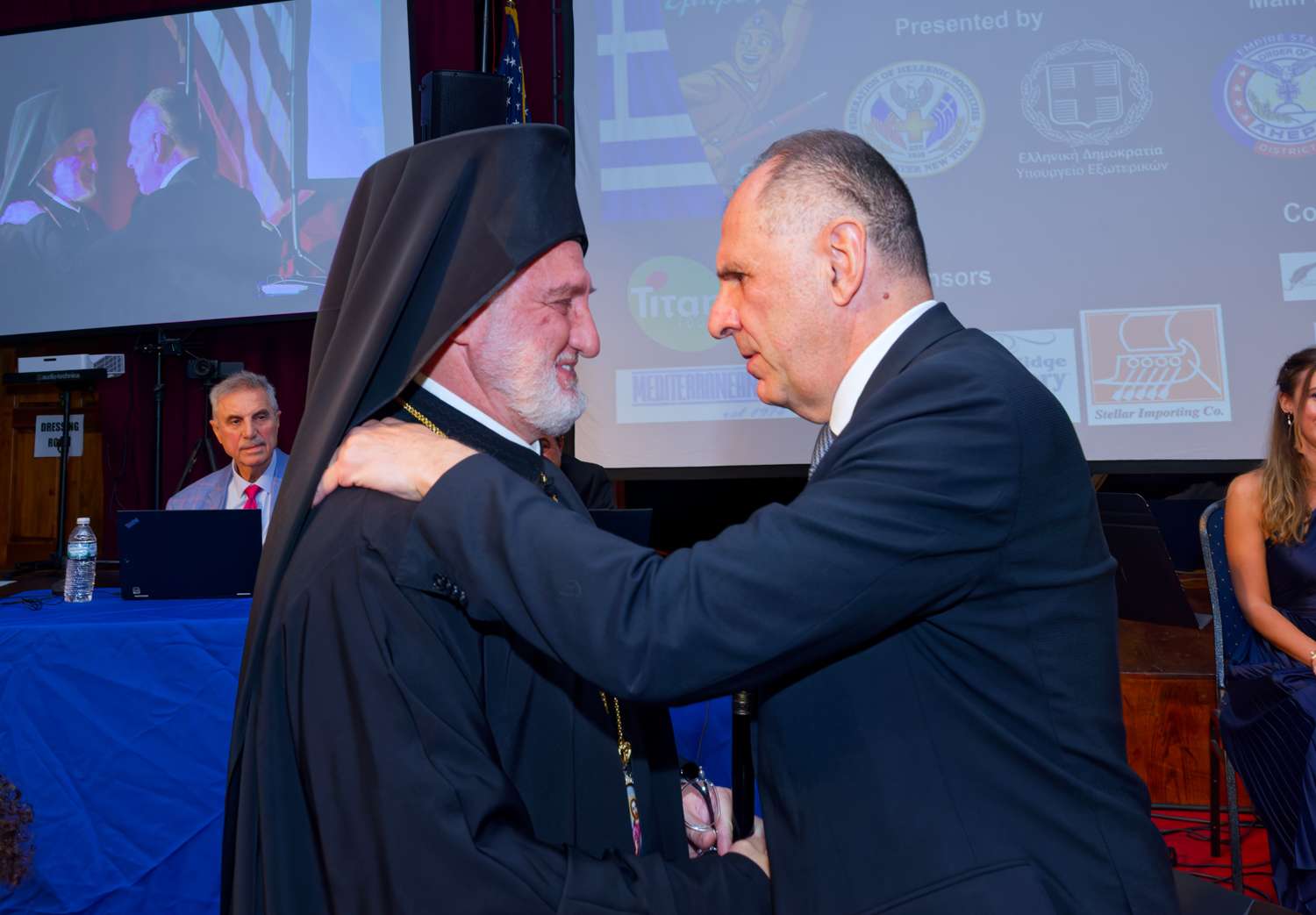
Also attending on behalf of the Hellenic Republic were Greece’s Ambassador in Washington, Antonis Alexandridis; Greece’s Permanent Representative to the United Nations, Aglaia Balta; the Consul General of Greece in New York, Iphigenia Kanara; and the Director of Greece’s Public Diplomacy Office in New York, Spyros Diamantis.
The event combined an account of Greece’s participation in World War II with a musical program of songs from the era, audiovisual material featuring historical documents, films, and dramatized accounts of the epic struggle of 1940.
The event was planned by Evangelos Athanasopoulos and Grigoris Marinakis, together with Peter Stavrianidis, President of the Federation of Hellenic American Societies of New Jersey. Nikitas Tampakis directed the musical program and performed an exceptional selection of songs alongside Angeliki Psoni, accompanied by Kostas Psarros on bouzouki and Glavkos Kontemeniotis on keyboards.
The speakers’ accounts of the heroism and sacrifices of the Greek people during the war, the role of the women of Pindus in supplying the soldiers, and the contribution of Greek military chaplains, together with the performers’ renditions of songs associated with the epic struggle of 1940, had already created an emotionally charged atmosphere in the hall by the time Archbishop Elpidophoros of America and Foreign Minister George Gerapetritis took the floor. The musical performances culminated in Angeliki Psoni’s moving rendition of the iconic “Children, Children of Greece.”
Addressing those present, Archbishop Elpidophoros spoke of the significance of having senior officials of the Hellenic Republic at the event and, speaking directly to Mr. Vournias, emphasized the importance of unity within the Federation. In his address, His Eminence highlighted the spirit of Hellenism’s struggles for freedom throughout history, which continues to inspire people today:
“There are moments in the history of a people when time seems to stand still,” the Archbishop said, turning to a literary reference to illustrate how the Greek army had surpassed its apparent limits by defeating an adversary that was, in theory, overwhelmingly superior in every respect:
“Nikos Kazantzakis, in his work “Report to Greco”, describes a symbolic encounter with the great Cretan painter Doménikos Theotokópoulos, whom he calls his spiritual grandfather. He asks him for advice, and the painter replies: ‘Reach as far as you can, my child.’ But Kazantzakis is not satisfied. He asks for advice that is even harder, more demanding. And then he hears the answer: ‘Reach farther than you can!’ An entire approach to life is distilled into this phrase. Human beings are called not merely to exhaust their potential, but to dare to transcend what they consider impossible.”
The Archbishop also reflected on a second moment in which time seemed to stand still. The funeral of the national poet Kostis Palamas during the Occupation, in February 1943, became a symbolic act of resistance by the Greek people against the occupier. The verses of Angelos Sikelianos, recited by the Archbishop, captured the spirit of that day for eternity:
“Sound, you trumpets… Thunderous bells,
Shake the whole country from end to end…
Roar, drums of war…
You formidable flags, unfurl in the air!”
“Poetry that day was not merely a literary creation,” the Archbishop said. “It became an act of freedom.” With a third literary reference, this time to Yannis Ritsos, Archbishop Elpidophoros sought to connect Hellenism with Orthodoxy, and the struggles for national freedom with the pursuit of existential freedom as understood in Orthodoxy: “These trees will not settle for less sky.”
“This image is deeply moving. A tree cannot live without the sky. Nor can a human being truly live without freedom. Yet it is not enough simply to remove the chains imposed on us by others. There are chains we create ourselves. There are prisons without walls. It is precisely here, my dear friends, that historical experience meets the deeper message of the Gospel. The freedom Christ offers us is not the freedom to dominate others. It is the freedom of sacrificial love. And this dimension of freedom allows us to understand more deeply the sacrifice of the people of 1940.”
Before yielding the floor to Mr. Gerapetritis, Archbishop Elpidophoros also referred to those who lose their sense of proportion when writing on social media about the serious and sensitive issues of Greek foreign policy—”matters not to be trifled with”—hurling accusations, spreading rumors, or expressing views that defy all reason and are uninformed:
“Our duty, my dear friends,” the Archbishop said, “is to support with all our strength the foreign policy charted by our national leadership. Government officials, and especially our experienced diplomats at the Ministry of Foreign Affairs, having all the facts at their disposal, make decisions and determine the most appropriate strategy for our homeland. It is not wise for us to judge our national strategy, because we do not know what they are in a position to know. Quite simply, we cannot, and at times should not, know every aspect of these matters. We must have confidence in our homeland and preserve our national unity, especially on national issues.” Inviting George Gerapetritis to the podium, he concluded: “Mr. Minister, we look to you and your colleagues with confidence and assure you that all of us—the Church, the Greek diaspora, and all diaspora organizations—are always at the service of the nation. Long live Greece!”
“If you want to know the soul of Greece, travel!” George Gerapetritis opened his speech with these words, seeking to emphasize the special relationship between the worldwide Greek diaspora and the motherland, and the duty of Greece’s national leadership to keep alive the bridges that unite Greeks everywhere while also connecting their present with their past and future. The Foreign Minister also shared a personal account of his family’s history. As he explained, his family had set out from a small village on a small island in the Dodecanese, come to the United States, and, after working hard, managed to return home.
“In your faces, I see my own ancestors”, he said. He went on to speak of the particular honor he felt in being at the Federation and congratulated Mr. Vournias, likewise emphasizing the importance of unity: “Greece’s most precious jewel is the unity of its people!”
Mr. Gerapetritis then congratulated those who had contributed to the event, making special mention of the singers. Speaking about the spirit of October 28, he observed: “Greece has always defied the odds; Greece was the country that said the great Nos. We will never shy away from saying a resounding “NO” if necessary to defend our homeland.”
The Greek Foreign Minister spoke about Greece’s position in the world today, its voice being heard in international forums, its presidency of the Security Council, and its upcoming presidency of the European Council. Referring to the agreement with the Republic of Egypt concerning the Holy Monastery of Saint Catherine at Sinai, he emphasized the relationship between Hellenism and Orthodoxy through the centuries. He struggled to hold back tears as he spoke of the value of Greek identity, while also affirming the country’s determination to resist any hostile designs against it.
“There is no easy road” for those who harbor such designs against Greece, Mr. Gerapetritis warned to enthusiastic applause, before offering his wish: “Happy Anniversary, Greece!”
The post Archbishop urges support for Greece’s foreign policy appeared first on Orthodox Observer.