This post was originally published on this site
The Greek National Opera chose to place Crete and Nikos Kazantzakis at the center of its landmark, debut performance in New York City at the historic Carnegie Hall. The work of the celebrated author served as a source of inspiration for a number of composers, while several of his books are familiar to the American public through English translations, and most notably through the iconic film adaptation Zorba the Greek. Artistic Director Giorgos Koumendakis—himself a native of Crete—leveraged the New York audience’s familiarity with Kazantzakis’s legacy to curate a program that converses deeply with three of the author’s primary thematic pillars: the search for identity, the relationship with the divine, and the pursuit of both national and existential freedom.
The concert naturally opened with a tribute to the legendary Greek musician whose career was inextricably linked with Carnegie Hall: Dimitri Mitropoulos (1896–1960). The iconic conductor, who served for 11 years as Music Director of the New York Philharmonic, stood on the podium of Carnegie Hall for the last time on the afternoon of Sunday, January 24, 1960, just months before his untimely passing. Beyond his conducting legacy, Mitropoulos was also a composer, with one of his early works drawing directly from Cretan tradition. Cretan Feast was originally composed for piano in 1919 and orchestrated a decade later by another legendary—and tragically short-lived—Greek composer, Nikos Skalkottas (1904–1949).
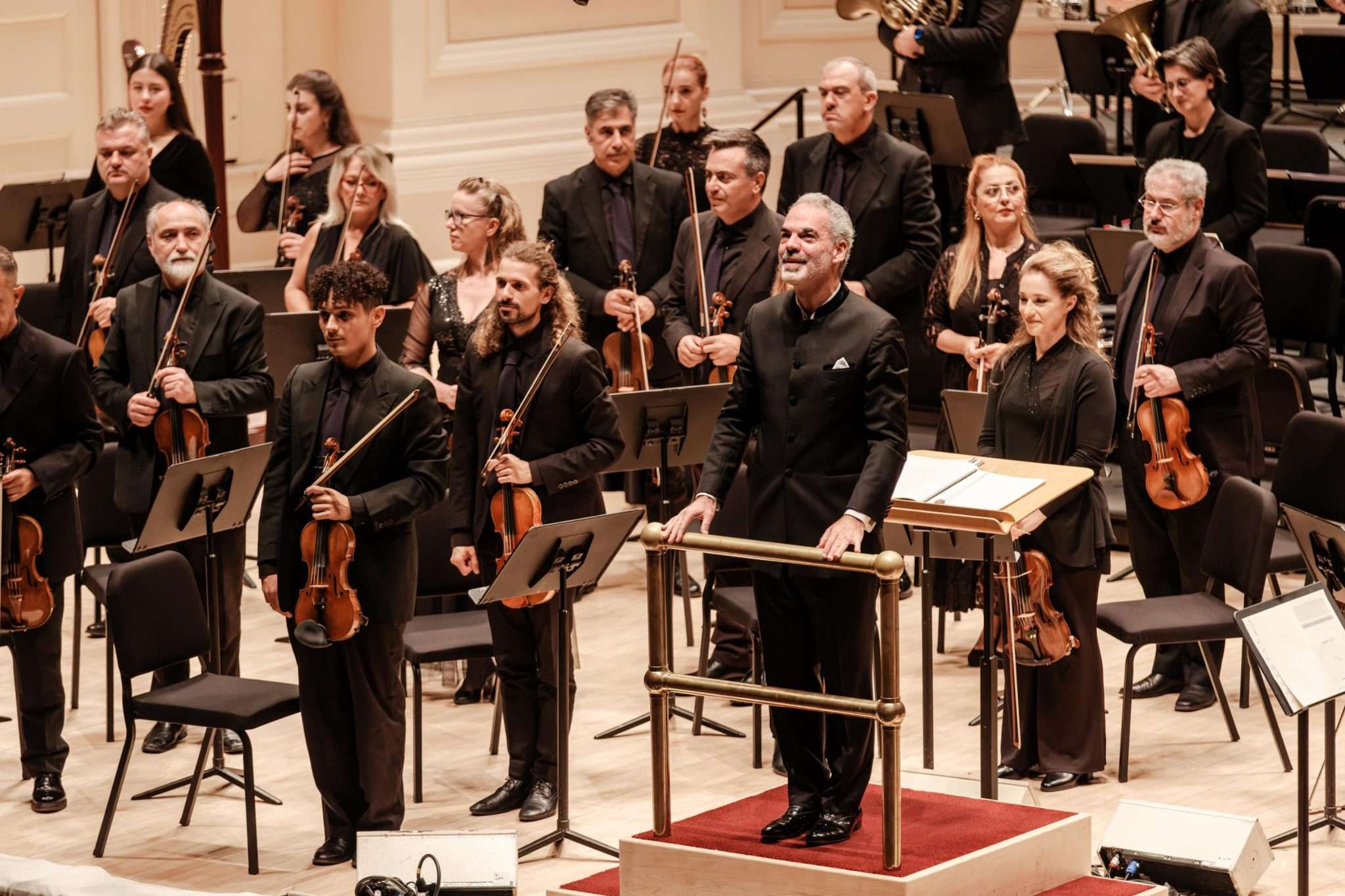
Skalkottas likewise delved deeply into Greek folk tradition, transforming it through his unique modernist idiom in his 36 Greek Dances. Three Cretan-inspired dances were performed during the evening, allowing the audience to recognize the distinctive rhythm of the Pentozali and the folk melody “The Maidens of Crete.” The interpretation by the conductor and the orchestra highlighted the intricate details and folk elements of the score, emphasizing their rhythmic vitality and symphonic richness.
The program continued with Giorgos Koumendakis’s Amor Fati. Composed in 2007 to mark the 50th anniversary of Nikos Kazantzakis’s death, the work represents—in the composer’s own words—a personal exploration of tradition and the existential questions central to Kazantzakis’s oeuvre. Koumendakis approaches “love of fate” not as fatalism, but as “a deeply active stance toward life—an acceptance of what cannot be changed while maintaining the inner drive to struggle, create, and move forward.” The evocative strings gradually guided the piece into silence, a mood respected by the audience, who allowed several seconds to pass before breaking into applause.
Following the intermission, the Manos Hadjidakis Ensemble took the stage alongside soprano Maria Kostraki to perform Hadjidakis’s Captain Michalis, inspired by Kazantzakis’s novel. The work reflects not only the struggle for Cretan freedom, but also Kazantzakis’s existential quests, his homeland, and his relationship with the divine. Conducting a small ensemble—an uncommon practice in Greek music—proved particularly impactful: Vassilis Christopoulos brought precision, cohesion, and sonic refinement to the performance, highlighting the contrasting moods of the score. In seamless synergy with the conductor, Maria Kostraki delivered a soulful and nuanced interpretation in what proved to be a highlight of the evening, earning well-deserved applause.
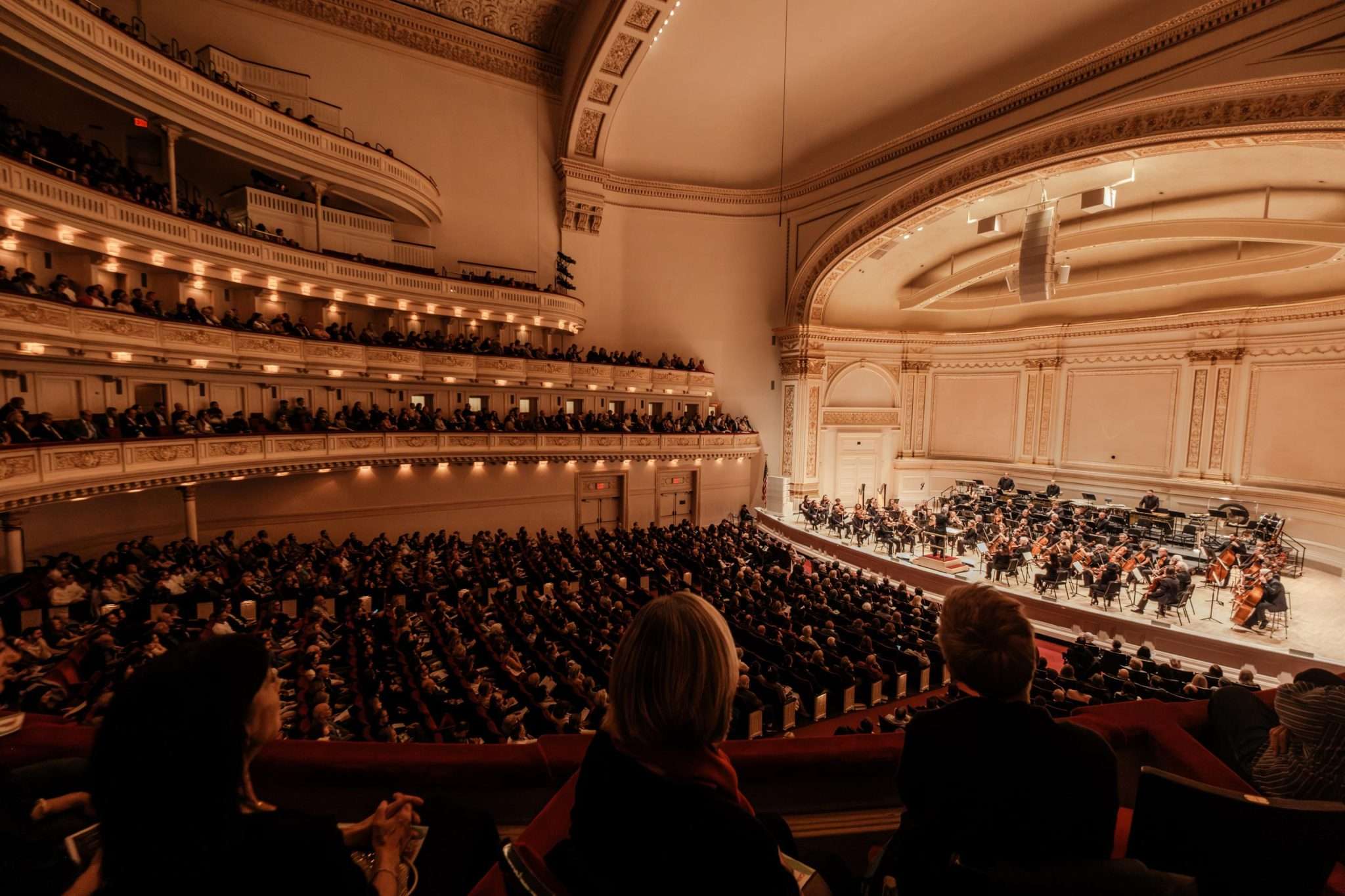
The full orchestra then returned to the stage, joined by acclaimed Georgian mezzo-soprano Anita Rachvelishvili and bouzouki virtuosos Vangelis Trigas and Paris Perysinakis, to perform selections from Mikis Theodorakis’s ballet Zorba the Greek (composed in 1987, when the composer revisited the themes and material of his famous 1964 film score).Here again, the orchestra under Christopoulos revealed the multi-layered depth and richness of Theodorakis’s music far beyond its famous motif, filling the Stern Auditorium with a sound world that masterfully bridges classical composition with Greek folk tradition.
At the first appearance of the iconic melody, members of the audience briefly broke concert etiquette and began to clap along. Recognizing that the piece still held more musical development, Christopoulos turned to the hall with a characteristic gesture to restrain—or rather delay—their enthusiasm. Rachvelishvili, a star of the world’s major opera houses including the Metropolitan Opera, has performed frequently in Greece with the Greek National Opera; through this collaboration, she sought to deepen her connection with the institution and the Greek public.
As the piece surged toward its climax, Christopoulos invited the audience’s rhythmic clapping, joined from the stage by Rachvelishvili. The applause accompanied the music through its final bars, culminating in an enthusiastic ovation honoring the Orchestra of the Greek National Opera.
Following the performance, conductor Vassilis Christopoulos spoke to the Orthodox Observer about the experience: “It was a great joy and honor for me to present an anthology of Greek music inspired by Crete and Kazantzakis with my beloved Orchestra of the Greek National Opera and the Manos Hadjidakis Ensemble at the legendary Carnegie Hall, experiencing both the enthusiasm of the American public and the deep emotion of the New York Greek-American community.”
The post Greek National Opera brings Crete and Kazantzakis to Carnegie Hall appeared first on Orthodox Observer.