This post was originally published on this site
The Icon Museum and Study Center marked its 20th anniversary Oct. 15 with the opening of the exhibition Light from the East: Masterpieces from the Ikonen-Museum Recklinghausen and the start of a two-day symposium, Encountering the Sacred Image: Highlights from the Icon Museum and Study Center.
The only specialized museum for icons and Eastern Christian art in the U.S., the Icon Museum and Study Center opened Oct. 15, 2006, then dedicated solely to Russian iconography. In recent years, the museum has begun diversifying its collection to include Greek, Veneto-Cretan, and Ethiopian works as well.
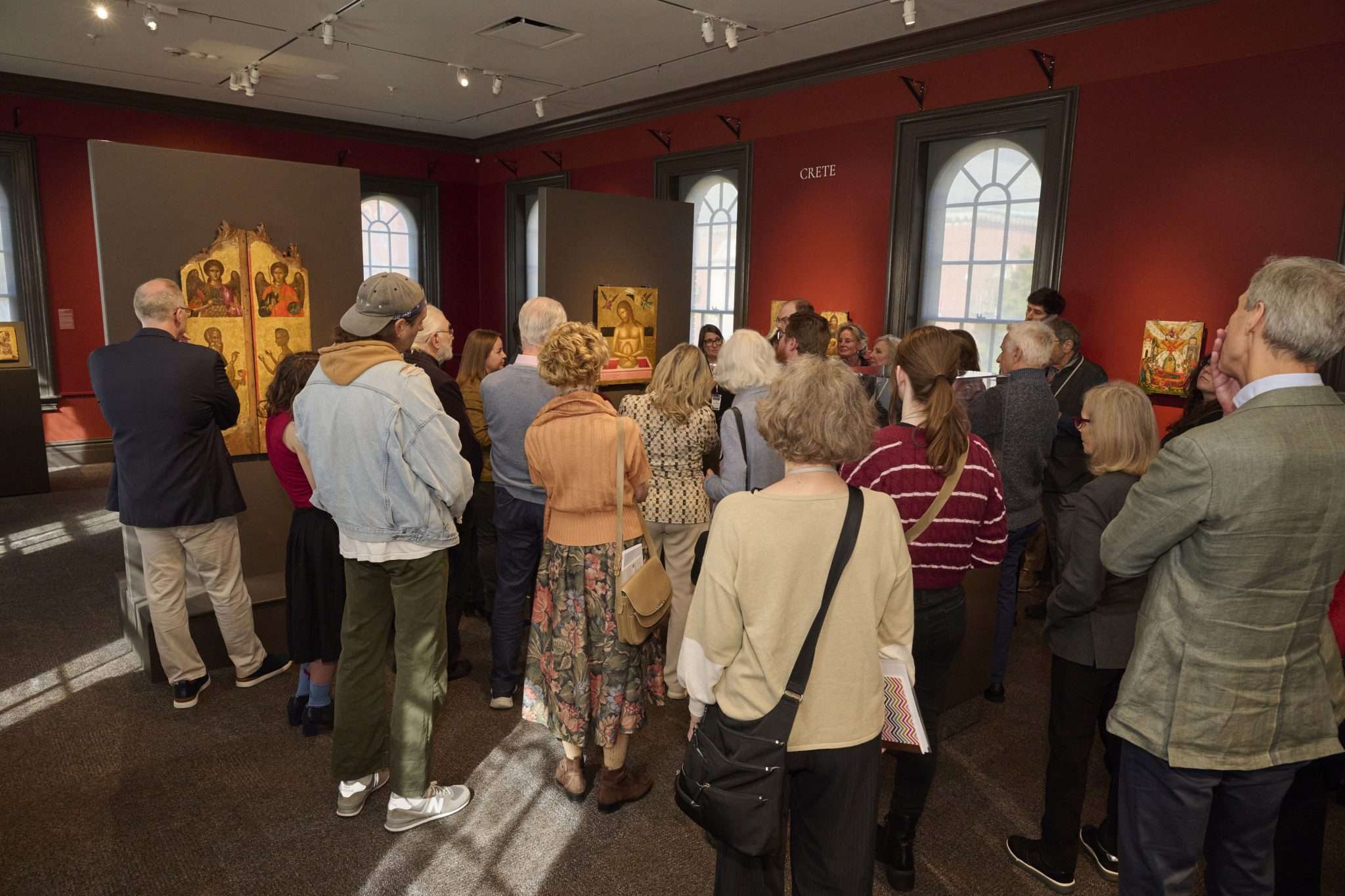
Germany’s Ikonen-Museum Recklinghausen holds the largest and most important collection of Orthodox icons in Western Europe, and Light from the East shows pieces from the Recklinghausen in the U.S. for the first time. According to the museum, it is the first U.S. exhibition devoted to the post-Byzantine legacies of both Slavic and Greek traditions.
A tour of the exhibition
The day began with a tour led by Elliot Mackin, Associate Curator and Study Center Manager. Mackin told attendees they were the first members of the public to see the exhibition.
“What [the exhibition] became was a story of Orthodox iconography from the fall of Constantinople in 1453 through the Bolshevik Revolution in 1917,” Mackin said, sharing the exhibition tells its story in reverse. As visitors enter the space, they first encounter an early 20th-century Old Believer icon painted just before the Russian Revolution before moving back in time. One half of the gallery follows Moscow and the rise of Imperial Russia back to medieval Novgorod; the opposite wall presents icons from the Greek-speaking world, generally from Crete.
A film premiere
Attendees also saw the U.S. premiere of the documentary Living Prayer in Christianity, directed by the late Jean-Claude Lubtchansky. The film explores Orthodox contemplative practice, focusing on St. Catherine’s Monastery at Mount Sinai, Mount Athos, and various sites in Russia. Introducing the film, Richard Temple of London’s Temple Gallery described it as both a documentary and “a work of art” that needs little introduction.
Symposium presentations
Each speaker on the first day focused on an icon in the museum’s collection.
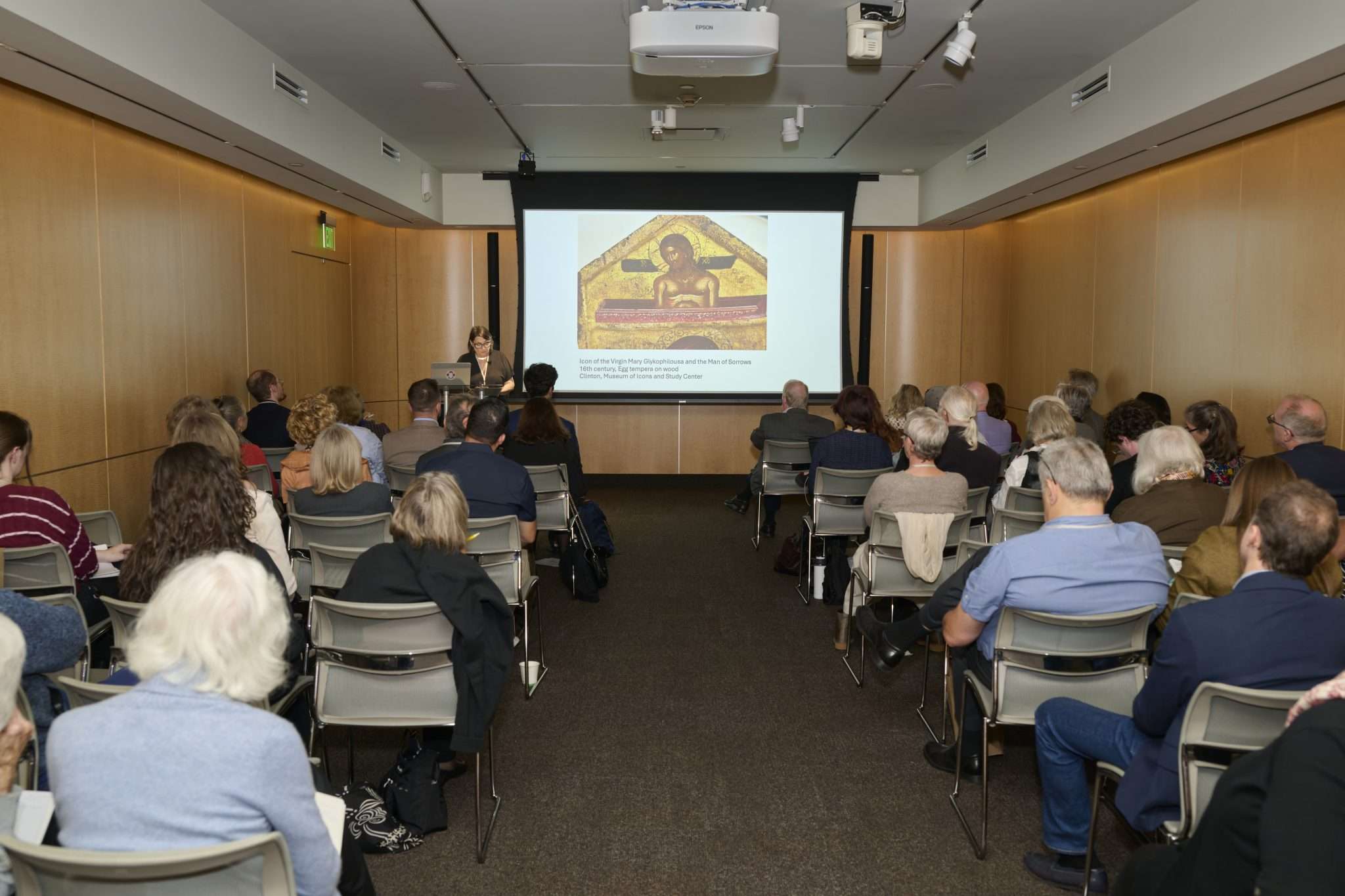
Eva Haustein-Bartsch of the Ikonen-Museum Recklinghausen presented a 16th-century icon the museum acquired at an Italian auction in 2023. The small panel pairs the Mother of God Tenderness with Christ, Man of Sorrows. Haustein-Bartsch said the pointed top of the panel is highly unusual for an icon in the Cretan style, and is more typical of 13th- and 14th-century Italian painting. She traced comparable Byzantine and post-Byzantine works and concluded that a Western patron likely requested the format. Traces of mountings on both sides indicate the panel was the center of a private devotional diptych. Its side panels have not been found, but, Haustein-Bartsch said, “it’s not out of the question that they may show up one day.”
Irina Shalina, head researcher at the State Russian Museum in St. Petersburg, discussed the museum’s icon for the month of February, one of 12 icons that made up a calendar of saints and feasts. The set was installed in 1569 in the Dormition Cathedral of the Monastery of St. Joseph of Volokolamsk near Moscow. Inscriptions on the backs of two panels name Archbishop Lavrentiy of Kazan, a former abbot of the monastery, as donor. Shalina said an epidemic that killed dozens of the monastery’s monks around that time may also have inspired the commission.
Justin Willson, Assistant Professor at Yale University and the museum’s former curator, presented the Mother of God, the Life-Giving Spring, donated to the museum in 2022. Removing a layer of varnish revealed the signature of Frangias Kavertzas, a Cretan painter active in Heraklion between 1615 and 1647, whose life Willson reconstructed from Venetian notarial records. Willson dated the piece to the late 1630s and said it shows the painter moving toward the experiments of the late 16th century while remaining rooted in earlier models. Kavertzas, he said, was “stable but not really rigid.”
Second day and looking ahead
The symposium continued Oct. 16 with presentations by Maria Vassilaki of the University of Thessaly, Wendy Salmond of Chapman University, Athanasios Semoglou of the University of Thessaloniki, independent scholar Natalia Komashko, Evan Freeman of Simon Fraser University, and Mackin. Attendees were also invited to explore the museum’s galleries and collections storage.
The Icon Museum’s Executive Director Simon Morsink also announced the museum will present an exhibition of post-Byzantine icons in America, opening in October 2028. The show will follow Byzantium After Byzantium at the Metropolitan Museum of Art, which closes in September 2028.
“We’ll keep the fire burning,” Morsink said.
The post Icon Museum and Study Center marks 20th anniversary with rare loans, scholarly symposium appeared first on Orthodox Observer.