This post was originally published on this site
For centuries, Byzantine chant has been the musical language of Orthodox worship, shaping the prayer of the Church and transmitting its theology through sacred melody. Today, this ancient tradition is experiencing a remarkable revival throughout the Greek Orthodox Archdiocese of America. What was once regarded by some as a specialized and declining discipline has become one of the fastest-growing areas of liturgical ministry, thanks to the renewed commitment of the Archdiocese and its National Ministries to educating clergy, cantors, and parish musicians who will serve the Church for generations to come.
At the heart of this renewal stand two complementary institutions: Holy Cross Greek Orthodox School of Theology and the School of Byzantine Music of the Greek Orthodox Archdiocese of America. Working in close collaboration, they have established a comprehensive model of formation that combines rigorous academic study, practical liturgical experience, and immersion in the living tradition of Byzantine chant.
With the blessing of His Eminence Archbishop Elpidophoros of America, this vision recently found expression in a pilgrimage and educational mission to Thessaloniki and Mount Athos, organized by the School of Byzantine Music in cooperation with the Metropolis of Thessaloniki. The delegation was accompanied by Georgios Theodoridis, Archon Music Instructor of the Greek Orthodox Archdiocese of America, and Protopresbyter Romanos Karanos, Professor of Byzantine Music at Holy Cross.
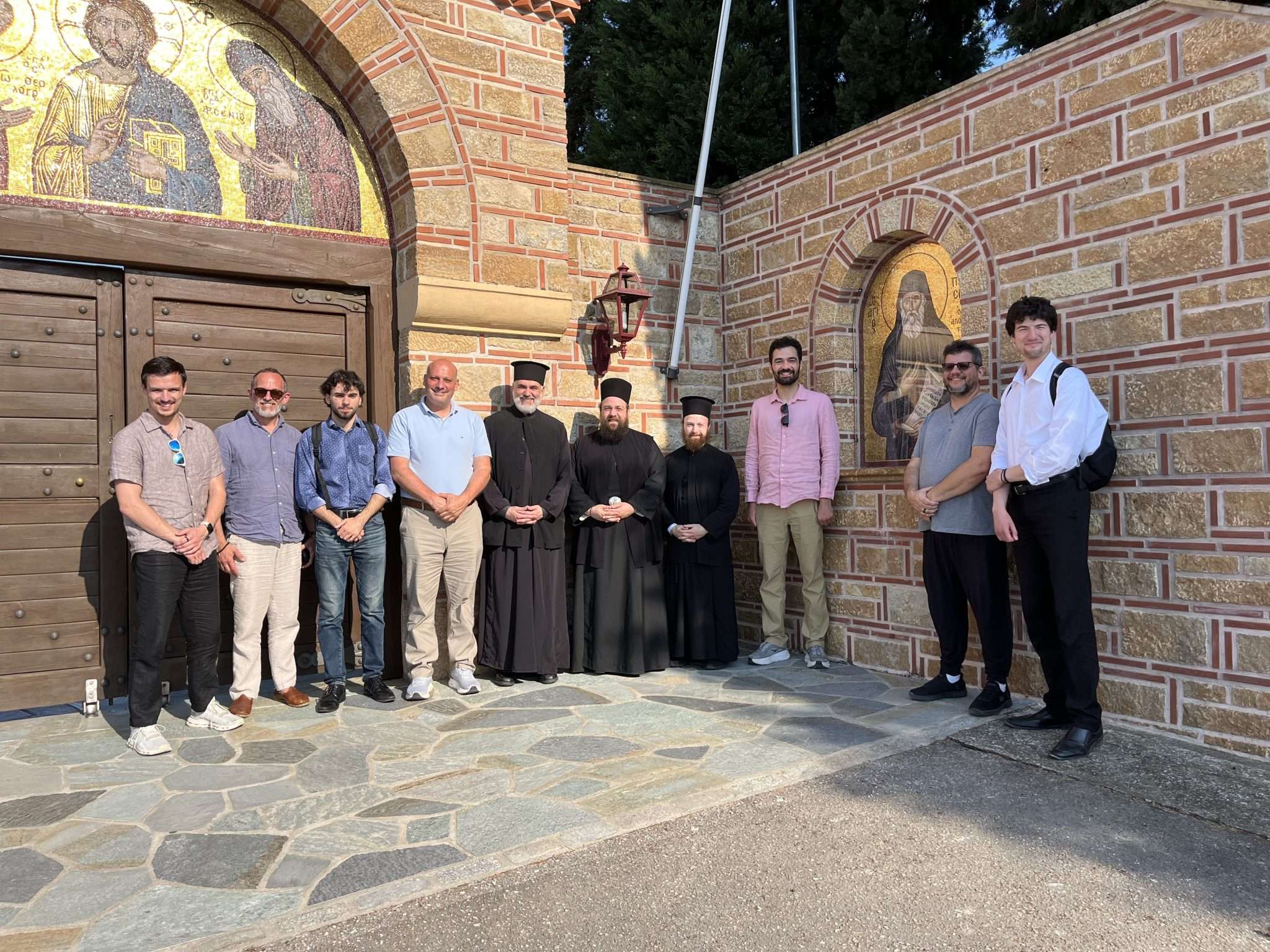
While classroom instruction provides students with a solid foundation in musical theory and notation, the pilgrimage offered something equally essential: participation in the living tradition of the Church. By chanting in historic churches, worshipping with monastic communities, and learning from distinguished Greek cantors, participants experienced Byzantine chant not merely as an academic discipline but as a living expression of Orthodox prayer. One of the spiritual highlights was the visit to New Skete on Mount Athos, where the group received instruction from Elder Damaskinos on the Athonite tradition of Byzantine chant. His guidance demonstrated the inseparable relationship between prayer, ascetic life, and sacred music that has shaped Orthodox worship for centuries.
Throughout their stay in Thessaloniki, the delegation participated actively in the liturgical life of the local Church, chanting at numerous services. A particular blessing was their participation in the Hierarchical Divine Liturgy at the St. Demetrios Cathedral on the occasion of the birthday of His Eminence Metropolitan Philotheos of Thessaloniki, allowing the students to apply years of study within the authentic liturgical setting for which Byzantine chant was created.
The educational culmination of the pilgrimage came with diploma examinations administered by the School of Byzantine Music of the Metropolis of Thessaloniki. Six graduates of the Holy Cross Certificate in Byzantine Music successfully completed the examinations for the Diploma of Mousikodidaskalos (Music Instructor), earning the grade of Excellent: Fr. Panayiotis Steele, John Anton, Matthew Cramer, Philip Gurguliatos, Samuel Herron, and Vasileios Karanos. Panagiotis Malamis completed the examination for the Certificate in Byzantine Music with the grade of Excellent and will begin studies at Holy Cross this fall. These accomplishments reflect not only individual achievement but also the success of a comprehensive educational vision developed over the past decade.
Since its establishment in 2013, the Certificate in Byzantine Music Program at Holy Cross has become the first comprehensive certification program in the Western Hemisphere modeled on the rigorous standards of conservatories in Greece. Through systematic coursework, daily chapel participation, choral singing, and comprehensive examinations, students receive both musical proficiency and the liturgical formation necessary for service in Orthodox parishes. The program has prepared dozens of clergy, cantors, choir directors, composers, and teachers who now serve throughout the Archdioceseand beyond.
Complementing this work, the School of Byzantine Music has expanded access to Byzantine music education through online instruction. Since launching its virtual program, the School has enrolled over one hundred students from across North America, making systematic training available regardless of geographic location. Many instructors are themselves graduates of the Holy Cross Certificate program, illustrating the close partnership between the two institutions and the emergence of a new generation of American-trained teachers.
The fruits of these initiatives are already evident throughout the Archdiocese. More parishes now have trained cantors, increasing numbers of seminarians receive formal musical education, and new English-language and bilingual musical settings continue to be composed by American composers. Workshops, conferences, festivals, and scholarly collaborations further strengthen the place of Byzantine chant within the liturgical life of the Church. The partnership with the Metropolis of Thessaloniki also enriches this mission by connecting students with one of the foremost centers of Byzantine music. Immersion in the liturgical life of Thessaloniki and the spiritual heritage of Mount Athos deepens their understanding of the tradition they have studied and prepares them to serve their own communities more effectively.
The examinations concluded with an audience granted by His Eminence Metropolitan Philotheos of Thessaloniki, who warmly congratulated the graduates and their instructors. He expressed his appreciation for the vibrant ministry of the Greek Orthodox Archdiocese of America, which he had recently witnessed during the Clergy-Laity Congress in Cleveland, and praised the high standard of Byzantine music education being cultivated through Holy Cross and the School of Byzantine Music. As a gesture of gratitude for his hospitality and paternal blessing, members of the delegation performed Ephrixe Ge (“The Earth Trembled”) and the Most Delightful Kratima by the post-Byzantine composer Panagiotis Chalatzoglou, offering a moving testimony to the unbroken continuity of the Byzantine chant tradition and its transmission to the new generation of cantors in America.
More than a successful educational excursion, this pilgrimage embodied a broader vision for the future of the Greek Orthodox Archdiocese of America: forming church musicians whose ministry is rooted in academic excellence, liturgical experience, spiritual formation, and the living tradition of the Orthodox Church. Through the collaborative efforts of the School of Byzantine Music, Holy Cross Greek Orthodox School of Theology, and valued partners such as the Holy Metropolis of Thessaloniki, a new generation of clergy, cantors, composers, and music teachers is ensuring that Byzantine chant will continue to enrich the witness of the Church in America for generations to come.
For more information on the Byzantine Music programs at Holy Cross Greek Orthodox School of Theology and the School of Byzantine Music of the Greek Orthodox Archdiocese of America, please visit www.hchc.edu/certificate-programs/certificate-in-byzantine-music/ and sbm.goarch.org.
The post HCHC, School of Byzantine Music participate in pilgrimage to Thessaloniki and Mt. Athos appeared first on Orthodox Observer.