This post was originally published on this site
NEW YORK — His Eminence Archbishop Elpidophoros of America received Dr. Stelios Kympouropoulos at the headquarters of the Greek Orthodox Archdiocese of America. Dr. Kympouropoulos was recently appointed by the government of Prime Minister Kyriakos Mitsotakis to lead the National Accessibility Authority, the body that advises the Greek state on disability policy and universal access. His appointment was approved by the Hellenic Parliament’s Committee on Institutions and Transparency in April.
Dr. Kympouropoulos told the Archbishop that his ambition in the new role is to advance participation and access for people with disabilities across Greek public life, beginning with the basics: Greece, he noted, still lacks reliable statistical data on its disabled population, and one of his first priorities is to work with the national statistical service to map a community generally estimated at ten percent or more of society. “It is a very large part of society,” he said, “and it is invisible.”
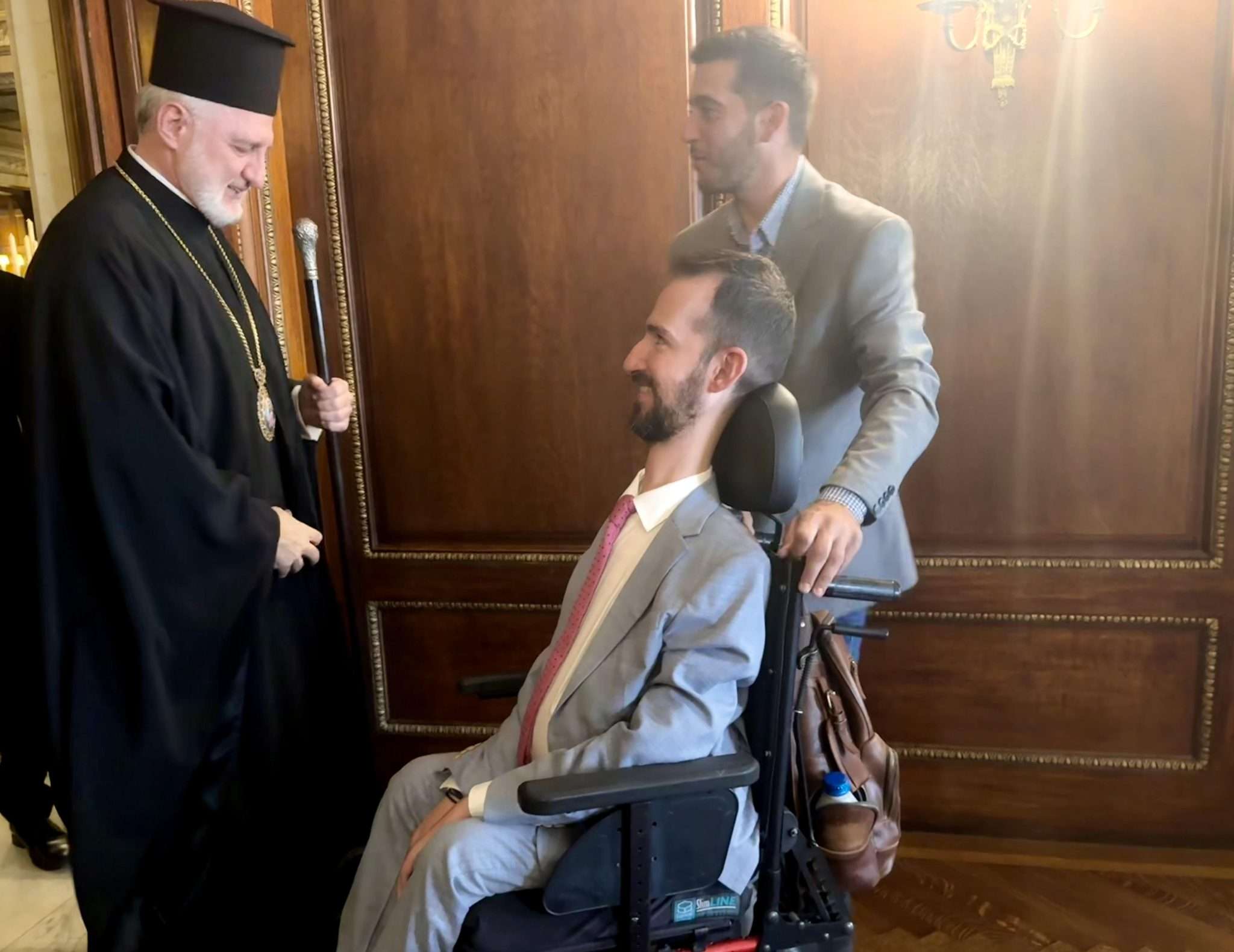
Dr. Kympouropoulos used a simple example to explain why disability should not be treated as a category separating “others” from the rest of society. A person who wears eyeglasses, he noted, also depends on an assistive device. Because glasses are familiar and socially accepted, they do not provoke stigma. A wheelchair, a white cane, sign language, a personal assistant, or an accessible text should be understood in the same way: not as symbols of limitation, but as instruments that make participation possible.
> Previously: Across jurisdictions, voices rise for the ordination of men with disabilities
Born in 1985 and diagnosed with spinal muscular atrophy as an infant, Dr. Kympouropoulos earned his medical degree with honors from the University of Athens and practiced psychiatry at Attikon University Hospital before entering politics. In the 2019 European elections he set a national record for preference votes, and he became known across Europe as an advocate for independent living. At fifteen, his case prompted Greece to change its law on flag bearers in school parades.
The Archbishop responded that the Archdiocese is working to widen participation in the life of the Church at every level, from the laity to the clergy, and to set aside disability as a limiting factor. He pointed to the theological conference the Archdiocese convened in America on disability and ordination, whose proceedings have been submitted to the Ecumenical Patriarchate. Each candidacy, he said, will be examined on its own merits: what the candidate can do, and how the Church can accommodate him. He mentioned one candidate for the diaconate who is blind, for whom the entire Divine Liturgy has been rendered in Braille.
The Greek Orthodox Archdiocese observed National Disability Employment Awareness Month last October and continues an ongoing initiative on disability, accessibility, and inclusion, in which Fr. John Chryssavgis, Archdeacon of the Ecumenical Throne and Executive Director of the Huffington Ecumenical Institute at Holy Cross School of Theology, has played a leading part.
> Previously: Fr. John Chryssavgis urges flexibility on disability and ordination
Dr. Kympouropoulos thanked the Archbishop for the Archdiocese’s work and expressed his readiness to contribute to its efforts on disability. He also shared a wish: to return to New York next year for the Greek Independence Parade on Fifth Avenue. “We look forward to welcoming you at that time,” His Eminence responded.
The post Archbishop Elpidophoros receives Stelios Kympouropoulos, Greece’s new Accessibility Chief appeared first on Orthodox Observer.