This post was originally published on this site
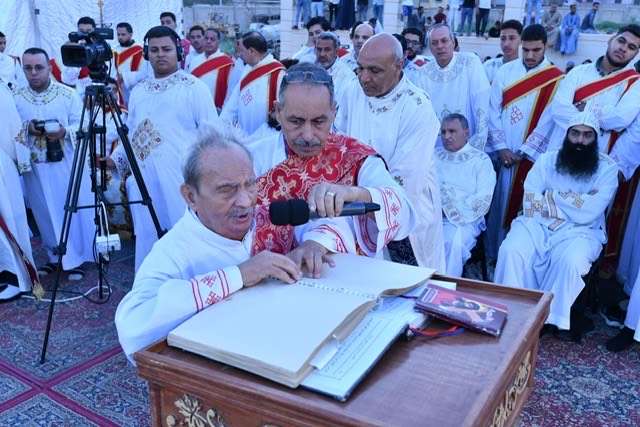
Growing up in Armenia, the Divine Liturgy felt like heaven to a young Deacon Tigran Khachikyan. But born Deaf, and with no interpreters present, he did not understand the words or their meaning. Today, he serves at the altar not in spite of his Deafness, but through it.
“I serve for every Deaf child who wonders if God hears them,” Dn. Tigran says. “I serve so that no Deaf believer ever again feels like a stranger in the house of God.”
Dn. Tigran’s story is at once singular and representative. Across jurisdictions–Eastern and Oriental Orthodox alike–a growing chorus of clergy, scholars, and laity is calling for the Church to more fully include people with disabilities in her liturgical life, including through the discernment of ordination for qualified candidates.
Already at the Altar
Dn. Tigran’s path to ordination was neither planned nor sought.
“It was not my ambition,” he says. “Rather, it was God who called me to serve … He called me to remain and to begin paving a path so that Deaf and hard-of-hearing Orthodox faithful could have access to the fullness of the Church’s liturgical life.”
Rather than treating his deafness as an obstacle to his calling, Dn. Tigran’s bishop, His Eminence Archbishop Hovnan Derderian of the Western Diocese of the Armenian Church, instead focused on Dn. Tigran’s faithfulness, commitment, and readiness to serve. Dn. Tigran now serves at St. Leon Armenian Cathedral in Burbank, California.
“My bishop approached the topic with pastoral discernment, trust, and openness,” Dn. Tigran says. “From the beginning, he blessed me to serve at the Altar and allowed my vocation to unfold through obedience and experience, rather than assumptions about limitation.”
“He recognized that God calls whom He wills, and that the Church’s role is to discern and support that calling. His approach gave me the confidence to serve faithfully and to trust that God was at work beyond human expectations,” Dn. Tigran says.
However, Dn. Tigran is careful to note his experience is not universal. He has a Deaf friend in Armenia whose bishop did not allow his ordination solely because of his deafness. This inconsistency, advocates say, is precisely the problem—and the opportunity.
“I believe awareness and understanding of disability within the Church is growing,” Dn. Tigran says. “With time, and God willing, this will help more bishops and clergy recognize the gifts of Deaf and disabled faithful.”
On Canonical Concerns
A persistent obstacle to broader inclusion is the widely-held (yet, as scholars argue, mistaken) belief that Orthodox canonical tradition forbids the ordination of men with disabilities altogether. Theologian and Archdeacon of the Ecumenical Throne Fr. John Chryssavgis, a consistent advocate for the full participation of people with disabilities, is direct in his assessment.
“I’m quite certain the fallacy that there are canonical impediments to ordaining individuals with disabilities is essentially and especially the result of ignorance and prejudice,” Fr. John says, sharing the Church has always drawn on pastoral experience to determine how canonical tradition should be applied to specific circumstances.
The primary canons on the matter come from the 692 Council of Trullo. “Canon 57 denounces anyone who mocks a disabled person. Canon 77 states that disability is not an impediment to ordination,” Fr. John says. “Canon 78 observes that if a disabled person is not ordained, it is not because of his disability but only because he may be unable to carry out specific priestly duties.”
Any concern, then, is functional rather than categorical.
“What should, I believe, hold ultimate validity in considering ordinands with disabilities are the same universal requirements for every aspirant to the diaconate, priesthood, and episcopate,” Fr. John argues, “so long as—according to the interpretation of the canonical tradition—the specific disability does not pose any impediment for the intended office, service, and ministry.”
> Read our full Q&A with Fr. John Chryssavgis
Fr. John is particularly emphatic on the question of the diaconate, noting that deacons are neither primarily nor exclusively liturgical ministers. Rather, their service encompasses a far wider range of work than is often appreciated. “The canons and their commentaries offer a certain flexibility for the ordination of individuals with disabilities so long as they can respond to and fulfill their ministerial obligations,” he says. “That is precisely why I am convinced we should begin to ordain select individuals with disabilities to the diaconate.”
Capacity and Calling
For many, the conversation is personal. Parishioner Nicholas Racheotes recalls wishing to become a priest as a young boy before his mother told him his blindness would make it impossible.
“There are certain parts of the liturgy and certain parts of administering the sacrament that really would be difficult,” Racheotes reflects.
For Racheotes, the principle is straightforward: each person should be free to participate in the life of the Church, expressing their vocation to its fullest extent. Even if someone cannot fulfill the duties of a priest, he says, they may still have a calling to the diaconate or as a reader.
Fr. Stavros Akrotirianakis, parish priest at St. John the Baptist Church in Tampa, Florida, arrived at a similar conviction by a different road—not through blindness, but through a physical difference others assumed would disqualify him from the very ministry that now defines his life.
Born with a cleft palate, Fr. Stavros frames his condition as a birth defect rather than a disability, even as he recognizes it had real implications for a priest who must preach, sing, and chant. He took voice lessons, learning how to enunciate and breathe correctly to compensate for not having a roof in his mouth.“Now, it’s like second nature,” Fr. Stavros said in an interview with the Orthodox Observer’s Salvatore Ambrosino. “I feel like I’m very blessed musically–that’s a gift God gave me, undeserved.”
As a child struggling to participate in the St. John Chrysostom Oratorical Festival, Fr. Stavros was told he likely wouldn’t have a career in public speaking. Now, his life is a testament to how God’s grace can work through limitation.
“God could have prevented me from being born with a cleft palate, but He didn’t,” Fr. Stavros says. “Sometimes God uses things for His greater glory.”
Fr. Stavros also raises a question that points toward the future: how do we understand capacity and limitation in an era of unprecedented medical technologies? If the principle has always been about capacity and calling, these interventions may allow others the support they need for ordained ministry, just as Fr. Stavros’s childhood coaching ensured his cleft palate did not prevent him from answering his own call to the priesthood.
“I would like to think that if someone can offer the liturgy and has a prosthetic leg … that would be fine. It would be acceptable,” Fr. Stavros says. “I mean, there is nobody who is perfect … The human condition is that we’re equal sharers of an imperfect nature.”
Theology in Motion
An area of particular hope is the recent momentum toward bringing American Sign Language (ASL) into the liturgical life of Orthodox parishes, led by the Assembly of Canonical Orthodox Bishops of the United States of America and the Orthodox Christian Deaf Association (OCDA). Dn. Tigran shares the effort was born from a shared vision: “that Deaf Orthodox Christians must be fully included, spiritually nourished, and embraced as vital members of the Body of Christ.”
This effort, Dn. Tigran says, is primarily a call for the Church to communicate her life with more fullness and clarity.
“When I began explaining the liturgical services, practices, theology, and Christian faith to Deaf faithful in sign language, I saw clarity and understanding take root,” Dn. Tigran says. “I realized that many Deaf people experience the Church in the same way I once did—present, reverent, but without access in their native language, which for us is sign language.”
Read: Dn. Tigran’s reflection “The Hands that Speak Theology”
The translation work is by no means straightforward. “Words like ‘Bishop,’ ‘Liturgy,’ ‘Seraphim,’ ‘Theotokos’ … need to carry theology,” Dn. Tigran says. “More than just a sign, it’s theology in motion.”
Fr. Davede Thompson, a hearing priest at St. Susanna Orthodox Mission in Sonora, California who has devoted himself to ASL ministry, speaks with reverence about the beauty he has witnessed when this translation work is done well. He notes the ASL sign for “Theotokos,” for example, “makes a visible and tender proclamation that God Himself was held in the arms of His Mother.”
“The term ‘Theotokos,’ rich with theological meaning, doesn’t necessarily roll off the tongue in English full of poetry and magic, but in ASL it does,” Fr. Davede says. “All peoples deserve to have this beauty available to them to offer up to God. God Himself deserves this beauty to be expressed in new ways, and in new languages, and in new peoples and cultures, to unite them with Him.”
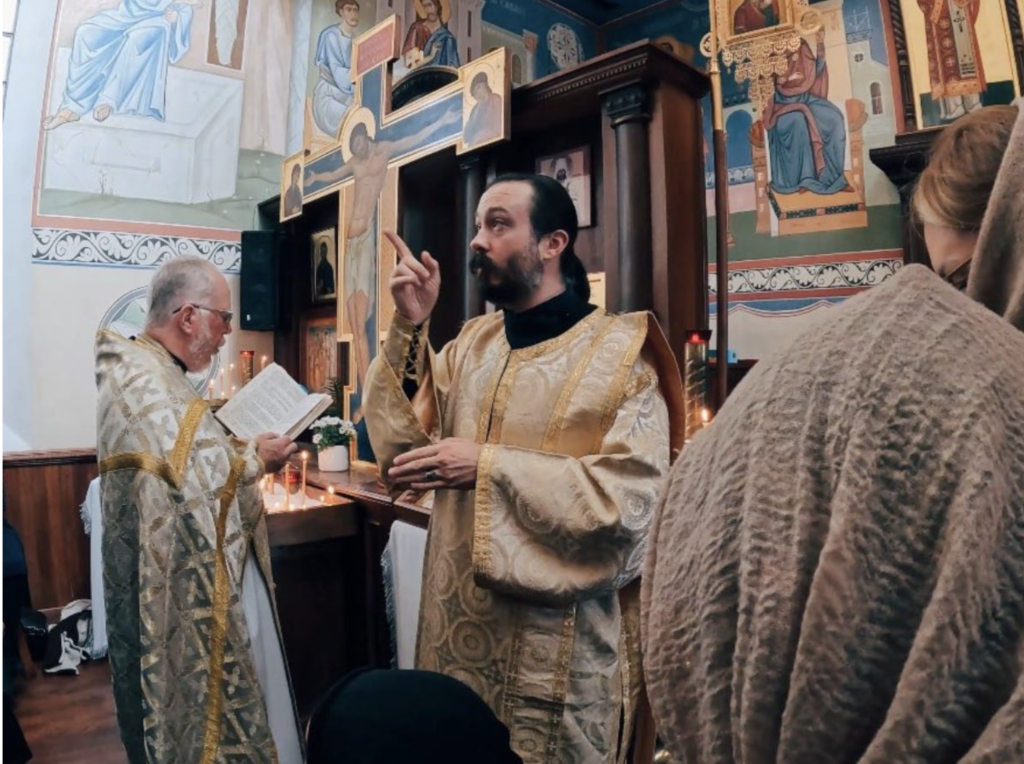
Among the laypeople doing this work is Lola J. Lee Beno, born Deaf, who serves on the ASL lexicon team of the Assembly of Bishops. She argues the responsibility runs upward as well as outward.
“Bishops need to be fully educated as to who in their diocese and the local communities … have disabilities and what their needs are,” Beno says.
Previously: Orthodox Christian Deaf Association to showcase new ASL signs for the Divine Liturgy
Fr. Davede emphasizes the importance of Deaf-led translation, as well as the argument it makes for the ordination of Deaf individuals.
“When someone who truly and deeply knows a language like ASL … takes God’s eternal truth and translates it, it is done so much better than if done externally, from someone hearing, someone who does not have that gut-level familiarity with the language,” Fr. Davede says.
“So, I do think that we should think very hard about ordaining a qualified Deaf person to ministry in an outreach to the Deaf in America,” he continues. “The Deaf, while familiar with American culture and the English language to various degrees depending on the person, have a culture and a language all their own. The Faith can be expressed so much more beautifully and powerfully by one who is fully a member of that culture.”
Dn. Tigran agrees: direct pastoral care in a person’s native language, he notes, allows spiritual guidance to feel immediate, personal, and confidential rather than filtered through interpretation.
Watch: Dn. Tigran’s interview on the Dust & Glory podcast
Fr. Davede acknowledges such ordinations require careful liturgical considerations: a Deaf priest or deacon facing East, in the same direction as the laity, cannot simultaneously be seen by faithful who depend on visual communications; liturgical actions during which the hands are occupied while simultaneous prayers are said raise their own concerns, as do prayers spoken while the Royal Doors and curtain are closed.
These liturgical challenges, however, are opportunities for further discernment, not reason to abandon the question. The conversation about Deaf ministry, in this sense, crystallizes the broader question facing the Church: not whether people with disabilities belong, but how fully she is willing to welcome them.
Parishioners Call for Accountability
The urgency of advocacy is felt acutely by the faithful who live with disability every day. Beth Thielman, who was born with Cerebral Palsy, frames inclusion as a Gospel imperative the tradition has always, if imperfectly or inconsistently, honored.
“When I first heard about these discussions, I was somewhat surprised,” Thielman says. “Not surprised it was happening, but that it was being treated as a new idea. After all, many of our priest-saints lived with disability and illness.”
She points to the theological grounding offered by author Summer Kinard, who emphasizes even Christ bore the marks of the crucifixion on His resurrected body. “To ordain disabled priests is to embrace and continue in this tradition, and to imitate Christ,” Thielman says. “I’d be very encouraged if ordaining disabled priests was more common.”
Thielman is careful to note that while the ordination of clergy with disabilities matters, it is not a full resolution. “The work required to get enough buy-in never stops,” she says. “Even when things are great and inclusive for individuals, entire groups of people living with disability, chronic illness, and mental illness (and their loved ones) are still mostly or entirely excluded from parish life.”
Nicholas Racheotes echoes the call for continued effort, observing the challenge is often accountability, not inspiration. “The challenge is to really follow through and get results,” Racheotes says. “We’ve got now, and the time is now.”
He advocates for sensory-sensitive liturgies, accessible worship spaces, catechetical approaches designed with disability in mind, and homiletics attentive to how messages might resonate with members of the congregation who have disabilities. “This would be a sea change,” Racheotes says.
A Nicene Moment
Fr. John Chryssavgis is unequivocal: the Church must be honest about how far it falls short.
“Here is the standard we should seek to uphold regarding individuals with disabilities in the church: If they are not visible, they are not included. If they are not included, they are not meaningfully participating. And if they are not meaningfully participating, then they are not members of the one body of Christ that we profess,” Fr. John says. “This line of thought can—and absolutely should be—extended and applied to how we welcome people with disabilities to the church but also to what decisions we make about ordaining people with disabilities to the priesthood.”
Dn. Tigran Khachikyan calls for what he names a Nicene moment—a moment of reckoning and resolution. “Serving people with disabilities is not optional or secondary, but central to the Gospel,” he says. “Christ teaches us that when we care for ‘the least of these,’ we are caring for Him. To neglect or overlook people with disabilities is, in a very real sense, to overlook Christ Himself.”
The advocates in this conversation are not asking the Church to compromise her theology. Rather, they are asking her to live it—to ensure the fullness of the liturgical and sacramental life is accessible to everyone, to ordain those whom God has called, and to build parishes where no one sits at the margins wondering whether they belong.
“Disability exists within God’s providence, not outside of it,” Dn. Tigran says. “Accessibility is not lowering the standard of the Church; it is allowing all faithful to stand equally before God.”
Dn. Tigran envisions a Church that recognizes every member as fully belonging—not in spite of how they were made, but through it. “God’s grace is made manifest through the particular lives He gives us,” Dn. Tigran says. “Every member of the Body of Christ is called, valued, and needed.”
It is a vision that began with a small boy in Armenia, present at the Divine Liturgy, reverent but uncomprehending, wondering whether God heard him. Dn. Tigran now has his answer. Whether the Church at large is ready to offer her own response remains, for now, an open question—and an urgent one.
The post Across jurisdictions, voices rise for the ordination of men with disabilities appeared first on Orthodox Observer.