This post was originally published on this site
His Eminence Archbishop Elpidophoros of America presided yesterday, Monday, April 20, 2026, at the Katholikon of the Holy Monastery of Saint Nektarios in Roscoe, New York, over the Divine Liturgy, the Funeral Service, and the burial of the ever-memorable Archimandrite Joseph, founder and Abbot of the Monastery and a spiritual child of the venerable late Elder Ephraim of Arizona.
Concelebrating with the Archbishop at the Hierarchical Divine Liturgy and the Funeral Service were His Eminence Metropolitan Savas of Pittsburgh, Their Graces Bishops Athenagoras of Nazianzos and Nektarios of Diokleia, the abbots of the men’s monasteries in America, and the two hieromonks of the Monastery. Also present in prayer at the Funeral Service were His Eminence Archbishop Demetrios, formerly of America; the grieving brotherhood of the Monastery; numerous clergy from throughout the Sacred Archdiocese and of other Orthodox presences; the abbesses of the women’s monasteries in America and Canada; a great number of monks and nuns; and thousands of faithful and spiritual children of the late Elder from the United States, Canada, and Greece, as well as his family—namely his two brothers.
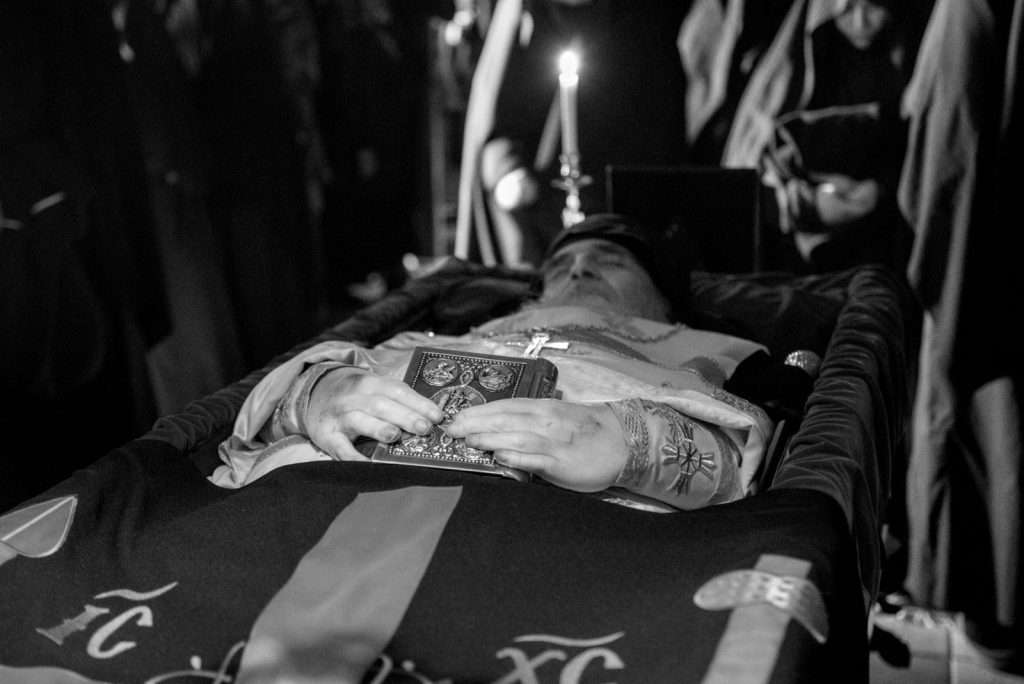
The Elder’s body was set out for veneration and thousands of faithful, among them His Eminence Metropolitan Apostolos of New Jersey and many clergy, came, despite the bitter cold, to pray for the repose of his soul. The burial took place in the Monastery cemetery, followed by the customary meal for all who had gathered.
The Archbishop arrived at the Monastery on Sunday evening, and after serving a Trisagion at the bier of the departed, he addressed words of consolation to the grieving brotherhood of twenty-four monks, as well as to the assembled elders and abbesses.
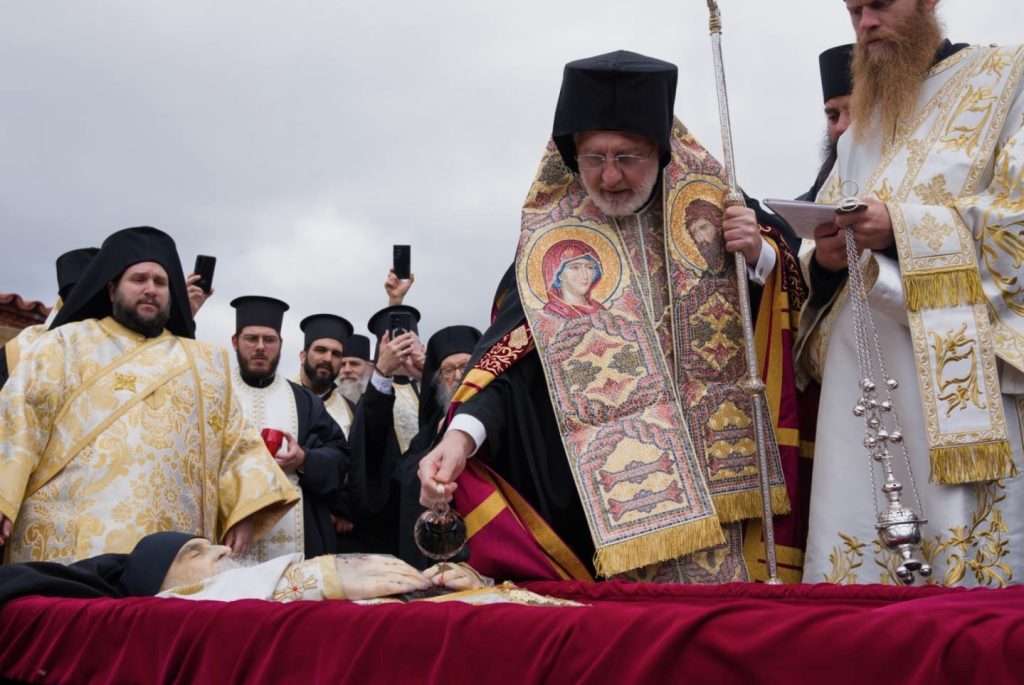
At the conclusion of the Funeral Service, the Archbishop delivered a Eulogy, highlighting the life, ministry, and spiritual gifts of Elder Joseph:
“Elder Joseph was a man whose life was a quiet yet powerful witness to the Gospel. Born into a pious priestly family, he was raised from a young age in the life of the Church. Even though he was distinguished in his studies in higher education, his heart was never attached to this fleeting world. He longed for something greater, something eternal. Like a deer thirsting for living waters, he departed for Mount Athos and attached himself to the spiritual guidance of the ever-memorable Elder Ephraim at the Monastery of Philotheou. There, turning away from the world and all that is of the world, in obedience and humility he was clothed with the angelic schema, tonsured, ordained to the priesthood, and entrusted with the sacred responsibility of spiritual fatherhood.
“In 1993, as one of the first monastics sent by Elder Ephraim to North America, he brought to us the sacred seed of Athonite monasticism. That seed took root and bore fruit in this good soil through his obedience, sacrifice, and unwavering faith. A bearer of the ancient monastic tradition, and especially of the hesychastic tradition of Saint Joseph the Hesychast, Elder Joseph played a vital role in transplanting the angelic life to our land, America. After years of spiritual labor in Canada and Arizona, God’s providence brought him here, to New York. In January 1999, with the blessing of my predecessor Archbishop Spyridon, he founded this Holy Monastery of Saint Nektarios, a true oasis of prayer and repentance, a blessed coenobium and a place of healing for souls.
“With the blessing of his Elder, Ephraim of Arizona, he cultivated the fertile spiritual soil of the souls of our faithful in the United States, implanting within them the virtues of prayer, repentance, and communion with God through the noetic practice. What was once a seed, watered by exile, blossomed through martyr-like humility and perfect obedience, and now bears abundant fruit…fruit that perhaps only now is becoming fully evident. His immense contribution to the life of the Church in this country will become ever more visible with the passage of time.
“From its humble beginnings with only a few fathers, this Holy Monastery has grown into a flourishing brotherhood of more than twenty monks. The buildings that surround us today bear witness to countless hours of labor, struggle, and sacrifice. Yet beyond these visible structures, the ever-memorable Elder Joseph built something far greater: a living spiritual community, rooted in the tradition of the Fathers of the Church and open to all who seek to behold the face of God.
“This Monastery became, through his love and care, a place of rest for the burdened, a refuge for the brokenhearted, a sacred space where countless souls found healing and guidance. Elder Joseph received all who came to him with warmth and kindness. He counseled with discernment, listened with compassion, and welcomed every person with a radiant smile, for he knew deeply the joy of the Resurrection.
“Central to his ministry was the Holy Sacrament of Confession. As a spiritual father, he devoted countless hours to receiving those who came to him burdened with sorrow, darkness of mind, and the many wounds of life. In the stillness of the confessional, he became a true physician of souls, guiding, counseling, and above all spiritually caring for those entrusted to him. He did not simply hear confessions; he entered into the struggle of each person. With patience and discernment, he helped purify consciences, strengthen faith, and gently guide souls to repentance and renewal….As a good spiritual father, he did not emphasize people’s failures, but rather the boundless mercy of God.
“Many of you here today, and countless others throughout America and Canada, carry within you the sacred legacy of his paternal counsel, spiritual guidance, and unwavering faith in the transformative power of repentance.
“In recent times, he bore the cross of illness with saintly patience and exemplary faith. His illness became his own ascetical struggle, his offering to Christ. This year, in a most evident and sacred way, he lived his own Holy Week, not in the monastery, but in the quiet suffering of the hospital. There, united with the Passion of the Lord, he prepared for his own passage from death to life.
“I had the blessing to be with him on the evening of Holy Saturday, together with Bishop Athenagoras and other clergy. Though he lay upon his bed of illness, his spirit was radiant. His face shone with hope, joy, and peace, without any trace of despair. He spoke as one who did not fear death, but who believed in the Resurrection. We spoke of his vision to expand the Monastery, to build a proper Katholikon; he inquired about the health of our Ecumenical Patriarch, asked for his blessing, and entrusted me to convey his respect. And now… he lives in the unending light of the Resurrection, interceding for the brotherhood he founded, for his spiritual children, and for all of us.
“Today we glorify God for his heavenly protectors who strengthened him in his final struggle: Saint Nektarios, the patron of this Monastery and healer of those who suffer, and the Most Holy Theotokos, our champion and protectress. Through their prayers, he endured with peace, and through their intercessions he has now entered the Kingdom of Heaven.
“And now he journeys to the triumphant Church, together with his spiritual forebears: with his spiritual ‘grandfather,’ Saint Joseph the Hesychast; with his venerable Elder Ephraim of Arizona; and with the blessed Elder Ephraim of Xeropotamou. There, as a citizen of the Kingdom of God, he continues the ministry of spiritual fatherhood in a new and wondrous way, interceding for us before the Throne of God.”
Addressing the fathers of the brotherhood, the Archbishop said:
“Fathers, I do not only offer you my condolences, I also offer you my gratitude. You cared for your Elder with such love, devotion, and sacrificial tenderness. You stood by him in his weakness, just as he stood by you throughout your lives. This is the true image of brotherhood in Christ. I see and understand your pain, which is shared by our entire Sacred Archdiocese. Yet you must not lose hope or fall into despair. As the Apostle Paul teaches us, we grieve ‘not as others who have no hope.’ Our hope is firmly rooted in the Resurrection of our Lord and Savior Jesus Christ.
“I therefore urge you to continue, to continue the sacred work your Elder began: the life of prayer, obedience, and hospitality; the plans he set forth for the growth and expansion of this Monastery. Do not be afraid. Your Elder has not departed from you. He is always near you. His prayers will accompany you. His blessing will guide you. His love will sustain you.”
Concluding his eulogy, the Archbishop said:
“Today we do not mourn as those who have no hope, for we are children of the Resurrection. We entrust the holy soul of Elder Joseph into the hands of the living God, through the intercessions of the Most Holy Theotokos and Ever-Virgin Mary, Saint Joseph the Betrothed, Elder Ephraim of Arizona, and all the Saints.”
Following the burial and the traditional meal, the Archbishop convened the brotherhood in the synodikon of the Monastery. After offering fatherly and exhortative words, he urged the fathers, through prayer, in a spirit of apostolic unity, without haste, forty days after the passing of the Elder, and in accordance with the internal regulations of their Monastery, to elect the most suitable among them to succeed Elder Joseph as their Abbot. Finally, he again expressed his love and unwavering support of the brotherhood and noted that he feels deeply blessed to have such a brotherhood within the Archdiocesan District, a vibrant spiritual monastic branch which blossomed under the spiritual labors of Elder Joseph.
The post Archbishop Elpidophoros presides over funeral for Archimandrite Joseph of St. Nektarios Monastery appeared first on Orthodox Observer.