This post was originally published on this site
Upon entering the ornate building of Brooklyn’s Appellate Division, Second Department, clear influence and traces of ancient Greece are present. The enormous white columns, ornate marble and gold ceilings, create a commanding atmosphere. On March 6, Presiding Justice Hector D. LaSalle and the Associate Justices of the Appellate Division, Second Department presented “Philotimo in Action: Greek-American Contributions to Faith, Justice, and Public Life.” The event recognized Hellenic contributions to democracy, the judiciary, and advocacy for civil and human rights.
Sponsored by the Hellenic Lawyers Association, the event honored retired Associate Justice, Second Department, Peter B. Skelos and hosted a fireside chat. Hon. Skelos sat as an Associate Justice for eleven years. He credits the Greek American community as being instrumental in supporting his election. He has been a member of the order of AHEPA for over 50 years and a contributor to many Greek religious and cultural causes.
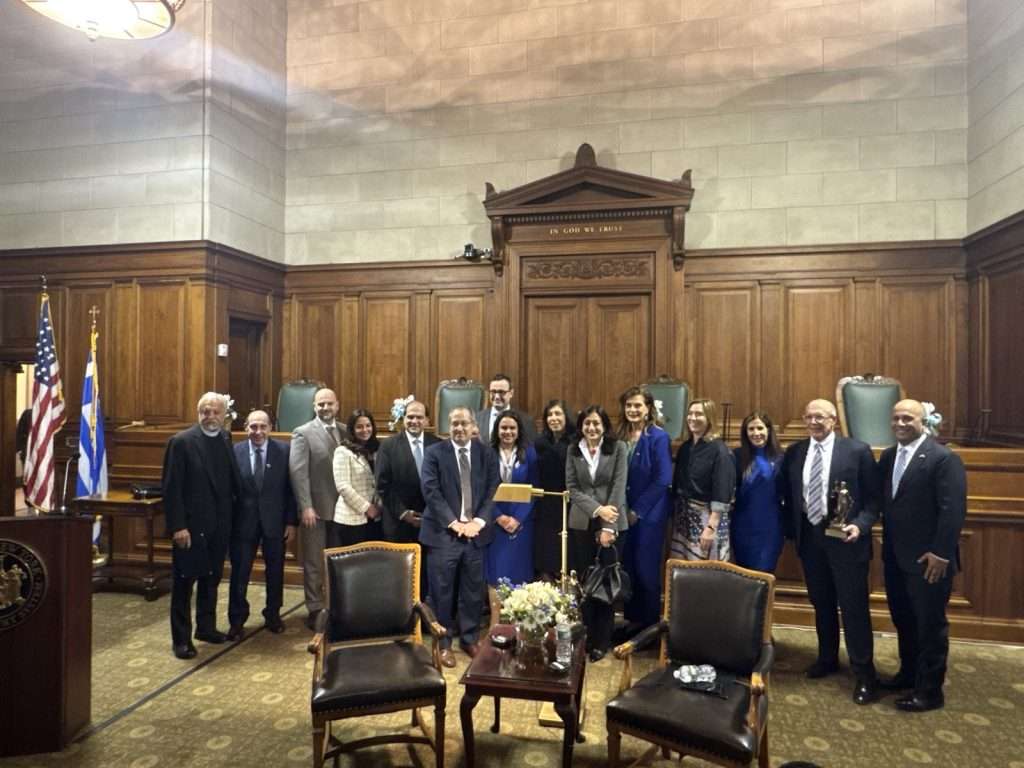
Current Second Appellate Division Justice Helen Voutsinas moderated the fireside chat with Fr. Alexander Karloutsos, Vicar General of the Greek Orthodox Archdiocese and Special Assistant to His Eminence Archbishop Elpidophoros of America. Fr. Alex is the Spiritual Advisor to the Archons of the Ecumenical Patriarchate, and to The Faith Endowment. He also serves as the representative of the Archdiocese to the White House, and has advised each American President since President Jimmy Carter. In 2022, Fr. Alex received the Presidential Medal of Freedom, the highest civilian honor in the United States, from President Biden, and in 2025 was elevated to Megas Protopresbyteros by His All-Holiness Ecumenical Patriarch Bartholomew.
Fr. Alex spoke about the unique position of Greek Americans in U.S. society, their role in the American civil rights movement, and the duty of Greek Americans to continue to honor our roots in creating and protecting modern democracy. He identified the two most significant moments in modern Greek history as Archbishop Iakovos’s march in Selma, and OXI day, when Greek Prime Minister Ioannis Metaxas rejected an Italian ultimatum demanding the free passage of troops to occupy strategic Greek strategic locations, directly leading to Greece’s involvement in WWII.
Though Archbishop Iakovos’s march with Rev. Dr. Martin Luther King Jr. is often celebrated as a proud moment for the Greek community, Archbishop Iakovos received great pushback at the time. Fr. Alex discussed how, after the march, the Archbishop received death threats and many communities refused him when he visited their parishes.
“Someone called me a traitor, some said I am not an American, some I am not a Christian,” Archbishop Iakovos said in a speech.
Archbishop Iakovos was the highest ranking clergyman who marched in Selma. Fr. Alex explained Archbishop Iakovos’s background, which was crucial in understanding why Archbishop Iakovos was so compelled to walk with Rev. Dr. King. Archbishop Iakovos was born in Imbros, now Gökçeada, where he was born as second-class citizen under Ottoman rule.
“I will stand for both rights, civil and human, as long as I live. I feel the Christian duty and the duty of a man who was born as a slave,” Archbishop Iakovos said in the documentary Iakovos: A Legacy.
Fr. Alex spoke about his role in continuing to encourage young Greek Americans to remain engaged with their community and bring their heritage into public life. One example is Fr. Alex’s connection with Peter Peterson of Blackstone. Peterson never told people he was Greek, but attempted to hide his cultural background though his mother only accepted letters from him in Greek. Fr. Alex highlighted the hanging of Greek immigrants working on the Nebraska railroads amid deep anti-immigrant and racist sentiments in the early 1900s, positing that Peterson, also from Nebraska, was likely aware of a tragic incident which influenced the concealment of his Greek identity.
Fr. Alex emphasized the importance of honoring our ancestors and their sacrifice and struggle, but also their achievements and contributions to greater American society, and the sacrifices they made for young Greek-Americans to succeed. The sacrifice and support made by these Greeks who came before us embody the theme of the event–φιλότιμο.
“Love is a verb that needs action,” Fr. Alex. “If you say you love something, everything that comes outside of that thing is driven by that principle … So φιλότιμο means being active in believing something greater than yourself.”
Fr. Alex further linked this concept of φιλότιμο as embodying the Rev. Dr. King Jr. quote, “If you have nothing worth dying for, you have nothing worth living for.” Fr. Alex emphasized that not only Greeks possess the quality of φιλότιμο, but anyone who acts with love as an action.
Fr. Karloutsos joked there was a Greek founding father because Thomas Jefferson was Greek in his mind, asserting that a manner of thinking about society and the practice of φιλότιμο are more important than blood.
Nearly twenty Greek American judges attended the ceremony, among them Judge Madeline Singas of the New York Court of Appeals, the highest court in New York State. Judge Singas is the first Greek-American on the New York Court of Appeals, appointed in 2021. Hellenic lawyers and law students were also in attendance, as well as judges, attorneys, and attendees of various backgrounds. The event showcased the importance of sharing our culture without neglecting our roots.
The post Brooklyn’s Appellate Division, Second Department hosts “Philotimo in Action” appeared first on Orthodox Observer.