This post was originally published on this site
On October 15, 2026, the Greek National Opera will present Nikos Kazantzakis: An Odyssey in Music at Carnegie Hall’s Stern Auditorium / Perelman Stage—a sweeping musical homage to one of Greece’s most far-reaching literary figures. The concert featuring the Greek National Opera Orchestra, led by the prominent Greek conductor Vassilis Christopoulos, takes place under the auspices of the Greek Orthodox Archdiocese of America, with ten percent of the proceeds benefiting the Archdiocese’s Hellenic Education Fund. The Orthodox Observer serves as the official media sponsor.
The program celebrates the enduring influence of the Cretan writer whose imagination and philosophical depth have inspired artists across nearly every discipline. Kazantzakis’ legacy has long extended beyond the written word, shaping symphonic music, opera, ballet, theater, and film scores. The tour of the Greek National Opera to the USA is made possible by a grant from the Stavros Niarchos Foundation (SNF) to enhance the GNO’s artistic outreach.
“We are proud to partner with the Greek National Opera (Εθνική Λυρική Σκηνή), one of Greece’s most distinguished cultural institutions,” said Archbishop Elpidophoros of America. “This collaboration not only brings a magnificent evening of music to Carnegie Hall, but also opens the door to extending our partnership into our schools, where we hope to inspire a new generation of Greek American students through the richness of Greek music and culture.”
At the center of this artistic journey stands Giorgos Koumendakis, the Greek National Opera’s Artistic Director. Born in Rethymno in 1959, Koumendakis is widely regarded as one of Greece’s most versatile and imaginative contemporary composers. His creative range spans symphonic and chamber music, opera, theater, dance, cinema, and interdisciplinary installations. Among his major works is the acclaimed opera The Murderess (2014), based on Alexandros Papadiamantis’ novella. His artistic milestones include early recognition by György Ligeti, his participation in the Venice Biennale, international collaborations with leading ensembles, and the prestigious Prix de Rome. His long-standing partnership with choreographer Dimitris Papaioannou culminated in their celebrated work for the opening and closing ceremonies of the Athens 2004 Olympic Games, where Koumendakis served as music director and composer. “Presenting this program at Carnegie Hall—one of the world’s most iconic stages, before New York’s discerning and culturally sophisticated audience—is an exciting prospect for the entire company,” said Giorgos Koumendakis, Artistic Director of the Greek National Opera. “We thank His EminenceArchbishop Elpidophoros for his enthusiastic support and his vision of extending our partnership into Greek American schools. Bringing music and culture to young students gives this collaboration a meaning that reaches far beyond a single concert.”
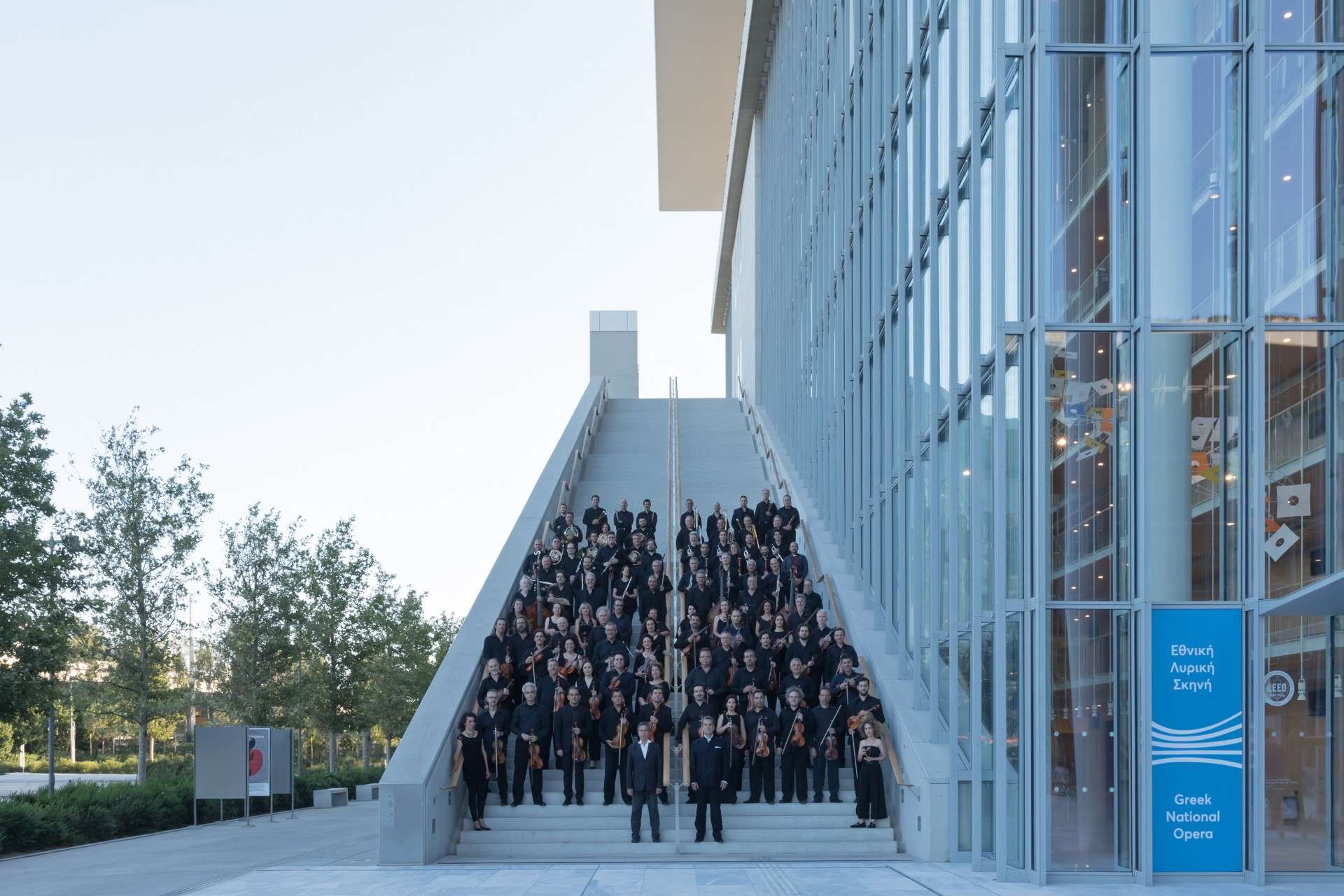
The Greek National Opera Orchestra, founded in 1939, brings its long and distinguished history to New York for this performance. Over the decades, the Orchestra has performed a vast repertoire ranging from early opera to contemporary works and has collaborated with renowned conductors such as Tullio Serafin and Nicola Rescigno, as well as with legendary soloists including, among others, Maria Callas, Jon Vickers, Maria Guleghina, Paata Burchuladze, Jonas Kaufmann, and Agnes Baltsa.
Across generations, composers such as Manolis Kalomiris, Dimitris Mitropoulos, Mikis Theodorakis, and Giorgos Koumendakis have drawn inspiration from Kazantzakis’ characters, landscapes, and spiritual restlessness to create musical worlds that echo his profound understanding of the human condition. Music, with its universal language, becomes an ideal medium through which audiences can enter the author’s inner universe without translation.
The Carnegie Hall program forms a powerful musical arc connecting generations of Greek composers. Despite their differing aesthetics and artistic paths, all these composers were deeply inspired by the spiritual world of Nikos Kazantzakis and by the island of Crete—either as a place of origin, heritage, orsymbolic reference.
The concert features Kalomiris’ Symphonic Fantasy from The Master Builder and Konstantinos’ aria from Konstantinos Palaiologos, followed by Nikos Skalkottas’ vibrant Three Cretan Dances. Dimitris Mitropoulos’ Cretan Feast, orchestrated by Skalkottas, adds another facet to the soundscape. Koumendakis’ ownwork Amor Fati brings the program into the present, while the evening concludes with highlights from Mikis Theodorakis’ beloved Zorbas, featuring solo alto and amplified bouzoukis. In total, eighty-nine performers will take the stage, including a full symphonic orchestra, soloists, saxophones, bouzoukis, richpercussion, and a lush string complement. Select amplification supports the bouzoukis and the alto soloist, allowing their timbres to integrate naturally into the hall’s acoustic environment.
Manolis Kalomiris (Smyrna, 1883–Athens, 1962), a native of Smyrna, was a pioneering Greek composer and the founding figure of the Greek National music school. He studied in Smyrna, Constantinople, Athens and Vienna, but it was his exposure to the Russian national school during a stay in Kharkiv that proved decisive to his development. Kalomiris dedicated his career to a singular goal: forging a self-sufficient Greek musical identity. This new style was inspired by Western compositional techniques but was profoundly infused with the melodic modes and spirit of Greek folk tradition. Among his most significant works is the opera O Protomastoras (The Master Builder).
Dimitri Mitropoulos (Athens, 1896 – Milan, 1960) was an internationally renowned conductor, composer, and pianist. He studied piano and composition at the Athens Conservatoire. His international debut took place in 1930, when he conducted the Berlin Philharmonic Orchestra. In 1938 he took over the direction of the Minneapolis Symphony Orchestra, a position he held until 1949. In 1949 he moved to the New York Philharmonic, where he served as co-conductor, music director, and artistic director until 1957. Mitropoulos was also a noteworthy composer. His compositional output includes approximately 40 works for orchestra, piano, and voice, as well as the opera Soeur Beatrice.
Nikos Skalkottas (Chalkida, 1904 – Athens, 1949) was a leading figure in Greek music, with an original and internationally recognized body of work, and a member of the Second Viennese School. He studied violin at the Athens Conservatoire and later composition in Berlin, where he was a student of the pioneering Arnold Schoenberg. He composed feverishly, creating over 170 works. The largest part of his output consists of atonal and serial works, which develop a completely personal musical idiom. In parallel, he also wrote more accessible works, such as the famous 36 Greek Dances for orchestra, which are ingeniously inspired by Greek traditional music in a genius way.
Mikis Theodorakis (Chios, 1925 – Athens, 2021), of Cretan and Asia Minor descent, was one of the leading Greek composers of the 20th century, whose work left an indelible mark on Greek musical and political life. He wrote symphonic music, oratorios, music for ballet and cinema, for theatrical performances, as well as dozens of numerus song cycles based on poetry. Mikis Theodorakis left behind a diverse and rich body of work, which extends beyond music into areas such as poetry, prose, and philosophy.
Nikos Kazantzakis: An Odyssey in Music is not only a concert but a cultural ambassador—an invitation for audiences in New York to experience the creative landscape shaped by one of Greece’s most important writers and the composers who brought his inner world to life. With this program, the Greek National Opera offers a celebration of Greek imagination, artistic continuity, and spiritual depth, presented on one of the world’s most storied stages.
As the official media sponsor, the Orthodox Observer will provide exclusive access to the production, including behind-the-scenes coverage of rehearsals and interviews with the lead artistic contributors in the weeks leading up to the performance.
The post Greek National Opera will present ‘Nikos Kazantzakis: An Odyssey in Music’ at Carnegie Hall appeared first on Orthodox Observer.