This post was originally published on this site
“I am an Arab by birth, Greek by primary education, American by residence, Russian at heart, and Slav in soul.”
— St. Raphael of Brooklyn
Many saintly, dedicated, and faithful servants helped plant the seeds of Orthodoxy in America, but few were as well-prepared for such labor as St. Raphael of Brooklyn. As the quotation above suggests, St. Raphael embodied the evangelical and missionary spirit needed in his own time which is all the more needed in ours as we mark the 250th anniversary of our nation.
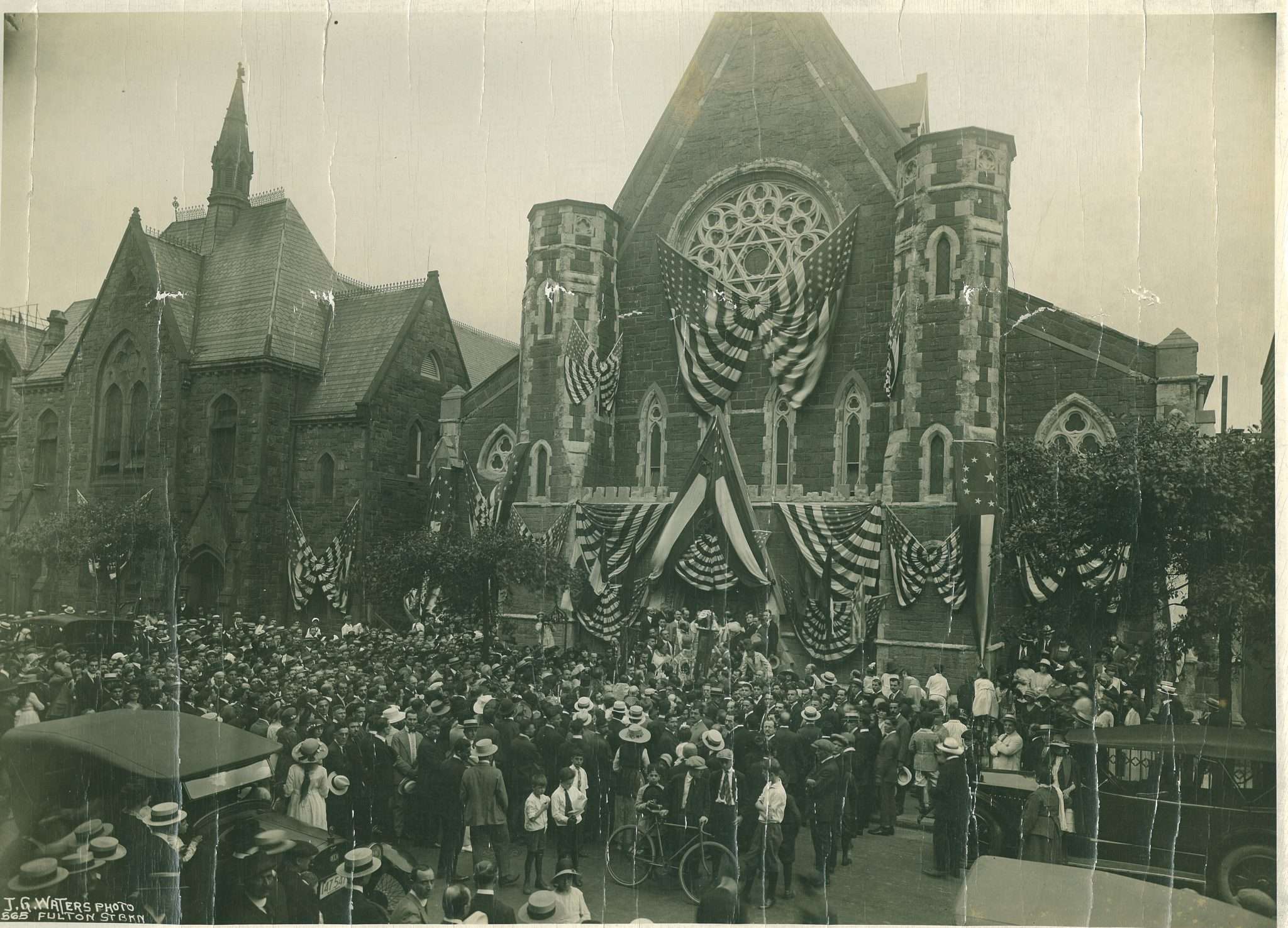
Before reflecting further on St. Raphael and his example, I would like to mention a photograph that struck me in the hall of our St. Nicholas Cathedral in Brooklyn, NY. Taken at the consecration of our current Cathedral on State Street in 1920, the photograph shows a massive crowd gathered outside. What covered the cathedral’s façade was not, as one might expect today, a mix of American flags and those of the immigrants’ countries of origin. Rather, the façade was completely draped in the flags of the United States of America alone. That image left a profound impression on me and speaks volumes to the mindset of those early immigrants. They loved the cities, villages, and families they had left behind, yet they knew they were here to stay in America. They desired to be full participants in their adopted land while preserving their ancient faith and traditions. It was into this context that St. Raphael, then Archimandrite Raphael Hawaweeny, arrived to New York in 1895.
Prior to arriving in the United States, St. Raphael lived in several centers of Orthodoxy, from his native Damascus, to Constantinople and the island of Halki where he studied, and to Kiev and Moscow. It is in this way that, through his extensive travels and his acquisition of multiple languages in both colloquial and liturgical contexts, St. Raphael, by God’s providence, was well-prepared to undertake his mission in this new land: to help establish parishes for newly-arrived Orthodox immigrants of various ethnic backgrounds. Although his primary calling was to serve Arabic-speaking immigrants from Greater Syria—that is, modern-day Syria and Lebanon—through the newly-formed Syro-Arab Mission of the Russian Orthodox Church, St. Raphael became a respected and beloved figure among Orthodox immigrants more broadly, especially in the New York area. His tireless missionary efforts took him across the United States, Canada, and even Mexico, where he baptized, married, and served memorials for faithful people living in remote areas. In each locale, he also encouraged the faithful to found parishes and promised them priests once they committed themselves to this holy task.
As the mission grew, the then-head of the Russian Orthodox diocese in North America, St. Tikhon of Moscow, recognized that St. Raphael should be made a bishop to oversee the young mission parishes throughout the United States expanding work, with the agreement of both the Patriarch of Moscow and the Patriarch of Antioch. On March 13, 1904, St. Raphael was elevated to the episcopacy at St. Nicholas Cathedral in Brooklyn, New York, becoming the first Orthodox bishop of any background to be consecrated on American soil. Without his missionary zeal and steadfast dedication to serving the faithful, many Orthodox immigrants might well have been religiously assimilated as they pursued the American dream in their new homeland.
St. Raphael’s ability to move between cultures and to draw on the best of Orthodox customs makes him a model for our own time. He could speak to people in their own language and understood their traditions because of his life experiences, while also encouraging them to adapt to their new homeland. He upheld the teachings of the Church with vigor and protected his flock from ravenous wolves, while adapting to the realities and norms of the American experience without compromising the faith.
What, then, can we learn from St. Raphael’s life as we celebrate 250 years of the American democratic experiment? We should be deeply grateful for figures like St. Raphael who cultivated the seeds of Orthodoxy in America. Just as American citizens look to the founding fathers of our nation and to the sacrifices they made to build a stronger and better country, so too should we should look to our own “founding fathers,” of Orthodoxy in America, learn from their witness, and make it our own. We must continue to nurture what has grown from their early labors, even as we welcome those who now embrace the Holy Orthodox Faith by choice.
Just as America has been called “the great melting pot,” so too does the Orthodox faith gather into one those who seek to embrace Jesus Christ within the ark of the Church, where “There is neither Jew nor Greek, there is neither slave nor free, there is neither male nor female; for you are all one in Christ Jesus.” (Galatians 3:28). To Him be all glory and honor forever and ever.
The post What can we learn from America’s first Orthodox bishop? appeared first on Orthodox Observer.