
This post was originally published on this site
Scenes from the Passion of Christ — from Peter’s denial to the carrying of the cross to the Crucifixion — across three centuries of European painting. El Greco, Caravaggio, Fra Angelico, Uccello, and more. All at the Metropolitan Museum of Art, New York.
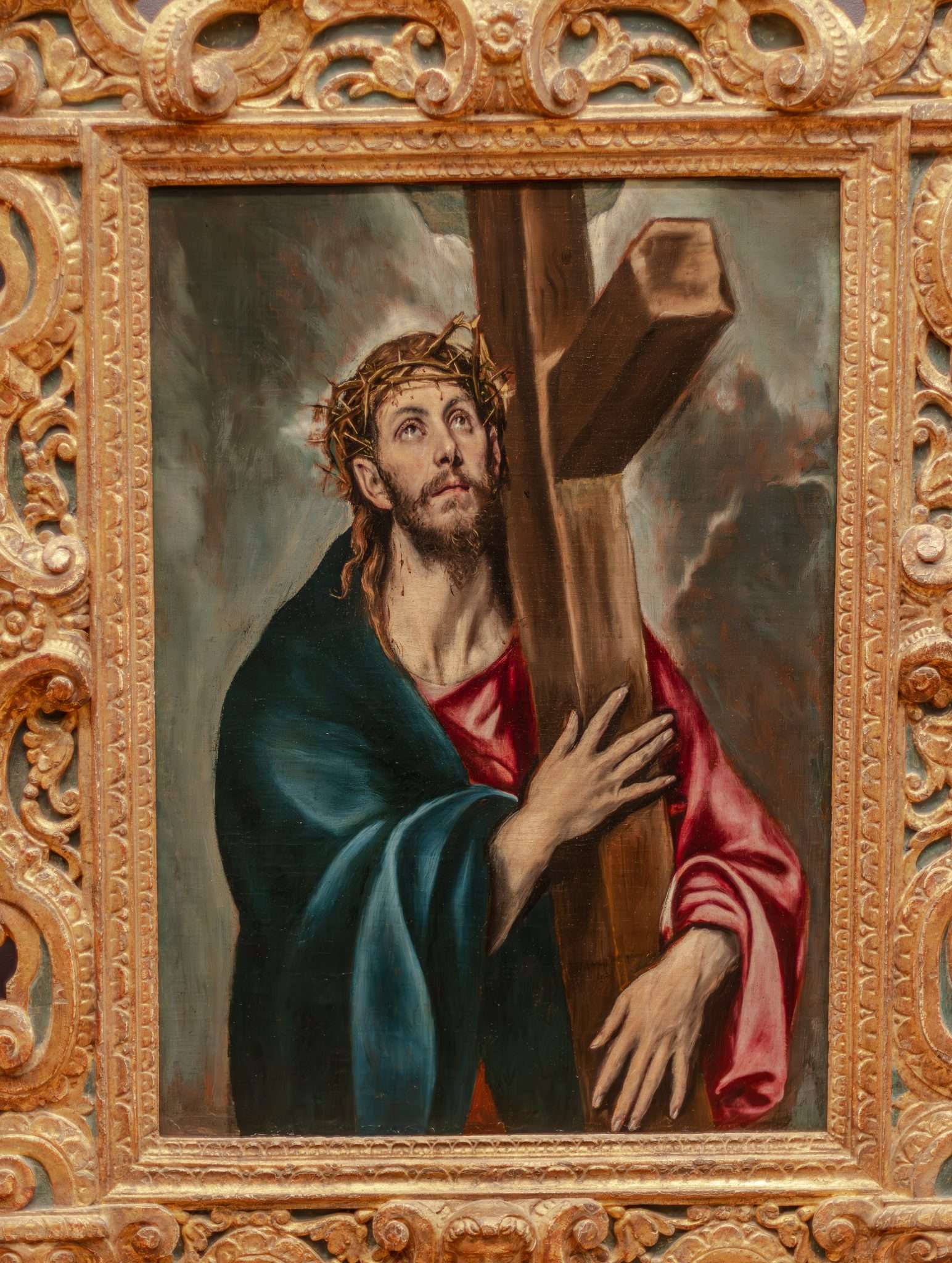
1. El Greco (Domenikos Theotokopoulos) Greek, Iráklion (Candia) 1541–1614 Toledo
Christ Carrying the Cross, ca. 1577–87. Oil on canvas.
El Greco produced numerous paintings of Christ carrying the cross, but this is among his most innovative and meticulously painted. Probably his earliest version and the first that he executed in Spain, it departs from the typical narrative approach to this subject: no other figures are represented and the setting is not recognizable. Instead, El Greco created a highly focused devotional image of haunting immediacy, resonant with pathos. Christ’s willing sacrifice for mankind is conveyed through his gentle, even elegant, embrace of the weighty cross and his heavenward gaze.
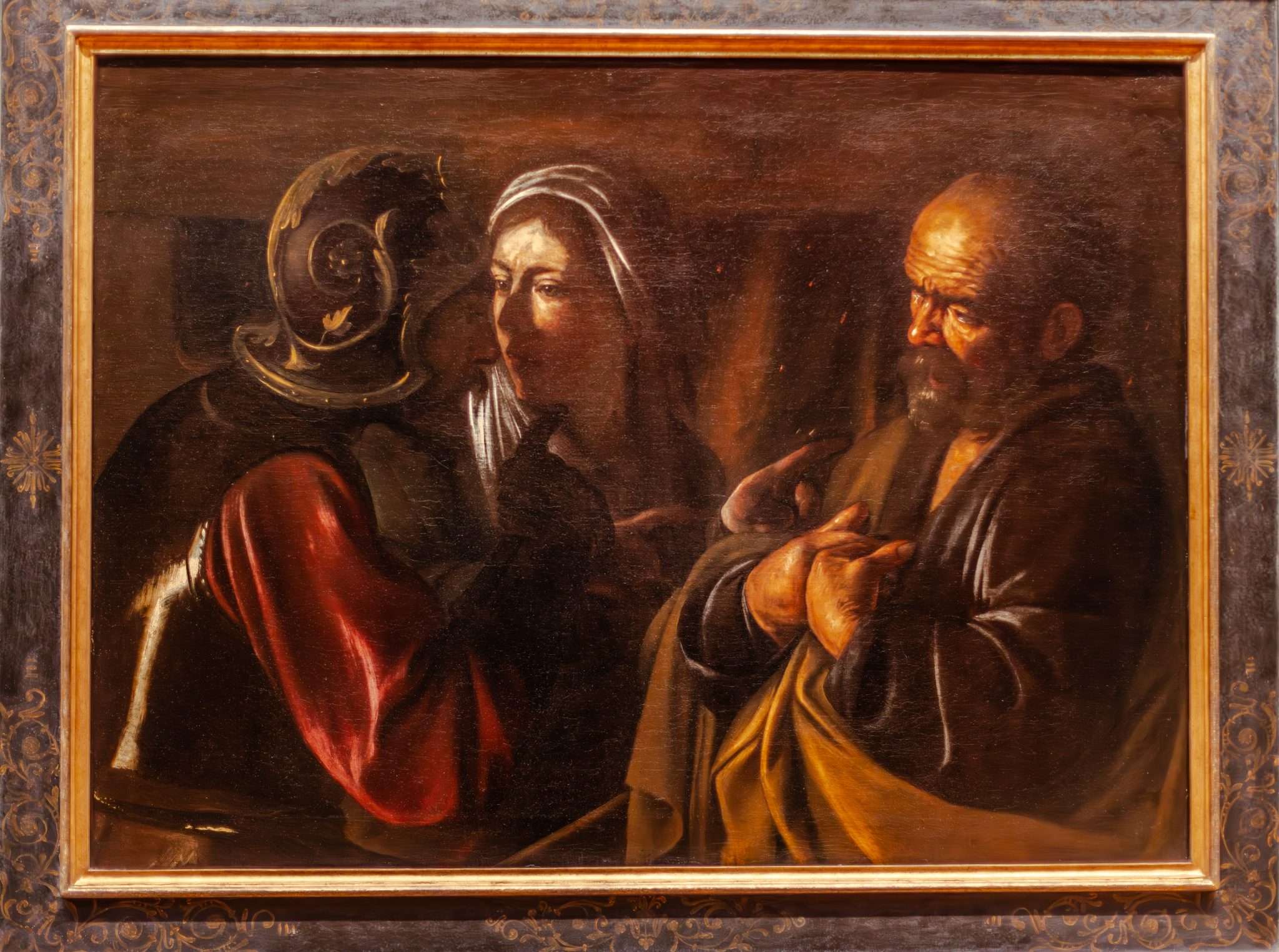
2. Caravaggio (Michelangelo Merisi) Italian, Milan or Caravaggio 1571–1610 Porto Ercole
The Denial of Saint Peter, 1610. Oil on canvas.
Caravaggio’s late works, painted in Naples, depend for their dramatic effect on brightly lit areas standing in contrast to nearly black backgrounds. This painting, a marvel of narrative concision, was painted in the last months of Caravaggio’s life and marks an extreme stage in his revolutionary style. Standing before a fireplace, Peter is accused of being a follower of Jesus. The pointing finger of the soldier and two fingers of the woman allude to the three accusations and to Peter’s three denials. In 1613 this painting belonged to the artist Guido Reni, who received it from the engraver Luca Ciamberlano as compensation for debts.
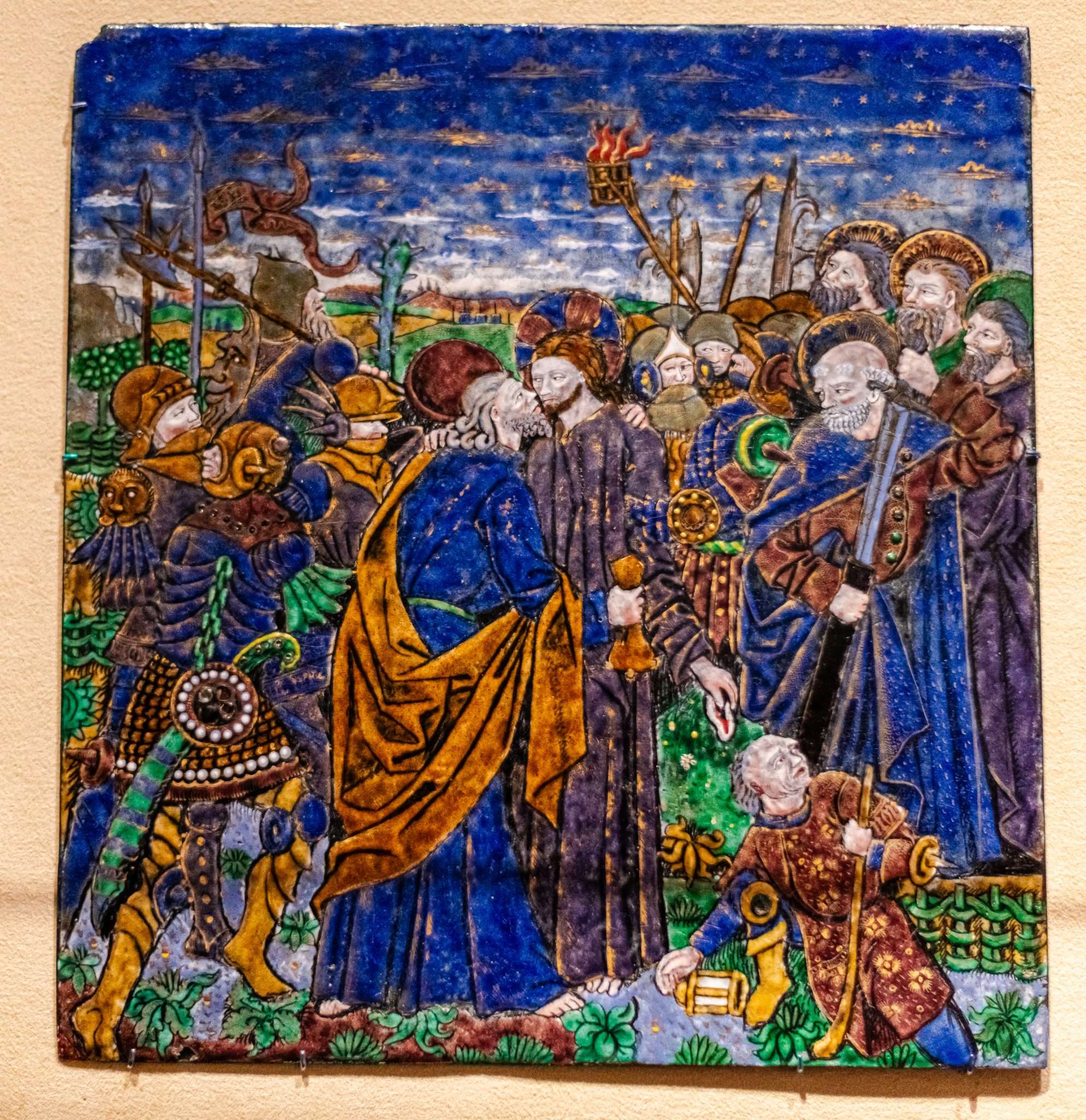
3. The Kiss of Judas Enamel, partly gilded, on copper Anonymous master “Monvaerni” French (Limoges), late 15th century.
The names of all but one of the earliest enamel painters in Limoges are unknown, but some of them had distinct styles that are recognizable today and that help with attributions. The enamelers were not organized in a guild, but, starting in the sixteenth century, a limited number of families–Pénicaud, Limosin, Reymond, and de Court–seem to have dominated production for several generations, some well into the seventeenth century. Until about 1530 their enamels were overwhelmingly religious in subject, and from about 1500 to 1530 they preferred brilliant colors made of a type of glass that tended to decompose. Many of their early works were framed as triptychs for use in private devotion; others were assembled as altarpieces, sometimes in series that illustrate biblical narratives. By the 1530s some with secular subjects are thought to have been incorporated into the wood paneling of small rooms.
The names of all but one of the earliest enamel painters in Limoges are unknown, but some of them had distinct styles that are recognizable today and that help with attributions. The enamelers were not organized in a guild, but, starting in the sixteenth century, a limited number of families–Pénicaud, Limosin, Reymond, and de Court–seem to have dominated production for several generations, some well into the seventeenth century. Until about 1530 their enamels were overwhelmingly religious in subject, and from about 1500 to 1530 they preferred brilliant colors made of a type of glass that tended to decompose. Many of their early works were framed as triptychs for use in private devotion; others were assembled as altarpieces, sometimes in series that illustrate biblical narratives. By the 1530s some with secular subjects are thought to have been incorporated into the wood paneling of small rooms.
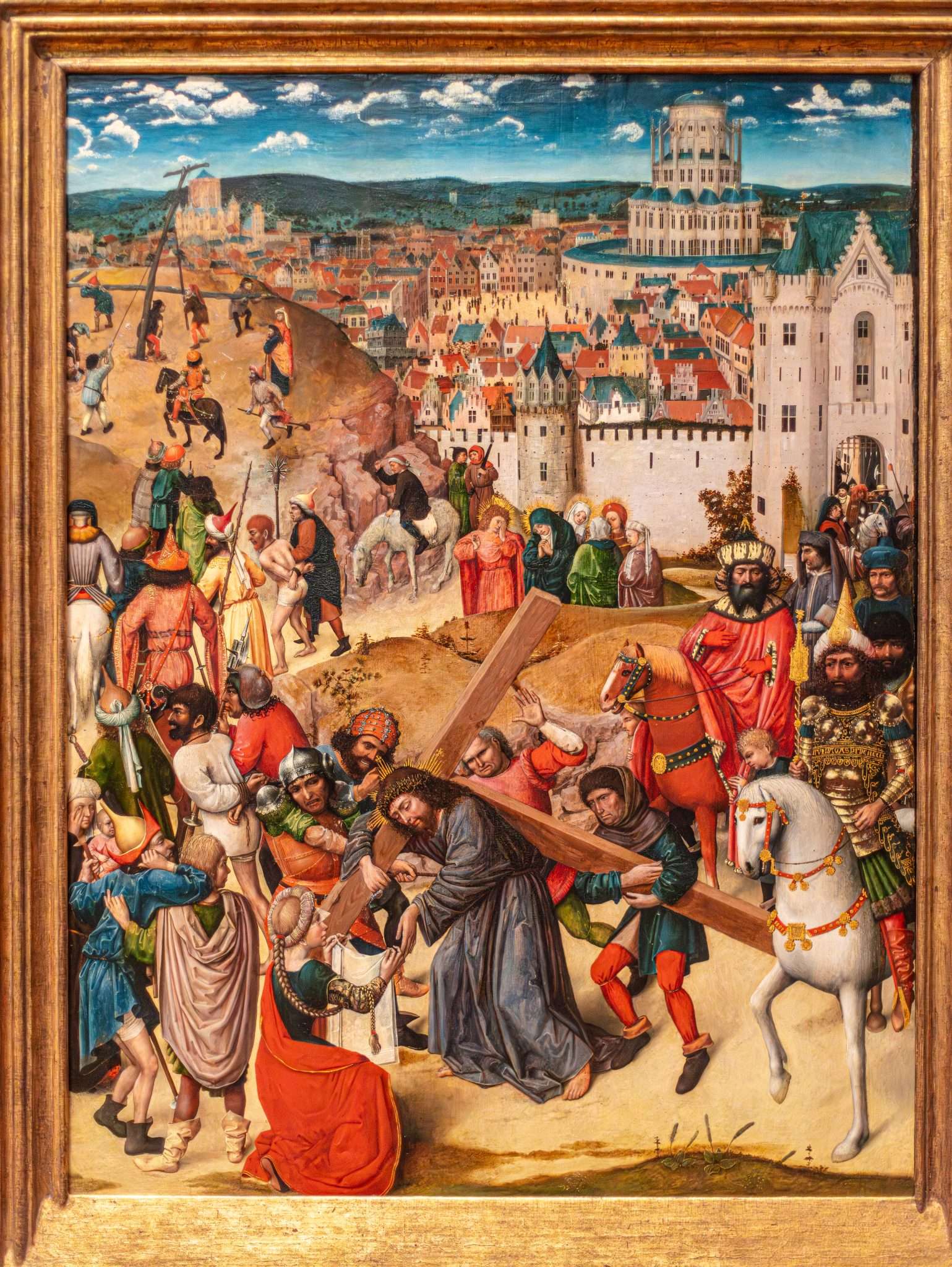
4. North Netherlandish, Bruges. “Christ Bearing the Cross,” ca. 1470
Set against the backdrop of a contemporary townscape, this theatrical portrayal of Christ on the road to Calvary recalls the Procession of the Holy Blood, an annual civic celebration in Bruges. This event included a reenactment of the episodes shown in the painting: Christ carrying the cross aided by Simon of Cyrene, Veronica receiving the icon of the Holy Face, and the Virgin and Saint John waiting for Christ. The procession was the responsibility of the Confraternity of the Holy Blood, whose members appear in the painting following the armored horseman carrying the group’s official standard.
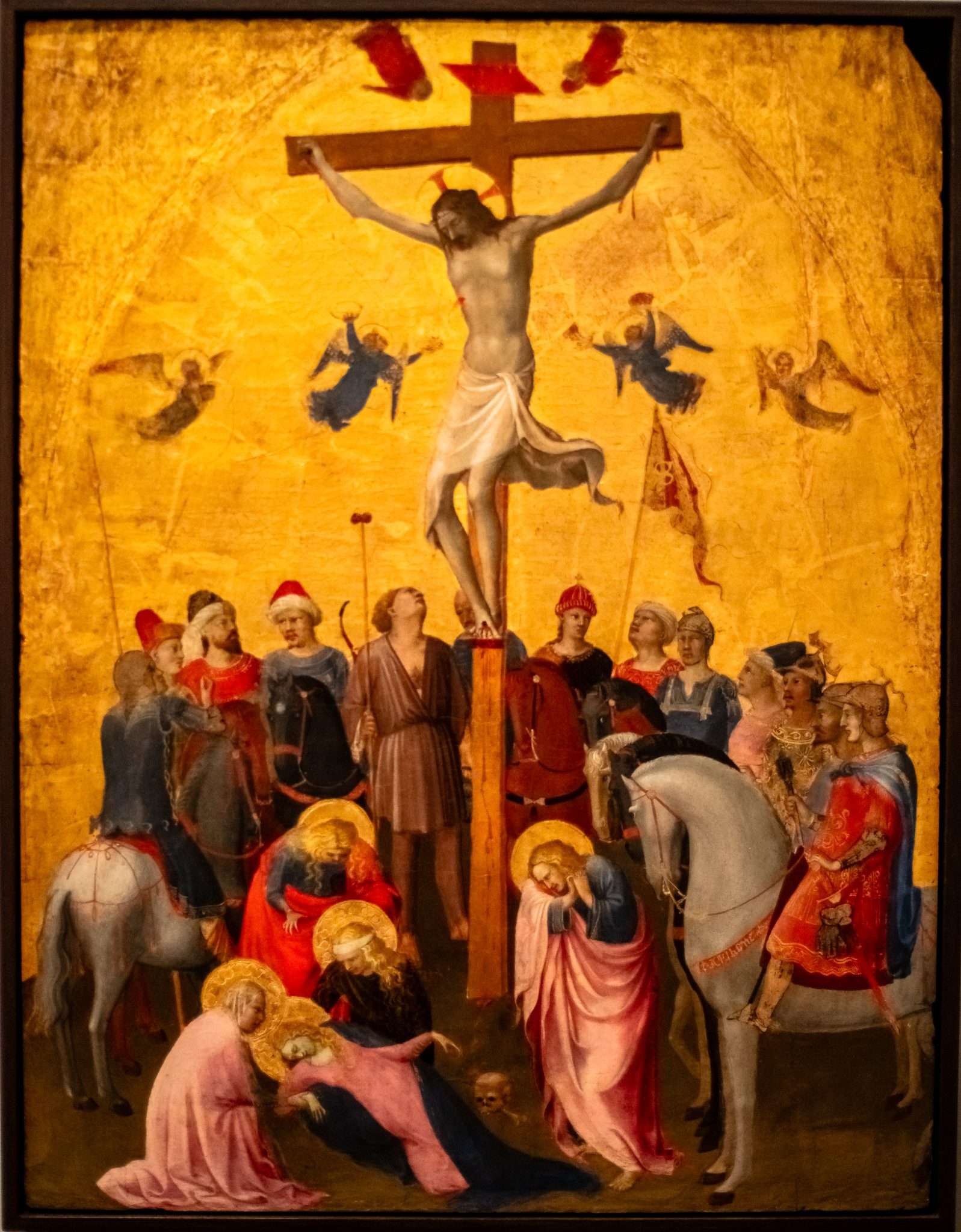
5. Fra Angelico (Guido di Pietro) Italian, Vicchio di Mugello ca. 1395–1455 Rome. The Crucifixion, ca. 1420–23
This early work by Fra Angelico, likely made for private devotion, accentuates the drama of Christ’s Crucifixion. In the foreground the Virgin collapses in grief, surrounded by the lamenting Mary Magdalene and Mary of Cleofas. Behind them, a band of Roman soldiers and their horses stand watch around the cross. Some men focus their gazes on Christ, while others exchange glances. The innovative circular composition was inspired by the bronze doors created by Lorenzo Ghiberti for the Baptistry of Florence. In its focus on spatial effects and convincing human emotion, this painting provides evidence of what would become Fra Angelico’s trademarks.
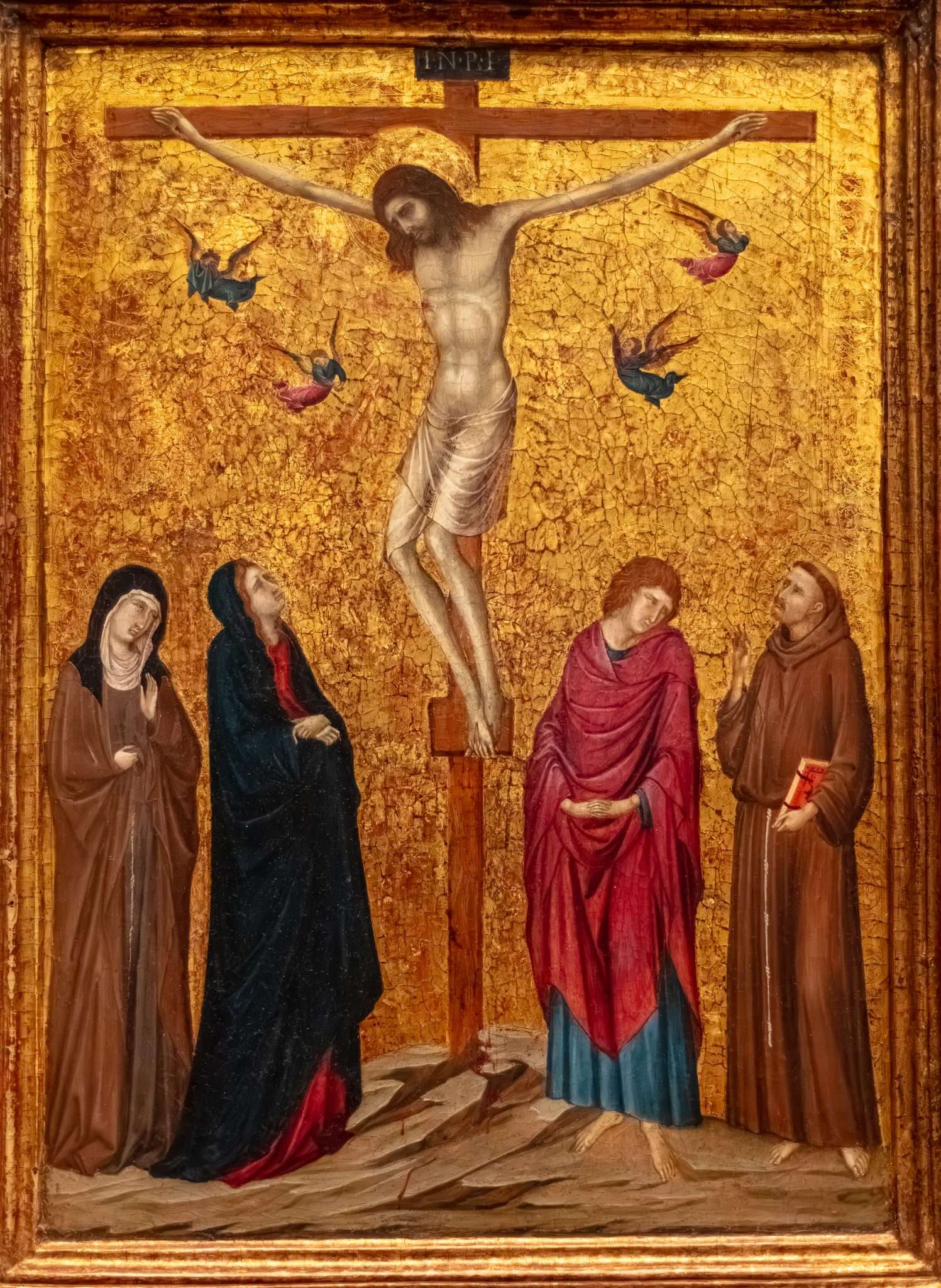
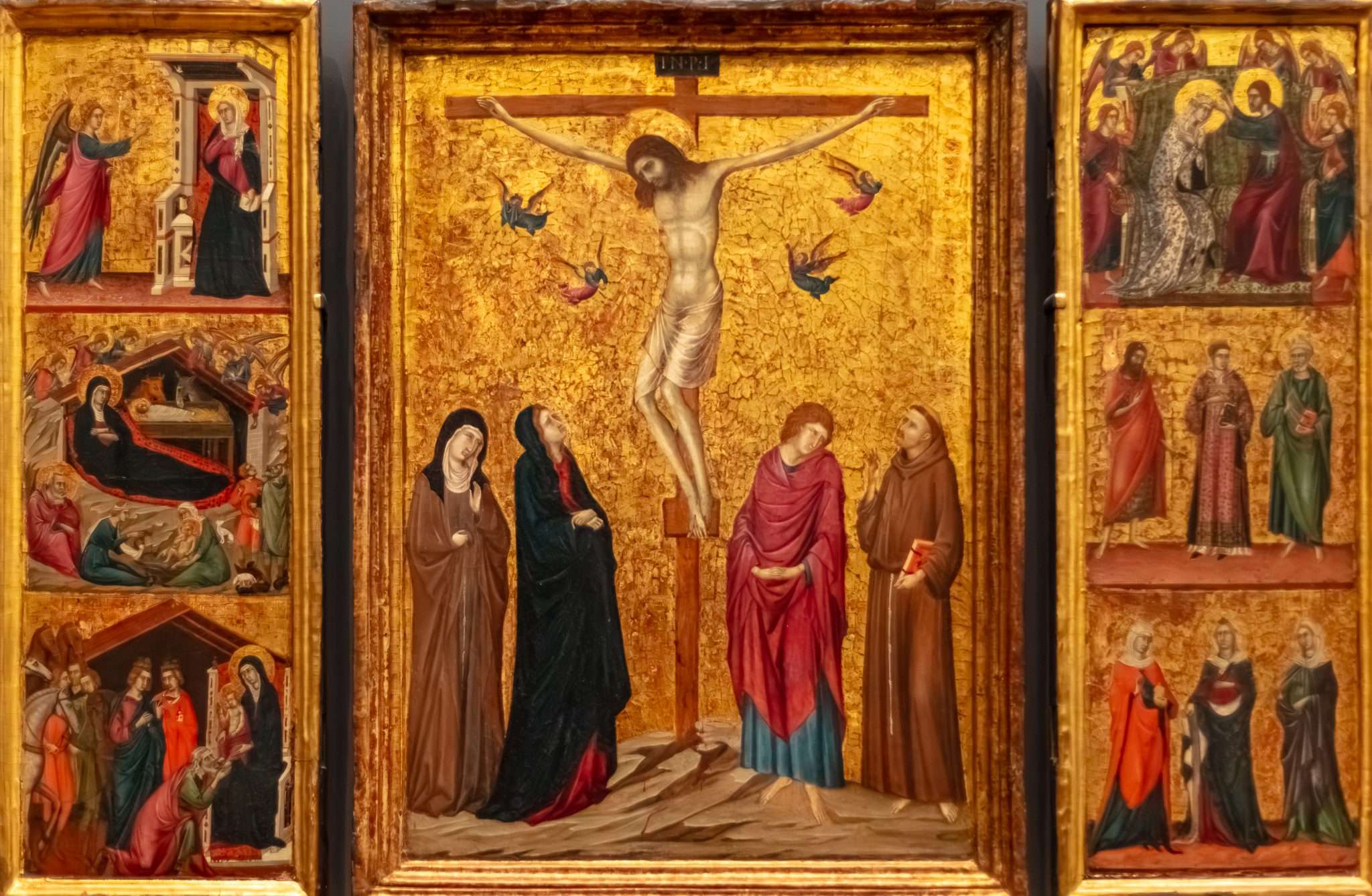
6. Attributed to Ugolino da Siena. Italian, Siena, active by 1317–died 1339(?) /49. The Crucifixion, ca. 1315–20. Tempera on wood, gold ground
Famous in Florence as well as Siena, Ugolino was a close follower of Duccio di Buoninsegna, from whom he derived his remarkable sense of color and use of gesture and expression, creating an effect at once lyrical and tragic. The presence of Saints Francis and Clare in the powerful painting indicates that it belonged to a Franciscan friar or nun, or possibly to a member of a lay Franciscan group who associated especially closely with the Crucifixion because of its associations with the Stigmatization of Saint Francis, when the saint received marks on his body resembling the wounds Christ received at his execution.
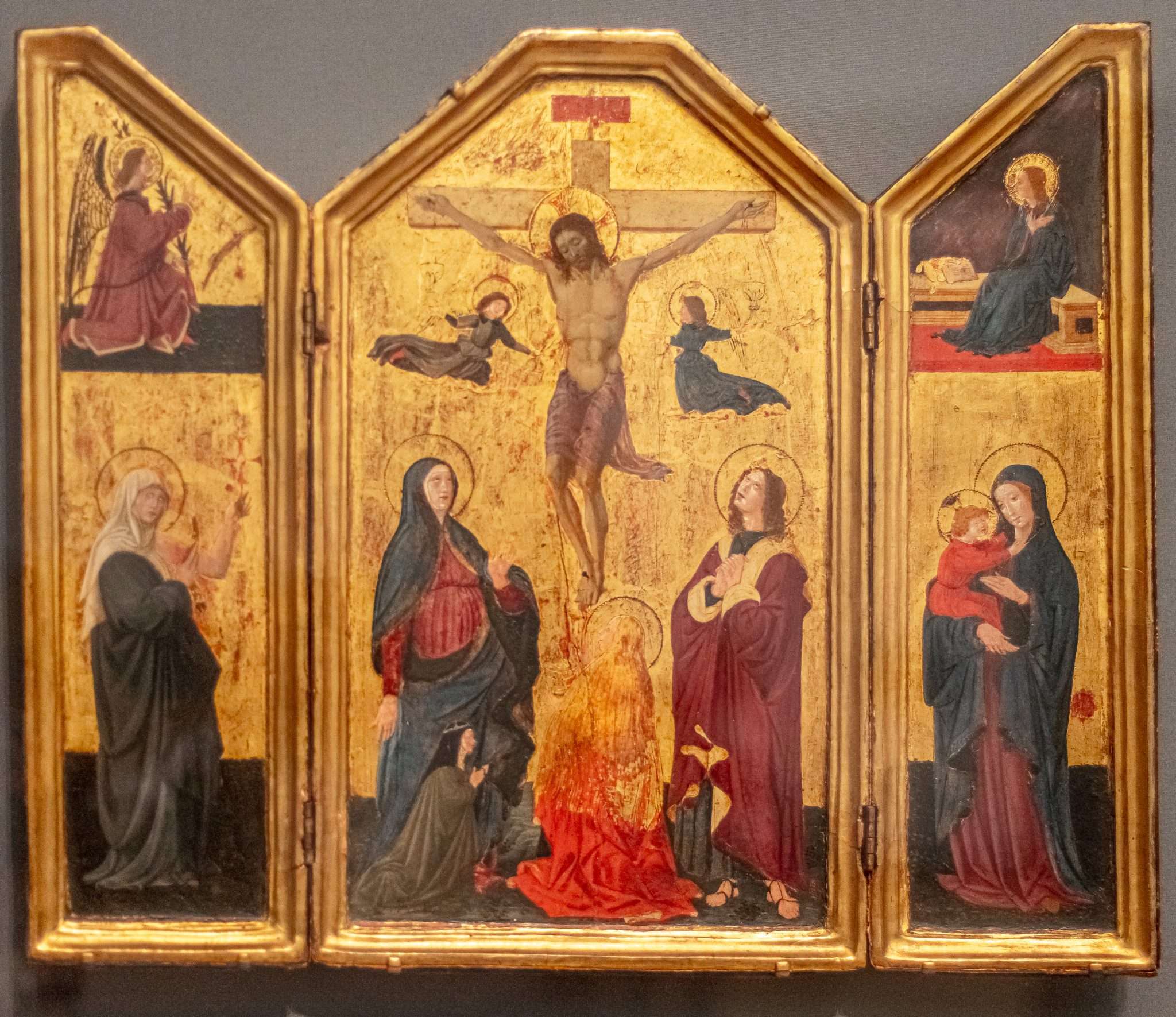
7. Paolo Uccello (Paolo di Dono) Italian, Florence 1397–1475 Florence The Crucifixion, probably mid-1450s. Tempera on wood, gold ground.
Uccello is best known for his battle scenes for the Medici palace and for frescoes in the cloister of Santa Maria Novella, Florence; however, he also painted small devotional panels. This portable triptych includes the depiction of a nun of the Brigitine order at the foot of the cross, identified by an inscription as Sister Felicity (possibly Felicita di Francesco Casavecchia, who joined the order in January 1455, which is about the date of the painting). The triptych was painted for her private devotions in her cell at the Brigitine convent of Santa Maria del Paradiso near Florence.
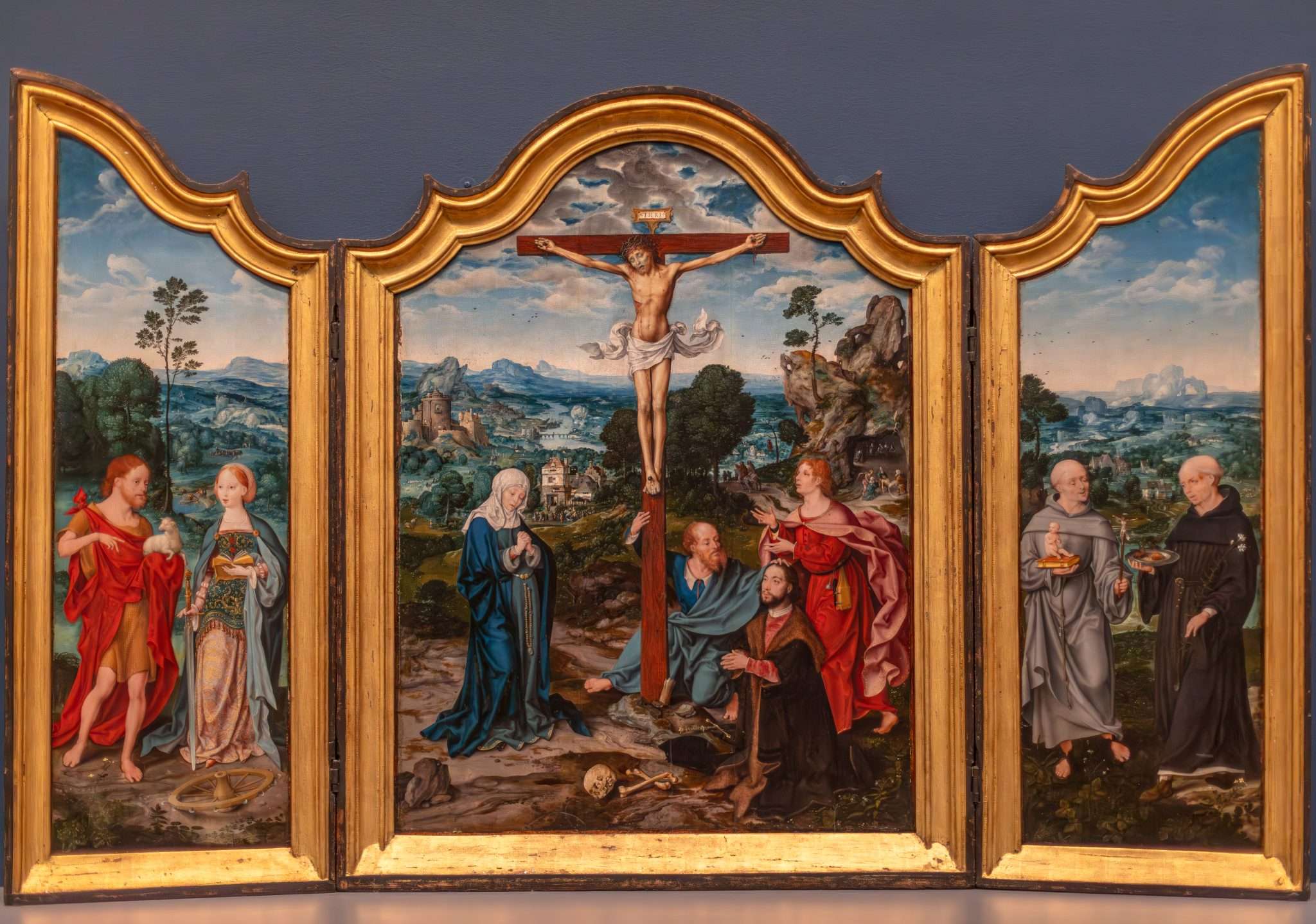
8. Joos van Cleve and a collaborator Netherlandish, Cleve ca. 1485–1540/41 Antwerp The Crucifixion with Saints and a Donor, ca. 1520. Oil on wood.
This splendid triptych combines the talents of a landscape specialist with those of the figurative painter Joos van Cleve. The setting for the Crucifixion, witnessed by the Virgin, Saint John, and the donor with his patron Saint Paul, is a vast landscape whose panoramic vista unifies the interior. On the left wing are Saints John the Baptist and Catherine; on the right are Anthony of Padua and Nicholas of Tolentino. The latter two suggest that the altarpiece was an Italian commission. The frame is original.
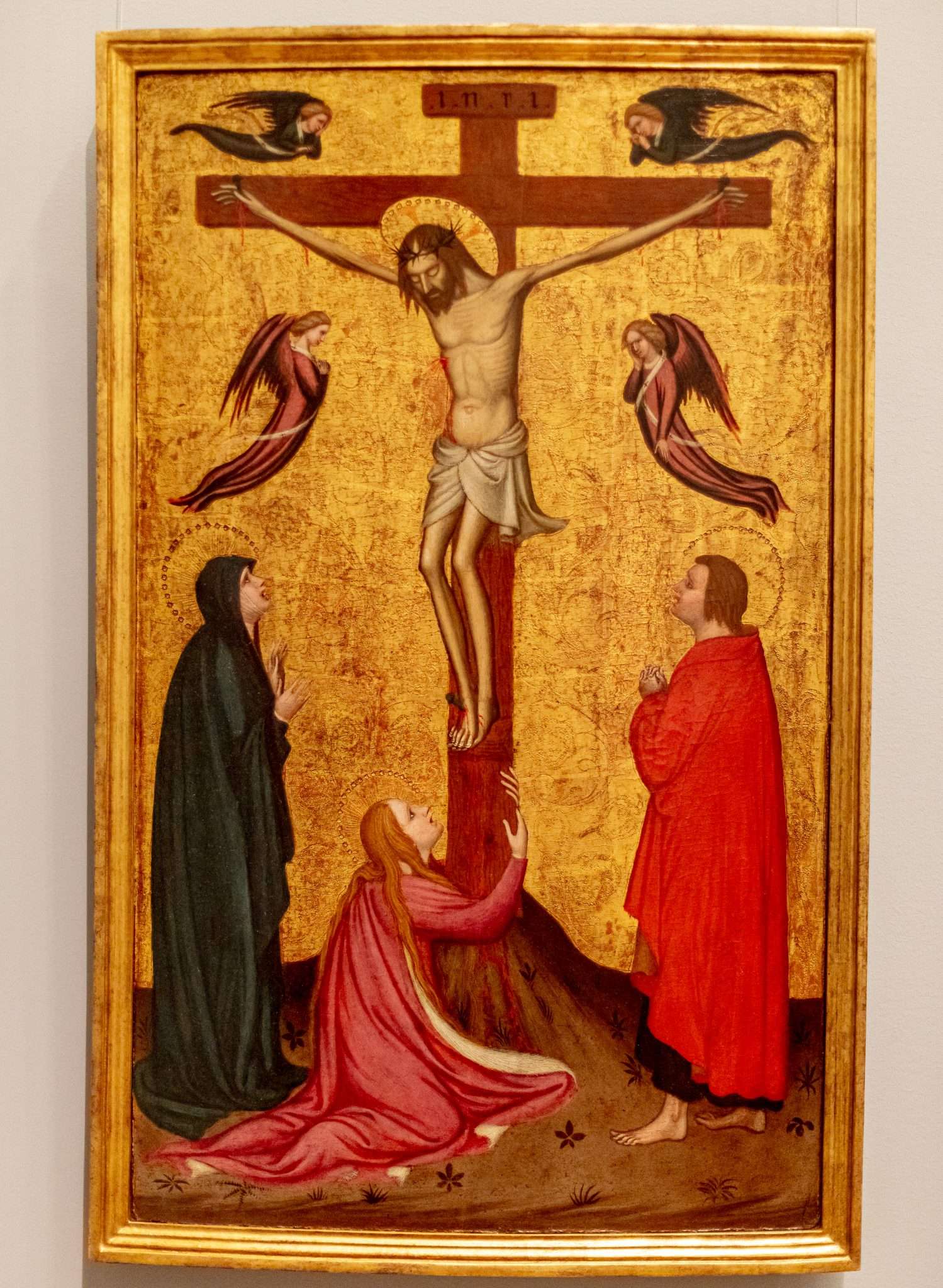
9. Stefano da Verona (Stefano di Giovanni d’Arbosio di Francia) Italian, Paris or Pavia ca. 1374/75–after 1438 Verona The Crucifixion, ca. 1400. Tempera on wood, gold ground.
This deeply affective work combines an austere composition with elegantly varied expressions of grief characteristic of painting at the cosmopolitan court in Milan. Stefano was a leading exponent of the International Gothic style, which owes much to Burgundian sculpture and to French miniature painting. The tooled gold background emulates expensive goldsmith work (the thornless roses are emblems of the Virgin Mary). Mary Magdalen, kneeling in sorrow at the foot of the cross, unusually wears robes lined in expensive ermine fur, suggesting that this painting was destined for an elite patron.
The post 9 Scenes from Passion Week at the Metropolitan Museum of Art appeared first on Orthodox Observer.