This post was originally published on this site
Though fewer than 1% of Americans serve in the U.S. military, an even smaller group walks beside them–Orthodox Christian military chaplains. This ministry, rooted in faith while shaped by the realities of military life, remains an important yet often unnoticed part of the Greek Orthodox Archdiocese of America. A retired Navy chaplain and the Archdiocese’s current Endorsing Agent, Fr. William “Bill” Bartz shed light on this vocation in a recent interview with the Orthodox Observer’s Marissa Costidis, highlighting the decades of service, sacrifice, and spiritual care military chaplains provide to service members and their families around the world.
Fr. William “Bill” Bartz says his path to military chaplaincy was not planned or pre-ordained. “Rather,” Fr. Bill says, “I was blessed to be influenced by selfless people.”
Growing up in Akron, Ohio, Fr. Bill was the son of a priest. His father, Fr. George Bartz, was a great man who inspired more than a dozen parishioners to pursue the priesthood. Fr. Bill initially resisted the idea of following in his father’s footsteps but eventually enrolled at Hellenic College Holy Cross (HCHC).
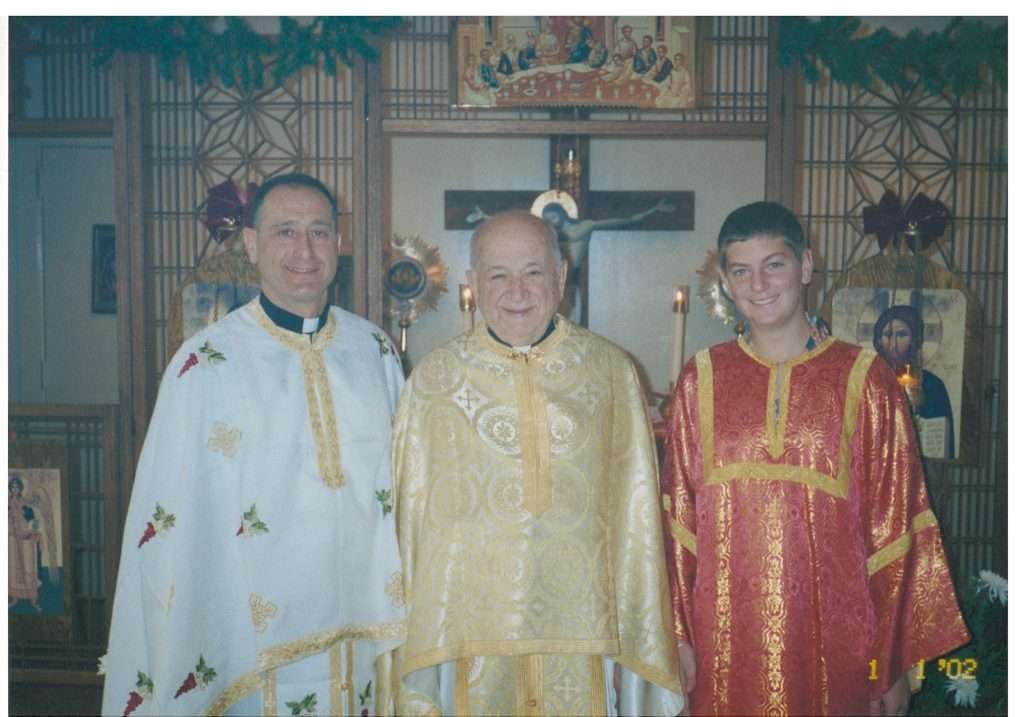
While attending HCHC, Fr. Bill met Fr. George Paulson, who was the first-ever active-duty Orthodox military chaplain. Fr. George happened to be in Boston, and his presence on campus piqued the interest of many students, who waited in long lines to speak with him.
Because of his friendship with his classmate Nicholas Pissare (now His Eminence Metropolitan Nicholas of Detroit), who scheduled all of Fr. George’s appointments, Fr. Bill was able to meet often with Fr. George. Through these meetings, something shifted, and Fr. Bill felt his own calling and purpose evolve.
“My parents gave me the raw materials,” Fr. Bill says. “Fr. [George] Paulson smoothed them out.”
Fr. George did more than counsel Fr. Bill–he exemplified a different kind of ministry, one that extended beyond the parish and into the lives of people navigating crisis, displacement, distance and uncertainty.
One day, Fr. Bill casually told Fr. Paulson that he was considering joining the U.S. Navy. “Let’s do it,” Fr. George replied.
Fr. Bill was commissioned in May 1977 and began training. He graduated in 1975 and in 1978, he married Emily Mamalis, whom he had met at Ionian Village. After serving at Saint Paul Church in North Royalton, Ohio, he went active-duty in 1984. Fr. Bill served in the Navy for a total of 34 years–27 years in active duty and 7 in the Navy Reserve–and has been retired from the military for 15 years. He expresses gratitude for his role in the Church and in “helping others and bringing them some comfort and peace” in the military.
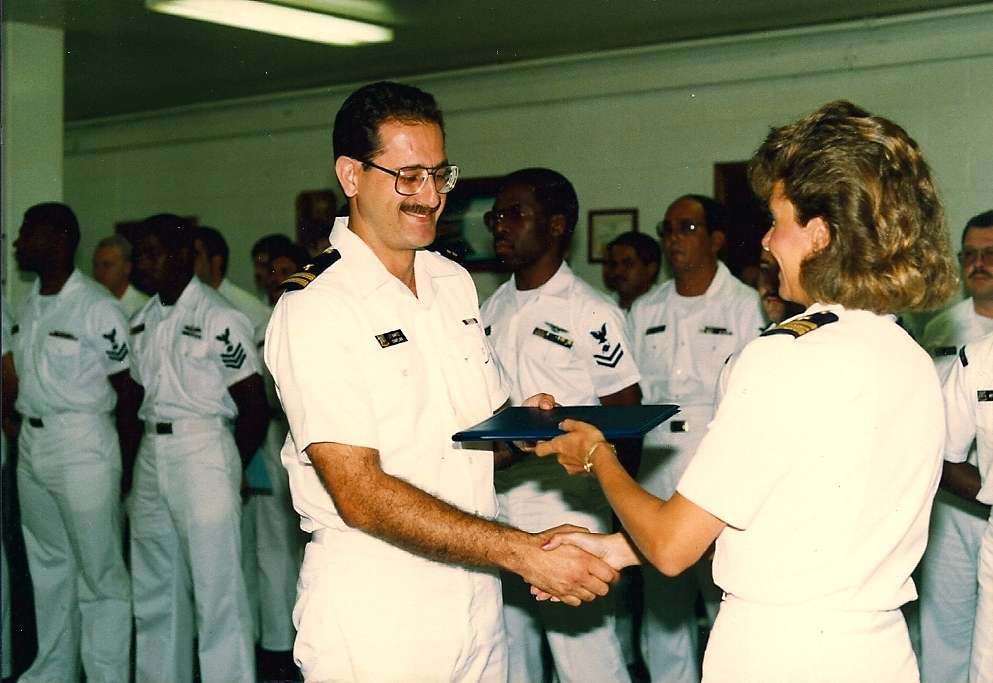
The Archdiocese has maintained a steady presence in military chaplaincy in the early 1950s, when Fr. George Paulson first entered active duty. Today, this ministry continues with a structured system ensuring military chaplains are prepared for the demands of their particular service. At the center stands the Endorsing Agent role–currently held by Fr. Bill, whose decades of experience lead the next generation.
Working under the Military Ordinary and Institutional Overseer, His Eminence Metropolitan Nicholas of Detroit, Fr. Bill ensures Orthodox clergy within the Assembly of Canonical Orthodox Bishops of the United States of America are properly endorsed before entering the military, which is a requirement for all chaplains, and guides them through the preparation process.
“All chaplains must be endorsed by their religious body before entering the military,” Fr. Bill explains. “Our role is to ensure that they are prepared—spiritually, pastorally, and practically—for this specialized ministry.”
Orthodox military chaplains must be priests, but they may serve full-time while active-duty or part-time in the Reserve while serving a civilian community as well. For instance, a priest may have a parish, but also drill once per month at the Reserve Center and train at a larger military installation for two weeks in the summer to expand their experience and their knowledge.
Fr. Bill explains that when priests are active-duty, they are full-time military service members and must go wherever they are assigned, serving all personnel regardless of religious affiliation.
“This is a calling,” Fr. Bill says. “It requires commitment, adaptability and a willingness to always serve, anywhere.”
Military chaplains’ responsibilities are often encompass three key areas: providing care for members of their own faith, facilitating religious support for all service members, and advising military leadership.
Training is critical, Fr. Bill emphasizes. “The majority of issues service members face are not theological; they are often medical, legal, financial, or relational,” he says. “But what makes Chaplains unique is the trust placed in them. Conversations are confidential, and that allows people to speak freely,” Fr. Bill says.
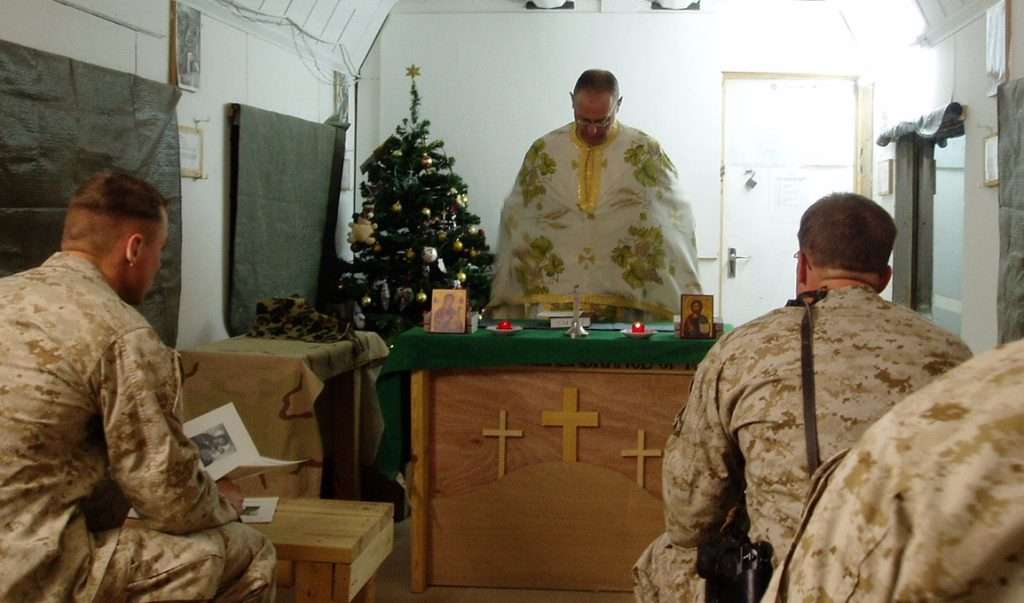
This confidentiality makes chaplains a critical resource, particularly in high-stress environments such as combat zones.
“War is difficult and traumatic. War is hell,” Fr. Bill says. “It can change people. Chaplains provide a space where individuals can process what they are experiencing, ask questions, seek guidance without fear, and assist them in getting the help they need.”
“Trust is everything,” Fr. Bill continues, explaining service members need to know they can talk to chaplains without their words being repeated.
In combat zones and high-stress environments, Chaplains encounter every human emotion–grief, anger, guilt, and doubt–as they accompany service members through moments of uncertainty, moral questioning, and personal crisis. Some service members question their faith entirely. When they do, Fr. Bill does not argue.
“I take them where they are,” he says. “I listen.”
For Fr. Bill, it is his presence that he feels is most comforting. Chaplains are not there to impose their own beliefs, but rather to walk alongside others as they encounter life’s hardest moments.
With a catch in his voice, Fr. Bill recalls such a moment in Okinawa, Japan, in the 1990s. What began as a routine interaction with a distant, gruff Marine turned, days later, into something far more powerful. Carrying the weight of a family tragedy, the Marine sought out Fr. Bill, bringing him into his home where his wife sat motionless beside the urn of their recently-deceased son.
Instinctively knowing what to do, Fr. Bill was able to help through prayer, ritual, and his comforting presence. For weeks, the woman had been paralyzed with grief after this immeasurable loss. But during Fr. Bill’s visit, something quietly lifted, and she began to weep, finally able to feel again.
“Those are holy moments when someone comes in and bares their soul, and I can make a difference,” Fr. Bill says.
While voicing his personal satisfaction from a lifetime of service as a chaplain, Fr. Bill is quick to note that this has not been his service alone. Military life, he says, is a “double sacrifice” for families. Spouses endure long separations, raising children alone during deployments, and moving every few years further disrupts routines and relationships.
His own wife, Presvytera Emily, experienced this firsthand. During one deployment, Pres. Emily was six months pregnant when Fr. Bill left; he met his son when he was three months old.
“I signed up,” Fr. Bill says. “She didn’t.”
And yet, he adds, those experiences often shape families in positive ways, as well. Children grow up adapting quickly, with resilience and an ability to connect and empathize. He is grateful his own three children have been able to adapt and grow through the strong loving care of Pres. Emily.
Now in what he calls a slower phase of life, Fr. Bill continues to serve in a quieter capacity, overseeing the endorsement process for new chaplains and helping sustain a system that depends on both personal calling and institutional structure. He is also looking ahead—to the next person who will take on his role, and to the continued need for clergy willing to enter a ministry that is as demanding as it is unseen.
Fr. Bill encourages those who are drawn to this manner of service in the Church to pursue it, to ask the questions, to take the chance to help people at their most vulnerable.
Looking back over his 34 years serving in and around the U.S. Navy, Fr. Bill is grateful and gratified; and this confirms what he had come to believe and understand–that his life’s calling is his ministry as a military chaplain.
The post Faith on the front lines: Fr. Bill Bartz on military chaplaincy appeared first on Orthodox Observer.