This post was originally published on this site
Scholars, hierarchs, and missionaries from around the world gathered at Hellenic College Holy Cross (HCHC) in Brookline, Massachusetts, March 2–4, 2026, for an international conference honoring the life and legacy of Archbishop Anastasios of Albania. Organized by HCHC’s Huffington Ecumenical Institute and Missions Institute of Orthodox Christianity, the gathering drew on the testimony of those who knew him most closely — and the portrait that emerged was of a man whose spiritual stature was matched only by his personal humility.
> Watch: Night 1 livestream
The conference opened with Vespers at HCHC’s Chapel of the Holy Cross, followed by a reception at the Maliotis Cultural Center. A keynote session featured a welcome from Archbishop Elpidophoros of America and a keynote address from Archbishop Joani of Tirana, setting the tone for three days of reflection on Archbishop Anastasios’s life.
> Previously: Archbishop Joani of Albania reflects on predecessor’s legacy
The morning of March 3rd turned to Anastasios’s Archpastoral role. Archbishop Demetrios, formerly of America, drew on eight decades of friendship, recalling how a young Anastasios was moved by Christ’s prayer for unity in John 17. “He said, ‘I see now a call for my life, a call to establish work, to promote unity among the believers,’” Archbishop Demetrios recounted.
His Eminence Metropolitan Neofitos of Eldoret and Northern Kenya spoke on Anastasios’s time as the acting archbishop of Kenya, Uganda, and Tanzania. Archbishop Anastasios, he said, believed “the Church must become local: African in expression, Orthodox in faith.”
“His vision encouraged use of local languages in worship, indigenous clergy and bishops, authentic African cultural expression within apostolic continuity,” Metropolitan Neofitos said. “Such a balance prevented dependency while preserving theological authenticity, missionary expansion and pastoral legacy.”
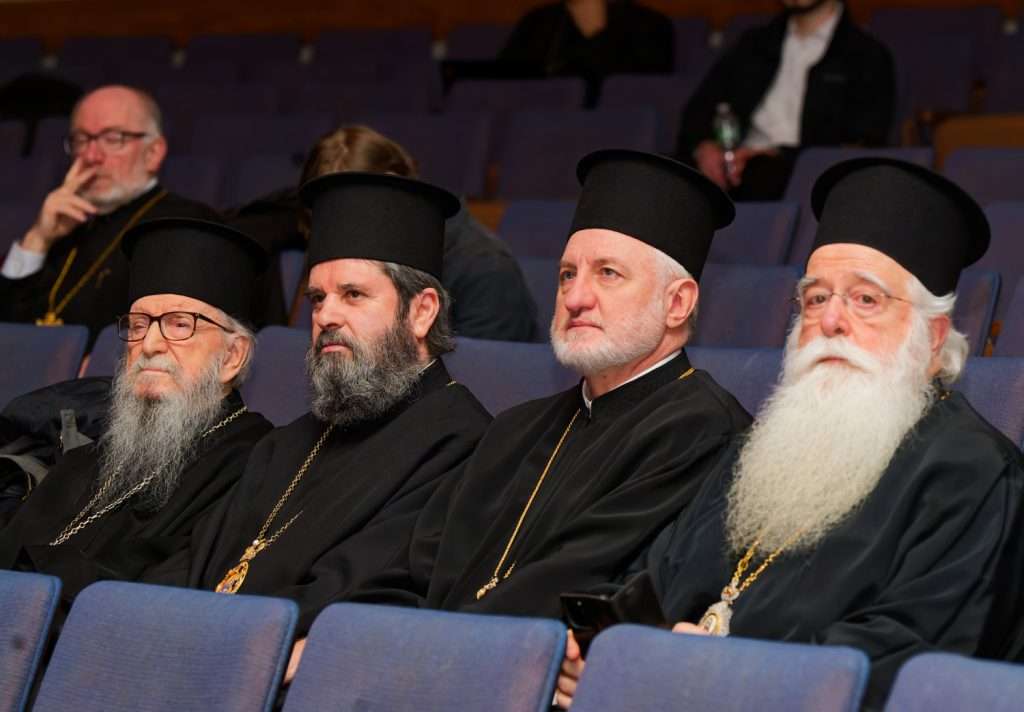
Following sessions focused on Archbishop Anastasios’s work as a theologian, missionary, and educator. In the first of these, Dr. Nikolaos Tsirevelos examined Archbishop Anastasios’s interfaith theology and framework for cultivating peaceful coexistence.
Tsirevelos recalled Anastasios’s teaching that “Religion is a divine gift given to soothe hearts, heal wounds and bring individuals and people closer … Every form of violence in the name of religion violates, in every possible sense, religion itself.”
The missionary session that followed explored the theological foundations of his outreach, while the education session featured a personal reflection from Gabriela Hoppe, who grew up in atheist Albania with no knowledge of God or church, and came to faith through the work the Archbishop set in motion. She recalled his own description of his vocation: “I am simply a candle that has been lit before the icon of Christ. I am lit so that the world can see the icon.”
> Watch: Day 2 livestream
The final day examined the practical dimensions of missionary preparation and concluded with a session on Archbishop Anastasios’s ecumenical leadership. Fr. Nicolas Kazarian argued that the Archbishop’s ecumenical vision was inseparable from his missiology.
“For him, unity was never reduced to the status of a mere institutional convergence or diplomatic consensus,” Fr. Nicolas said. “Rather, for Archbishop Anastasios, unity was and remains grounded in the Church’s participation in God’s universal love and expressed concretely through witness, service, and dialogue.”
> Watch: Day 3 livestream
Highlights of the conference came on the evening of March 3rd. Fr. Luke Veronis, Director for HCHC’s Missions Institute, offered a reflection drawn from years of ministry alongside Anastasios in Kenya and Albania. Summarizing the Archbishop’s spirit, Fr. Luke recalled a lesson Anastasios once shared with him:
“‘I’ve learned to adapt wherever I am and with whomever I meet. I never feel superior to anyone. I never feel inferior. I simply treat each person as a child of God …the obligation of every conscientious Christian is is to demonstrate respect for the divinely given dignity of every person with sincere love, irrespective of what they believe.’”
Xanthi Morfi, World Council of Churches Communication Executive Officer, followed by introducing the first public screening of a conversation she had recorded with Archbishop Anastasios–one of his last interviews.
“As a journalist, I have covered international and faith based issues in several contexts for more than 15 years. I have met leaders and institutions in vastly different realities,” Morfi said. “But communicating with Archbishop Anastasios could never fit into any conventional journalistic category.”
“Our relationship was long standing and deeply personal. It was mentoring, it was spiritual companionship that evolved over time. In every demanding step I took within international environments, he understood the terrain very well … He knew better than most what it requires to exist in such spaces–the personal investment, the inner cost, the discipline, and the responsibility.”
“He helped me understand that journalism is no longer just about recording events. It carries a responsibility to mediate, to build bridges, to practice a form of diplomacy, of reconciliation–constructive journalism, he would call it, with ethical values,” Morfi continued. “He taught me to look beyond stereotypes, to search for common ground, to elevate the language of cooperation. This perspective is not theoretical in my work anymore. It is the fruit of encounters with leaders of his caliber.”
The conference concluded with a question-and-answer session with His Beatitude Archbishop Joani of Tirana, Durrës and All Albania, who had been present throughout the gathering. Asked what single memory of Archbishop Anastasios he carried most deeply, Archbishop Joani answered without hesitation: “His peaceful smile–full of love, but yet firm.”
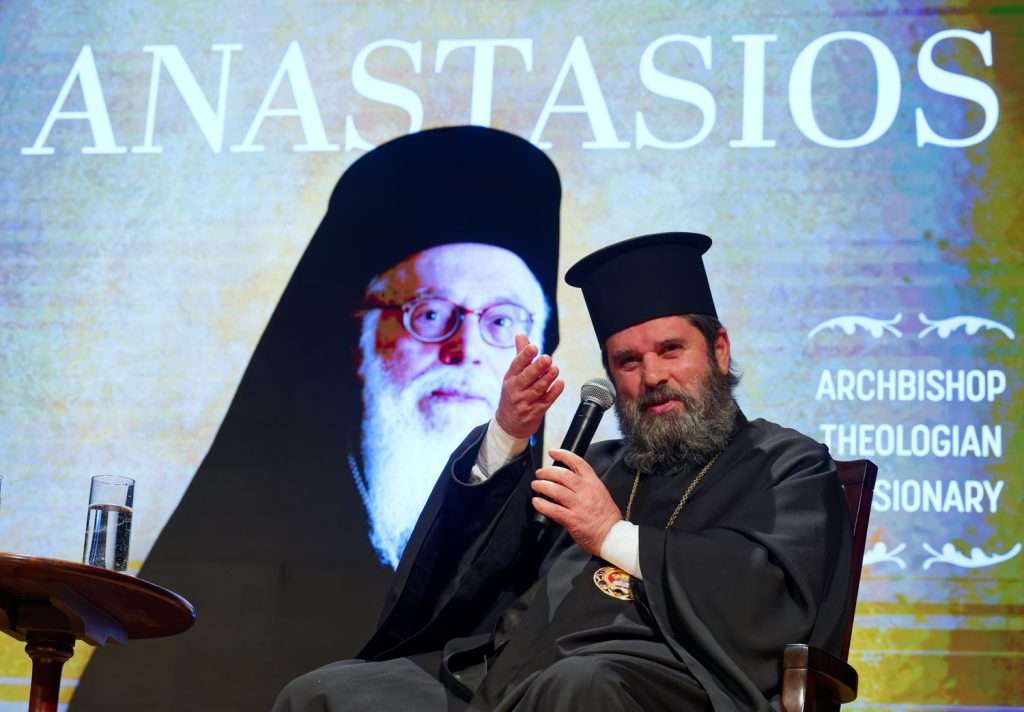
Asked about the path forward for the Orthodox Church worldwide, Archbishop Joani emphasized the theme of authenticity. He urged the church to learn the language of each new generation—not to dilute the Gospel but to communicate it faithfully.
“It’s our duty to know their language in order to transmit what we are really saying,” Archbishop Joani said. “We say things that are very good … but to the young people, we have a responsibility to speak their own language, something that they really understand, something that really they have experienced in their life.”
These words were an apt conclusion to a conference that was, itself, an attempt to translate Archbishop Anastasios’s extraordinary life into words, memories, and reflections we might carry forward into a new generation.
> Read: Our exclusive interview with Archbishop Joani
The post International conference marks one year since Archbishop Anastasios’s repose appeared first on Orthodox Observer.