This post was originally published on this site
Phoenix, Ariz. — At the recent Leadership 100 Annual Conference, amid conversations about the future of preservation and the past we risk forgetting, Cassandra Romas approached His Eminence Archbishop Elpidophoros of America with large envelope. He opened the envelope and, to his astonishment, found himself face to face with a photograph of youthful Archbishop Athenagoras with a full, black beard.
Images of the future Ecumenical Patriarch from his earliest period of service in the United States are exceedingly rare. Rarer still was the setting: the photograph had been taken inside a church—the Annunciation in Endicott, New York—that has long since vanished, now suddenly restored to memory through this single surviving image.
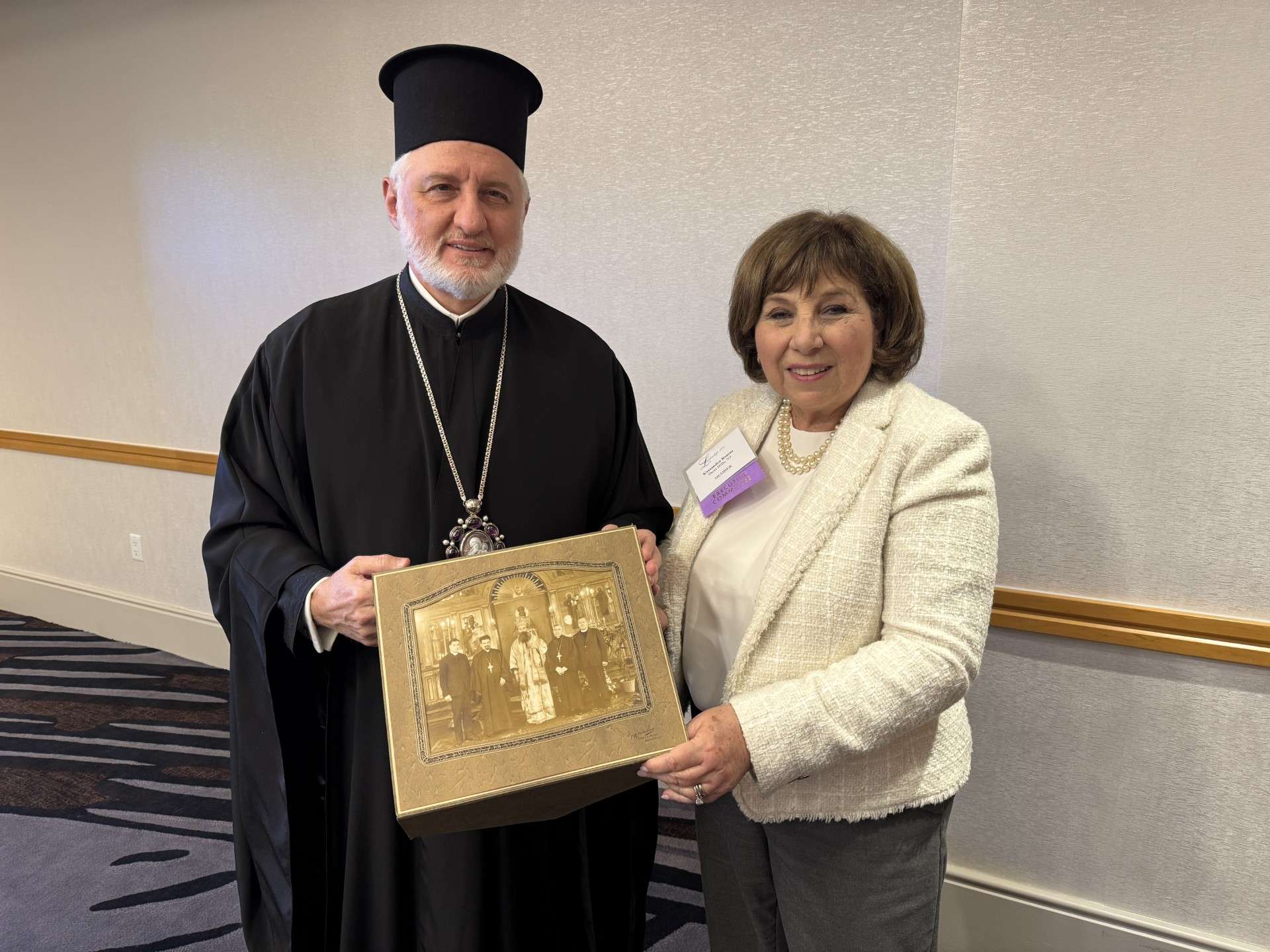
The photograph was from her private collection, long kept in safekeeping and largely unknown outside her family. Within days, the director of the National Archives of the Greek Orthodox Archdiocese of America realized they were holding something extraordinary. He dated the photo to Summer 1931, only months after Athenagoras arrived in the United States following the tumultuous twenties.
For historians, the discovery filled crucial gaps. For the current archbishop—who learned of the donation at the same conference where Romas first shared it—it offered an unexpected connection to the roots of his office and the spiritual lineage that shaped it.
But the photographs were only part of the story. Romas has been involved in ongoing conversations with the National Archives about preserving memory and history, sharing context, family recollections, and fragments of information that had never been formally recorded. Through her knowledge and engagement, historians will recover new details about the long-lost church: its layout, its community life, and its role in shaping the early years of a leader who would later guide a nation of faithful.
“Cassandra didn’t just donate a photo,” said the National Archives Director, Aristomenis Papadimitriou. “She donated memory, insight, and living history. Her discussion with us provided us with knowledge that official records alone could not.”
Collaboration has already begun at the National level to contribute tom interrogate, and broaden the existing historical narrative of Orthodox Christianity in America.
The National Archive sees this moment as a call to action.
Across the country, countless families hold photographs, letters, and artifacts that significantly document the cultural, civic, and spiritual life of the Greek Orthodox Archdiocese of America. Some are tucked away in albums; others sit in boxes in attics or basements. Many owners may not realize the broader significance of what they hold, how vulnerable and rare they are—or how urgently it may be needed to complete the historical record.
That is why this year, the National Archives is launching an ambitious grassroots acquisition campaign, aimed at identifying and preserving materials in private hands before they are lost to time. The campaign will provide guidance, preservation support, and opportunities for donors to contribute to the national story in meaningful ways.“In his immortal funeral oration, recorded by Thucydides, Pericles counseled the Athenians that their community memory is anchored in the minds of humanity, not just on stone engravings. Likewise, for our community history in America, memory does not live only in grand monuments or official documents,” said Papadimitriou. “It lives in the photographs families keep, in the letters they save, in the stories they tell. Cassandra Romas’s gift reminds us that the next major discovery may already exist in someone’s home, waiting to be recognized.”
For Romas, the decision to donate was rooted in a simple belief: that the past belongs to everyone. Meeting the current archbishop and sharing the photographs deepened that conviction, transforming what might have remained a private keepsake into a public legacy.
“I realized these images weren’t just part of my family’s story,” she said. “They were part of a larger story—one that deserved to be preserved and shared.”
Her example now stands as an invitation.
If you have photographs, documents, recordings, or artifacts that may hold historical or cultural value—no matter how modest they seem—the Archive encourages you to come forward. Archivists are ready to help evaluate, preserve, and contextualize materials, ensuring they are cared for and made accessible to future generations.Somewhere, in a drawer or a box or an album, there may be another lost church, another early moment of a public figure, another piece of a community’s memory waiting to be found.
As Cassandra Romas has shown, the act of sharing what we keep can illuminate what we thought was gone—and help a community recover hidden memories and tell lost stories, not just for the sake of telling stories but to enrich and inspire future generations.
The post How one donor’s private photographs are reshaping the historical record appeared first on Orthodox Observer.