This post was originally published on this site
Addressing the Leadership 100 Conference in Phoenix, the Archbishop outlined two transformative goals and spoke forcefully against far-right extremism in Orthodox Christianity
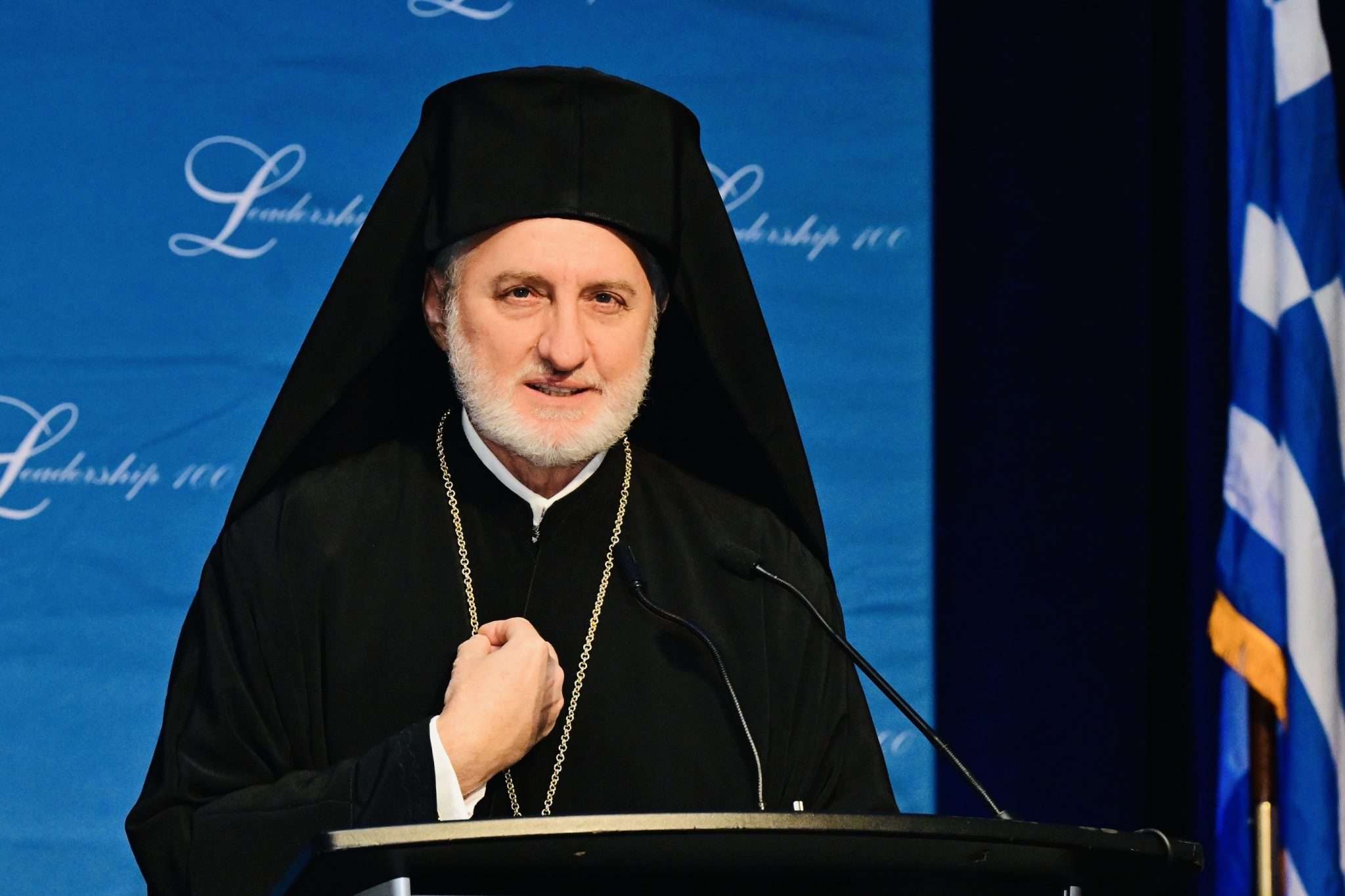
His Eminence Archbishop Elpidophoros of America laid out a sweeping vision for the future of the Greek Orthodox Archdiocese during a wide-ranging question-and-answer session at the 35th Annual Conference of the Archbishop Iakovos Leadership 100 Fund, held in Phoenix, Arizona.
Speaking to an audience of prominent Greek American leaders and philanthropists following his archpastoral address, the Archbishop articulated two major goals that he said would define the next chapter of the Church’s life in America: transforming Hellenic College Holy Cross Greek Orthodox School of Theology in Brookline, Massachusetts, into a full university, and relocating the Archdiocesan Cathedral to St. Bartholomew’s Church on Park Avenue in Manhattan.
‘The First Greek University in the United States’
Asked by Paulette Poulos, Executive Director of Leadership 100, to share his principal visions for the Church, Archbishop Elpidophoros identified the theological school as his foremost priority. He noted that as the institution approaches its 90th anniversary, its endowment remains smaller than the $38 million that Leadership 100 alone has granted it over 42 years.
“This school is the number one priority of our Church,” he declared. “We explored the idea to grow the Hellenic College Holy Cross to a university. Why not?”
To illustrate the point, the Archbishop cited the example of the University of Balamand in Lebanon, founded in 1988 by Patriarch Ignatius IV of Antioch. That institution, he noted, began as a seminary in a monastery in the Koura District of northern Lebanon—not in a wealthy capital, but in a rural area near the Syrian border—and has since grown into a thriving university with some 15,000 students. [In our case] “we have a school for 90 years [located at] the educational Athens of the world, in Boston,” Archbishop Elpidophoros said. “Let’s try to create the first Greek university in the United States,” adding that the project would require careful long-term planning and the full dedication of the community, not just its leadership.
Moving the Cathedral to St. Bartholomew’s: ‘Symbols Matter’
Drawing a direct line from the legacy of Archbishop Iakovos, who walked alongside the Rev. Dr. Martin Luther King Jr. in Selma, Alabama, in 1965 and in doing so placed the Greek Orthodox Church at the center of American public life, Archbishop Elpidophoros argued that the time had come for the next great step.
It was Archbishop Iakovos who took a huge step, His Eminence said. “He took an immigrant church and put it in the center of the American political, economic life. Everybody now knows, after Iakovos, who the Greek Orthodox Archdiocese of America is.”
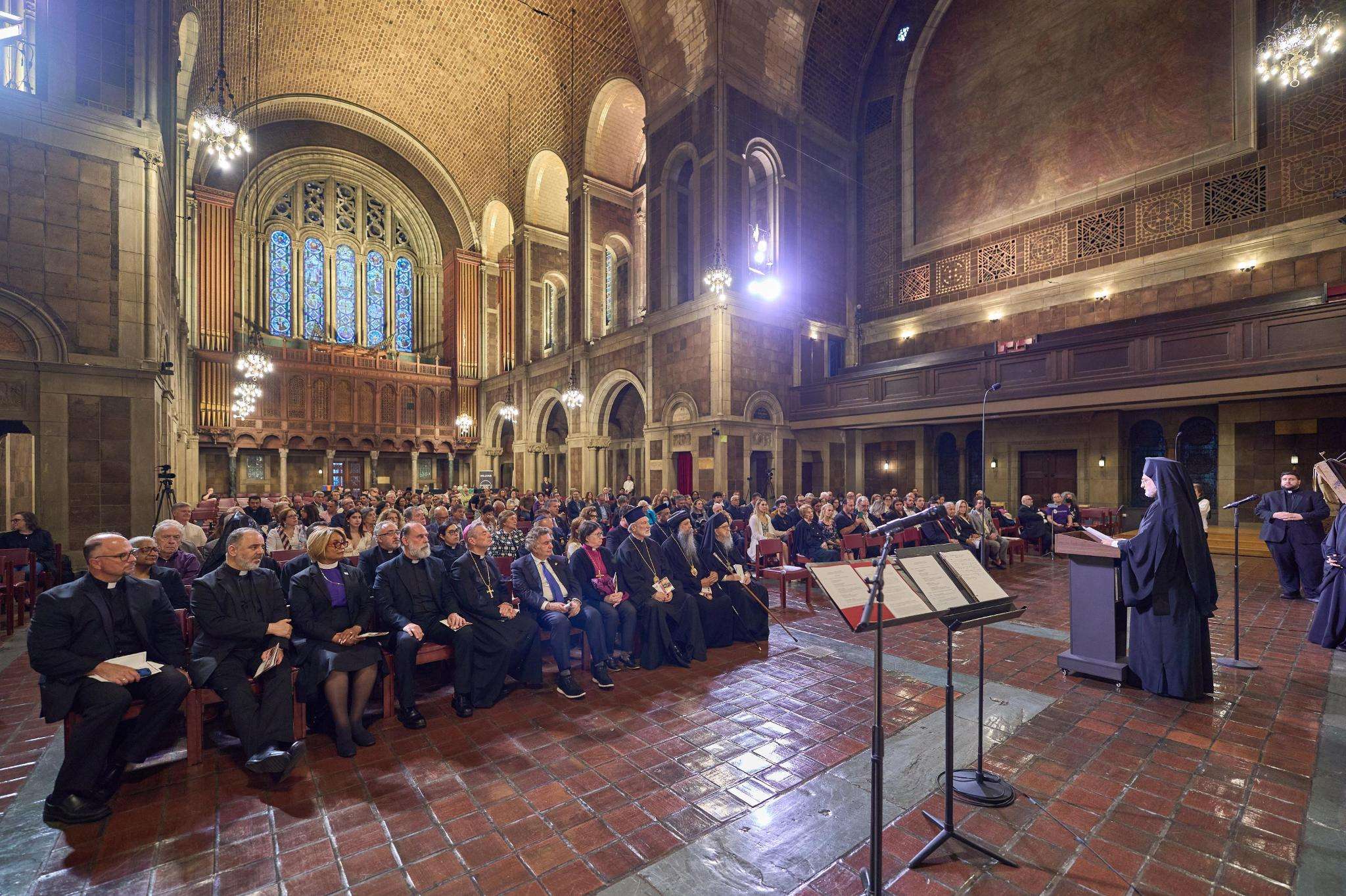
The next step, the Archbishop proposed, is to acquire St. Bartholomew’s Church—the landmark Byzantine-style Episcopal church at 325 Park Avenue between 50th and 51st Streets in Midtown Manhattan—and make it the new cathedral of the Greek Orthodox Archdiocese.
“In Manhattan, there are two monuments that are the monuments of Manhattan,” he said. “One is St. Patrick’s Cathedral. And the other monument in Manhattan is St. Bartholomew’s Church on Park Avenue. I think it’s time for us to move to St. Bartholomew’s.” Archbishop Elpidophoros noted that St. Bartholomew’s, is designated a National Historic Landmark and features richly Byzantine-inspired architecture.
The plan, as outlined by the Archbishop, would consolidate the institutional infrastructure of the Archdiocese. The substantial community house adjacent to St. Bartholomew’s could become the national headquarters of the Church. He proposed that Leadership 100, which currently pays rent for its offices, could relocate there. The National Philoptochos Society could move in as well. The Order of Saint Andrew the Apostle, Archons of the Ecumenical Patriarchate, could also be housed there.
Of the two Archdiocese-owned buildings on East 79th Street, the Archbishop proposed that one could be sold to help finance the acquisition, while the other—the building containing the chapel—could remain as the Archbishop’s residence.
“Symbols matter in this country and in every country,” he told the audience. “This will make our Church one of the mainstream churches in the United States, respected and accepted by everyone.”
Meanwhile, the current Archdiocesan Cathedral of the Holy Trinity on East 74th Street could be repurposed to dramatically expand the Cathedral School, which the Archbishop described as struggling for space. He pointed to a growing demand for church-run parochial schools in Manhattan as a strong reason to give the school room to grow.
The Archbishop’s vision received an immediate and enthusiastic response from the floor. Anita Kartalopoulos, First Vice President of the National Philoptochos Society, rose to remind the audience that Philoptochos had already anticipated such a moment. “In 2012, at the Clergy-Laity Congress, the National Philoptochos made the decision to buy a building in New York City,” she said, recalling that $85,000 was raised in 30 minutes from the floor. “Part of that decision was that if the day comes that the entire Archdiocese is together, Philoptochos would be part of that vision. Philoptochos thinks ahead. We’ll be there with you.”
Archbishop Elpidophoros responded warmly: “I cannot tell you how much I love Philoptochos, and we all love Philoptochos. They are silent, effective, hardworking, and they deliver. They are never in deficit.”
A Growing Church: The Wave of Converts to Orthodoxy
The session opened with a question about the widely noted influx of converts to the Orthodox faith. Archbishop Elpidophoros confirmed that the phenomenon is real, widespread, and shared by all Orthodox jurisdictions in the United States.
He attributed the movement to the deep richness of the Orthodox liturgical tradition. Recalling the historic conversion of the Slavic peoples, the Archbishop noted that it was the experience of attending a liturgy in Hagia Sophia in Constantinople—a service they understood nothing of, because it was in Greek—that led the envoys of King Vladimir to declare, “This is the place where God dwells.”
“Our liturgical tradition is powerful,” the Archbishop said. “People searching for a path to faith are drawn to it. We are the Orthodox Church—the uninterrupted connection to Jesus Christ through the uninterrupted succession from the apostles to today. The Holy Spirit works even when we are indifferent. People have the sense where the Spirit is, where the truth is.”
His Eminence also noted a significant demographic shift. Early in the movement, approximately 45 percent of converts were single men. Now, he said, entire families with children are coming to Orthodoxy, drawn by the desire for a safe haven where their children can be grounded in faith, culture, and healthy community.
The Need for Trained Catechists
The Archbishop stressed that the Church must prepare itself to receive this influx properly. Drawing on discussions held at the Assembly of Canonical Orthodox Bishops of the United States and at the Clergy-Laity Assembly of the Metropolis of San Francisco in February 2025, he outlined two concrete proposals.
First, the Archdiocese needs a unified catechesis—a consistent guidebook for instructing those seeking to join the Orthodox faith. Currently, he said, catechumens receive varying and sometimes contradictory instruction depending on the parish they visit. “We need a consistent and unified guidebook, what we call catechesis,” he said.
Second, the Church needs certified catechists—individuals who have completed coursework through the theological school, received proper accreditation, and are equipped to be the designated teachers of the faith in their parishes. These catechists would bring consistency and quality to the process of receiving converts.
During the discussion, a participant raised concerns about individuals who approach Orthodox Christianity not out of a desire for repentance, healing, and communion, but in search of a place to affirm pre-existing ideological convictions. The question invited reflection on how the Church should respond when faith is treated as a vessel for agendas rather than a path of spiritual transformation.
In his response, Archbishop Elpidophoros spoke with pastoral clarity about the nature and mission of the Church. He emphasized that the Orthodox Church is not a refuge for ideologies, but a spiritual home oriented toward Christ, humility, and the transformation of the human heart.
The Archbishop underscored that the Church must remain a place where the Gospel shapes the believer, not the other way around. When individuals seek the Church merely to feel validated or affirmed in views that stand at odds with the ethos of the Gospel, the Church cannot compromise her identity or calling in order to accommodate them.
A Church in a Season of Growth
Throughout the session, Archbishop Elpidophoros struck a note of determined optimism. He reminded the audience that the major financial challenges of the recent past have been resolved—the Saint Nicholas Greek Orthodox Church and National Shrine is complete, major debts have been paid off, and a $65 million pension plan deficit has been addressed.
“Now is the time to rise and build,” he said, invoking the theme of the upcoming Clergy-Laity Congress in Cleveland, Ohio.
He noted that Hellenic College Holy Cross currently has more than 60 seminarians—candidates for the priesthood—and approximately 200 additional students in the college program, for a total of about 260. While those numbers are consistent with historical enrollment, the growing Church now requires more clergy than ever. New communities are being established, converts need pastoral care, and some parishes now require two or even three priests.
Confronting the Ethical Challenges of Artificial Intelligence
Responding to a question about the implications of artificial intelligence, the Archbishop distinguished AI from all prior technological advances by identifying what he called its fundamental novelty: AI is not merely a tool that assists human decision-making, but a technology designed to make decisions in place of human beings.
“Up to now, technology was like a tool—it had a user, and we were the user,” he said. “AI, for the first time in the history of humanity, is creating a tool that is growing independently, making decisions for us without us.”
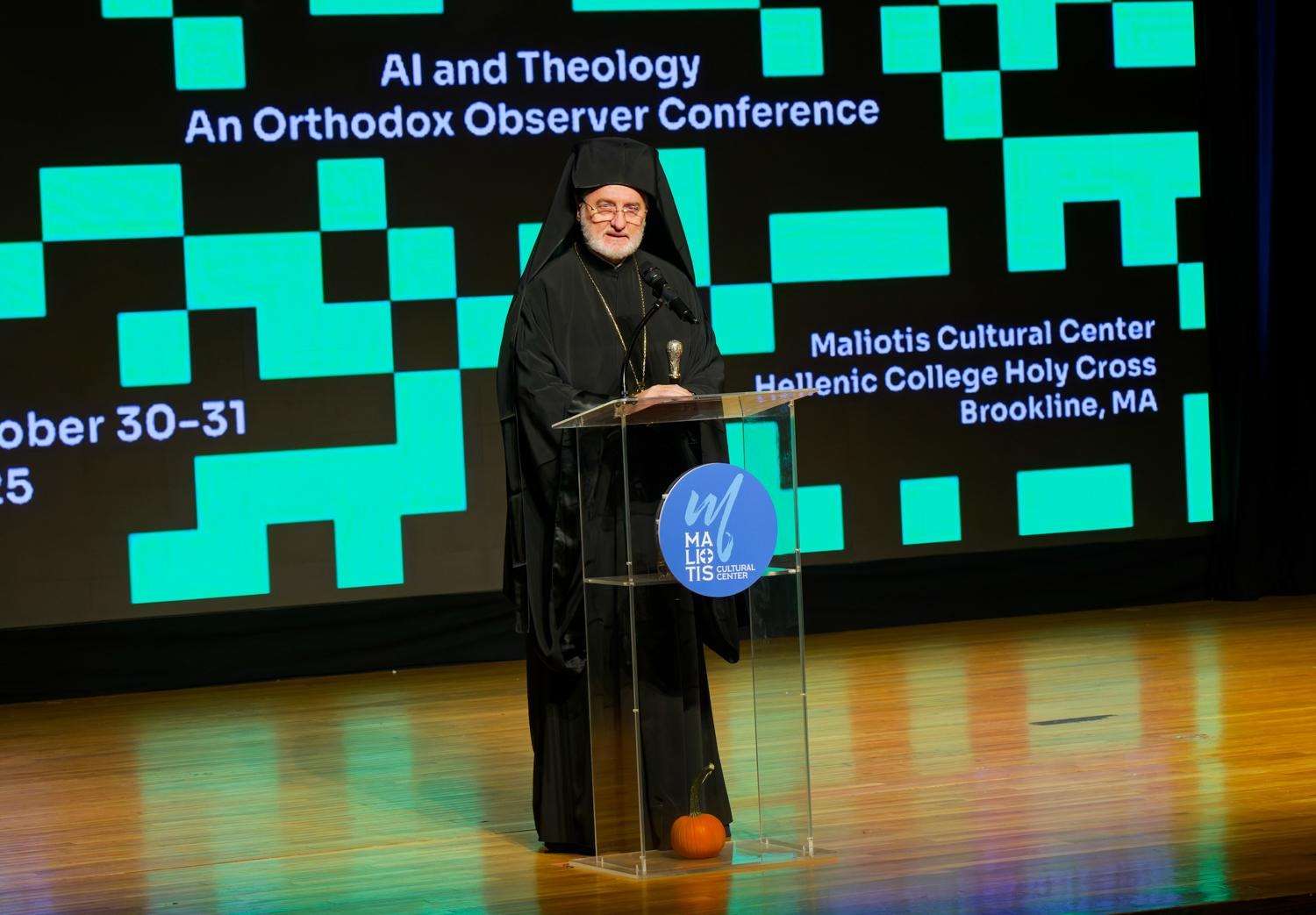
He raised the critical question of who feeds the data into AI systems and how that data might be manipulated, calling this “extremely dangerous.” The Archbishop said it is the responsibility of the Church to help draw the ethical lines around how AI is developed and deployed, in order to protect human dignity and freedom.
Orthodox Unity and the Challenge of the Russian Church
Asked about the complex relationship with the Russian Orthodox Church and its potential to fracture Orthodox unity, Archbishop Elpidophoros acknowledged the seriousness of the concern. “We should worry about that because it threatens the unity of Orthodoxy in this country,” he said.
He noted, however, that the Assembly of Canonical Orthodox Bishops of the United States is working to maintain unity domestically, and expressed hope that a resolution of the war in Ukraine will eventually open a path to reconciliation among the churches. Citing the principle articulated by Patriarch Photios the Great—that ecclesiastical matters tend to follow the course of political events—the Archbishop said that the terms of any peace agreement in Ukraine will likely shape the future of inter-Orthodox relations as well.
The post Archbishop Elpidophoros unveils bold vision: a Greek university and a new cathedral for GOA appeared first on Orthodox Observer.