This post was originally published on this site
“John, it was so good to see you! Thank you for your help!”
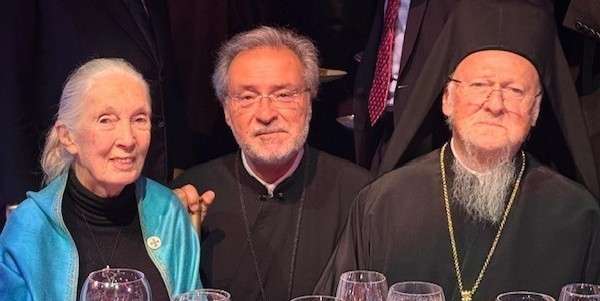
That was the last text I received from Jane Goodall. It arrived the morning after the ceremony at Lincoln Center in New York, where His All-Holiness Ecumenical Patriarch Bartholomew received the Templeton Prize on September 24, 2025. A few days earlier, on the phone, she’d insisted with her characteristic humor that in return for achieving the impossible to attend the event, I owed her ideas about what to say. “Tit for tat!” she laughed. “You have to help me figure out what to say to all those men in black!” That evening, with her white hair characteristically pulled back in a ponytail, wearing her signature scarf and pendant of the African continent, she dressed in black and announced to her audience that she was trying to fit in with the clerical occasion. Just six days later, on Wednesday, October 1, 2025, Jane died peacefully in her sleep in Los Angeles, doing what she did best and loved most—speaking to mesmerized crowds about caring for animals, people, and the planet.
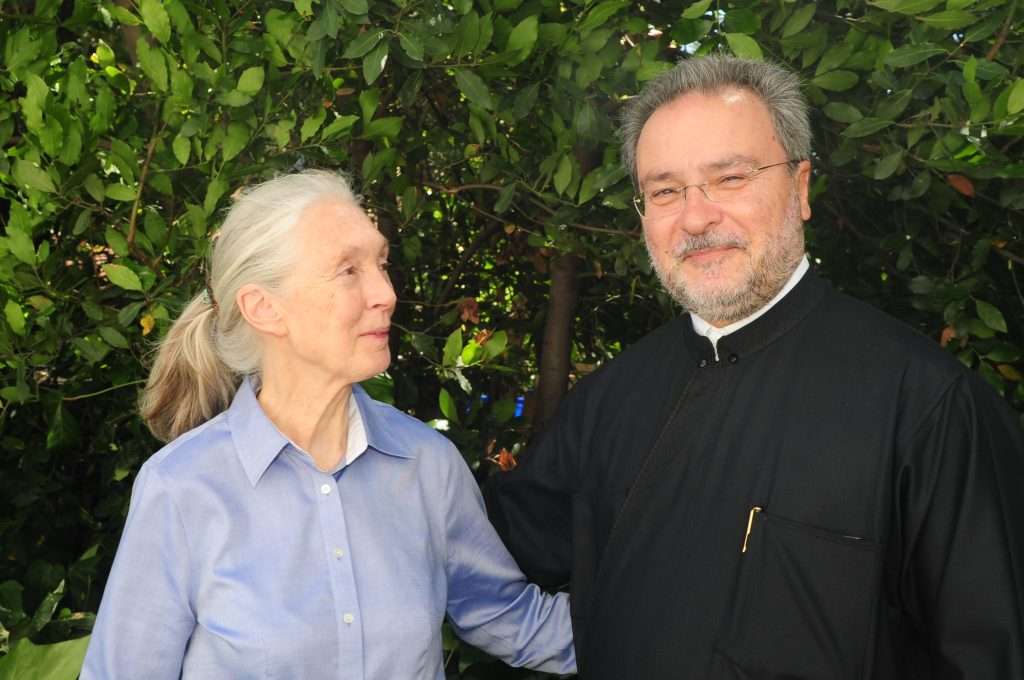
She traveled more than 300 days a year for more than sixty years. I can still hear her chronicling that dizzying calendar. In early June 2025, she wrote: “Am just back from Spain and then Italy for six days, today a lecture in London, and tomorrow Taiwan, followed by Japan. Makes me exhausted even to think about it, but I suppose I shall survive. Sending love, Jane.” And on another occasion: “I don᾽t know how much longer I can maintain this crazy schedule. As long as it’s meant, I suppose!” Yet amid this whirlwind, she would generously carve out time to edit an interview I wanted to publish or help me select one of her books to be translated for a Greek publishing house.
Jane learned in the space of a few years what most of us take an entire lifetime to recognize: the humility to acknowledge that human beings are hardly the pinnacle of creation, endowed with intelligence and entitled to dominion over the earth. How else could someone sitting silently in a rainforest impact the entire planet? How else could someone living with chimpanzees in the wild understand that loving animals is directly associated with loving people? How else could someone isolated from the rest of the world discern the harmony of all living creatures and the unity of all human beings? There’s no doubt in my mind that at this moment, she’s enchanting her Creator with all the intriguing lessons she learned about the interconnectedness of creation.
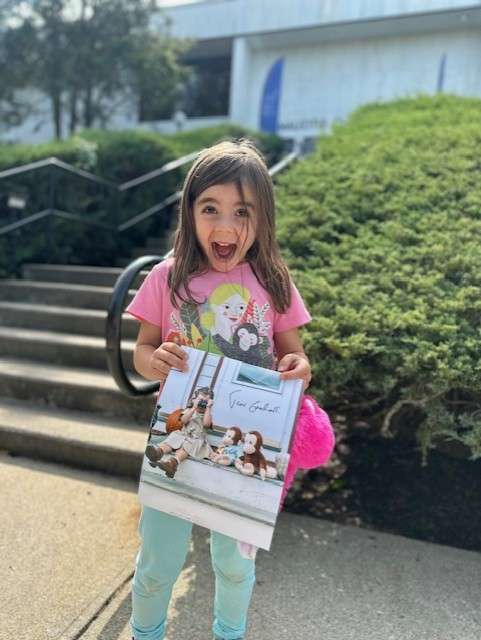
Some people transcend publications and prizes. Their mere presence evokes universal admiration and inspiration. More than anyone I’ve ever met or known, Jane Goodall honored and harmonized her innermost convictions and noblest causes without compromising or betraying either. From her student years to the end of her life, she swam against the tide of institutional science and patriarchal society. She conducted groundbreaking research on chimpanzees in the Gombe rainforest of Tanzania, shattering glass ceilings for women of all generations and vocations across the globe—scientists and activists, journalists and photographers, young girls who dressed up as their icon for Halloween. At the opening event of the then newly established Huffington Ecumenical Institute at Hellenic College Holy Cross, she met one of her young admirers, Sienna, and took the time to tell her that the world is as big as she makes it, that she can make a difference.
Jane’s gentle demeanor and dignified composure eclipsed the muscular exhibitionism and boisterous vulgarity of political authorities and corporate executives. Her mantra was simple: “We cannot get through a single day without having an impact on the world around us. What we do makes a difference.” In that respect, her outspokenness was quite radical, even revolutionary. On September 24, 2025, she addressed two crowded rooms in New York City—the Global Forum at the Plaza Hotel and the Templeton Prize at Lincoln Center—about protecting the world’s children and the planet’s resources. Her message was clear: “The climate crisis is the greatest challenge of our time.” Ironically, just one day earlier, addressing global leaders at the United Nations General Assembly, U.S. President Donald Trump excoriated climate change as “the greatest con job ever perpetrated in the world.”
Born in London on April 3, 1934, Jane became Dame Commander of the British Empire and United Nations Messenger of Peace. Her mother encouraged her to learn about animals and nature from an early age. She loved to read about Tarzan, about whom she frequently quipped that “he fell in love with the wrong Jane!” Her discovery in 1960, at twenty-six, that chimpanzees make and use tools rocked the scientific world and redefined the relationship between humans and animals. She discerned with striking clarity how primates raised their young, established leadership, and related socially. In 1963, her cover story for National Geographic, entitled “My Life Among Wild Chimpanzees,” took the world by surprise as she singlehandedly redefined the biological and behavioral divide between wild animals and human beings, bringing them closer together than scientists ever dreamed or theologians always dreaded.
In 1977, she founded the Jane Goodall Institute, with branches in twenty-six countries, to advance her work around the world for generations to come. In 1991, she founded “Roots & Shoots,” a global program that empowers young people in 140 countries to become encouraged and enlightened conservation leaders aspiring to make the world a better place. Dr. Goodall traveled across the globe, speaking about threats to our natural world—climate change, loss of biodiversity, the ever-growing environmental crisis. But she also spoke about reasons to hope. It’s not too late, she insisted, to reverse the harm we’ve caused. In her books and speeches, she emphasized the interconnectedness of all living things and the collective power of individual action.
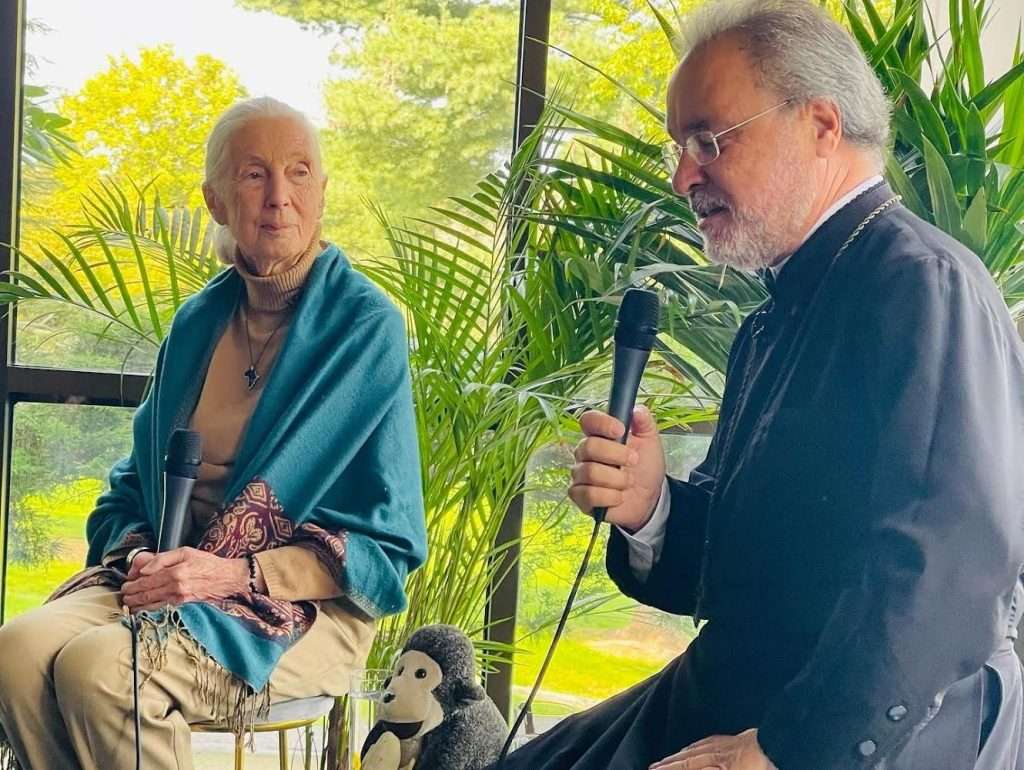
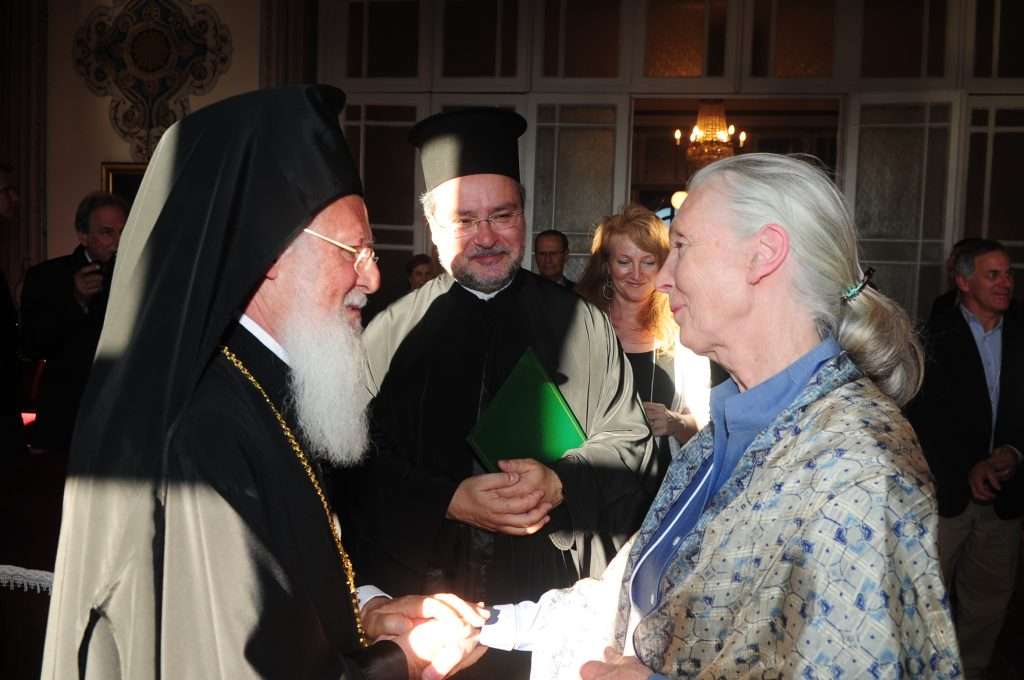
I remember reaching out to her in 2010 to extend an invitation on behalf of Ecumenical Patriarch Bartholomew to attend a major environmental conference. I was informed that her speaking schedule was impossibly committed and her booking fee enormously expensive. Yet in June 2012, Jane arrived as the keynote speaker at the inaugural Halki Summit at the quaint, retro Halki Palace Hotel off the coast of Istanbul, Turkey. She loved walking around the island, appreciating its car-free environment where the only transportation is pedestrian or horse-carriage. She preferred to climb the steep hill to the Theological School of Halki on foot rather than watch the aged horses whipped by their coachmen. The night before her address, Jane asked to see the conference room and podium. When she noticed the plastic water bottles before every participant’s seat, she asked if we could replace them with jars and glasses. We both laughed as the accommodating hotel staff nonchalantly emptied the bottles into glasses—there’s no source of water on the island, and it must be brought from the mainland. At the conference, we caught another glimpse of her charming humor when she remarked that the ecumenical patriarch’s beard reminded her of David Greybeard, the beloved chimpanzee she bonded with in the African jungle.
The world won’t be the same without Jane Goodall. But throughout her life, she made sure the world wouldn’t stay the same but instead become a better place—person by person, day by day. All of us owe so much to Jane’s pioneering vision and enduring legacy—a legacy that changed our perception of animals and humans, bridged differences between cultures and countries, and showed us the path toward a better world. She walked that path with gentle grace and indomitable spirit—right up to her final day.
The post Gentle, yet indomitable: A tribute to Jane Goodall appeared first on Orthodox Observer.